SEO Techniques, Ranking Optimization Tips and Strategies
In today’s digital business environment, companies are faced with a variety of online marketing options. Google SEO and B2B platforms such as Alibaba International Station and Amazon, although both aimed at enhancing a company’s online visibility and sales performance, have significant differences in strategy, objectives, effectiveness, and data analysis. Differences in Targeting Google SEO focuses on improving a company’s ranking in Google search results through website optimization to attract more organic traffic and enhance brand awareness. In contrast, B2B platforms aim to increase product visibility and sales volume on the platform through internal search optimization, promotional tools, and store hosting services. The focus of Google SEO optimization lies in website structure, high-quality content creation, and precise keyword layout to enhance search engine indexing and ranking. B2B platform SEO, on the other hand, emphasizes providing detailed business information, including product details, pricing, purchasing specifications, and transaction terms, while leveraging platform features such as Alibaba’s one-click mass distribution function to attract the attention of buyers. Sustainability of Effects and Return on Investment The results of Google SEO are long-term, requiring continuous website maintenance and content updates from companies. Once the website achieves a higher ranking in search results, it can bring stable traffic and brand exposure to the company. Compared to this, the effectiveness of B2B platforms depends on platform promotion activities and paid services, such as Alibaba’s P4P services, which usually require additional cost investment. Google SEO accumulates the company’s own traffic and customer resources, helping to build a private traffic pool for the company. B2B platforms, however, are more about building traffic and customer relationships within the platform. Depth and Quantifiability of Data Google SEO provides a wealth of data…
In the fiercely competitive world of e-commerce, Search Engine Optimization (SEO) has become a key strategy for increasing website visibility and boosting sales figures. For merchants using the Shopify platform, understanding and implementing effective SEO optimization for Shopify website is crucial. This article will explore how to optimize a Shopify website for SEO and focus on nine key areas of optimization. The essence of SEO is to improve a website’s content and structure to enhance its ranking in search engines, thereby attracting more organic traffic. Shopify, as a feature-rich e-commerce platform, offers many built-in SEO features, such as customizable URLs and automatic site map generation, which greatly facilitate merchants in setting up SEO for their websites. However, despite these basic functionalities, from an SEO expert’s perspective, Shopify’s code architecture is not particularly SEO-friendly in some aspects. Therefore, to achieve SEO optimization for a Shopify website, more detailed attention is required. Keyword Analysis and Selection The first step in SEO is the analysis and selection of keywords. It is recommended to use tools such as Google’s Keyword Planner to identify high-traffic keywords related to your products and integrate them skillfully into product titles, descriptions, and blog content. Landing Page Optimization Landing page optimization is crucial for the SEO of any website, including Shopify website. Based on SEO keywords, select pages with high relevance and ensure that each product page has unique, descriptive content, including keywords. Also, optimize the URL structure to be concise and keyword-rich, which can greatly improve search engine indexing efficiency. Improving Website Compatibility and Security Compatibility means that the website should display consistently across different devices and platforms. At the same time, improve the website’s loading speed and…
In the digital age, having a website that is easily discoverable by both users and search engines is crucial. Search Engine Optimization (SEO) is key to ensuring that your website’s content is properly indexed and ranks well in search results. This article will provide a comprehensive set of SEO strategies to help your website stand out in the competitive online world. Google optimization, as a core part of SEO, is essential for enhancing your website’s performance in search results. Effective Google optimization strategies not only improve visibility but also attract more targeted users. Implementing Google optimization requires a holistic consideration of all aspects of a website, including content quality, technical implementation, and user experience. Successful Google optimization requires ongoing efforts and continuous optimization, as Google’s algorithms are constantly updated, and competitors are also continuously improving their SEO strategies. Therefore, staying abreast of the latest trends in Google optimization and adjusting optimization strategies in a timely manner is crucial for maintaining the competitiveness of your website. Understanding the Working Principle of Search Engines Search engines like Google use automated crawler programs to continuously explore the internet to discover new web pages. Although most websites are automatically indexed after publication, proactive SEO measures can significantly improve your website’s visibility in search results. The core of Google optimization is to understand and adapt to the working principles of Google’s search engine. Google’s crawlers regularly crawl web pages, analyze their content and structure, and then store this information in Google’s index. When users search, Google retrieves the most relevant, highest-quality results from the index based on its complex algorithms. Therefore, an effective Google optimization strategy should focus on improving the crawlability, relevance, and authority…
The Importance of Foreign Trade Website Promotion In the wave of the globalized economy, foreign trade website promotion has become an important way for companies to expand into the international market. Through professional foreign trade website optimization services, companies can build a website that complies with international standards and attracts global customers, thereby enhancing brand influence and market competitiveness. Foreign trade website promotion not only helps enterprises cross geographical boundaries but also, through the power of the internet, spreads the enterprise’s voice to all corners of the world, achieving global brand coverage. Core Value of Foreign Trade Website Services Customized Design: A Window to Display Corporate Image The first step in foreign trade website promotion is customized design. Unlike generic templates, customized design can fully reflect the characteristics and needs of the enterprise, creating a unique website image and serving as a bridge for communication with the international market. This design service ensures that each website is tailored to the uniqueness of the enterprise, allowing it to stand out in fierce market competition. Content Material Guidance: Optimization Strategy in Line with Google Algorithm High-quality content is key to attracting users to a website. Foreign trade website optimization services provide content material guidance to ensure that website content is not only rich and attractive but also complies with Google algorithm rules, improving the website’s ranking in search engines. This guidance helps enterprises create valuable content, attract and retain visitors, and improve visibility in search results through optimization. Keyword Research and Analysis: Covering a Wider Range of Potential Customers Keywords are at the core of SEO optimization. Foreign trade website services provide detailed keyword research and analysis before the website is built,…
The Importance and Strategic Positioning of Foreign Trade SEO Optimization In the wave of digital globalization, for foreign trade enterprises to secure a foothold in the international market, they must make online marketing the core of their business strategy, especially SEO optimization. Foreign trade SEO optimization involves not only customized website optimization for overseas search engines but also enhancing rankings and visibility in search results to attract potential global customers. Such optimization and promotional activities can significantly increase website traffic, raise brand awareness worldwide, and expand a company’s international market share. Definition and Implementation Goals of SEO Optimization SEO, or Search Engine Optimization, is a method of improving a website’s ranking in the natural search results of search engines through well-designed content and structure. Foreign trade SEO optimization and promotion focus on optimization for international search engines such as Google and Bing, aiming to enhance the online visibility and competitiveness of foreign trade enterprises in the global market. Complexity and Challenges of Foreign Trade SEO Optimization and Promotion Compared to domestic SEO, foreign trade SEO optimization and promotion face more complex challenges. These include adapting to differences in search engine algorithms across various countries and regions, overcoming barriers caused by language and cultural differences, and dealing with potentially stronger competitors in the international market. To overcome these challenges, foreign trade enterprises often rely on the professional guidance and support of specialized SEO optimization and promotion service providers. Deepening Strategies for Foreign Trade SEO Optimization and Promotion Effective foreign trade SEO optimization and promotion require the integrated use of a series of strategies and execution steps. These include but are not limited to: Precisely targeting keywords highly relevant to the enterprise’s…
What is Google Merchant Center? Google Merchant Center (GMC) is a free product showcase tool launched by Google, designed to help shoppers discover, explore, and purchase products within Google search results. Merchants upload product information following GMC guidelines to their Merchant Center accounts for editing and management. This allows buyers to conveniently find and purchase items directly from the search results. What are the benefits of Google Merchant Center? Google Merchant Center adds a “free sales channel” for retailers. When a user searches, GMC visually displays products within the search results, which often results in high conversion rates. Compared to SEM and SEO, it does not require managers to have specialized technical skills. The tutorial guides provided by GMC are straightforward, and the only requirement to get started is a Google account for registration. For retailers, it is definitely a sales tool that should not be overlooked. Who is Google Merchant Center suitable for? Google Merchant Center is suitable for retailers or those who operate physical stores. Common website types include platforms like Shopify, which can synchronize applications directly to Merchant Center through the backend. Other systems that require site building will need to find plugins developed by the platform or third-party integration tools to interface with the application. Considerations for using Google Merchant Center: Value-Added Tax (VAT) regulations vary by country and region: Different countries have different VAT rates, and it is necessary to submit products (including VAT-inclusive prices) for different countries. Consistency with website pricing: When adjusting prices, ensure that the prices in GMC are consistent with those on the website. Submitting total prices for minimum quantities: For products purchased in bulk, the total price that must be…
I. The Importance of Website Building for International Trade Enterprises In the digital age, for international trade enterprises to secure a place in the global market, they must focus on online marketing. Promoting the building of international trade websites is the foundation of enterprises’ online marketing efforts. By establishing high-quality international trade websites, enterprises can showcase their products and services to global customers, enhance brand image, accumulate customer resources, and strengthen risk resistance. Professional international trade promotion website building services can also improve the website’s ranking in search engines, attract more high-quality traffic, and increase the website’s conversion rate. II. Choosing the Right International Trade Enterprise Website Building Platform Selecting the appropriate platform for building international trade enterprise websites is crucial for businesses. An excellent platform for promoting international trade website building should have the following characteristics: User-friendliness: International trade websites target global users, hence the platform must offer a superior user experience, facilitating easy navigation and usage for customers. Scalability: As businesses grow, the needs for building international trade websites also evolve. Therefore, the platform must be highly scalable to meet the expanding demands of enterprises. Customizability: Each enterprise has unique requirements for building international trade websites, so the platform should provide ample customization options to meet these individual needs. Reputation and Reliability: Opting for a platform with a strong reputation and high reliability ensures website security and stability, as well as better technical support and services. III. Key Points in International Trade Website Design The design of international trade websites should consider the following points:Compliance with International Standards: Targeting a global audience, the design style of international trade websites must adhere to international standards, avoiding overly localized elements….
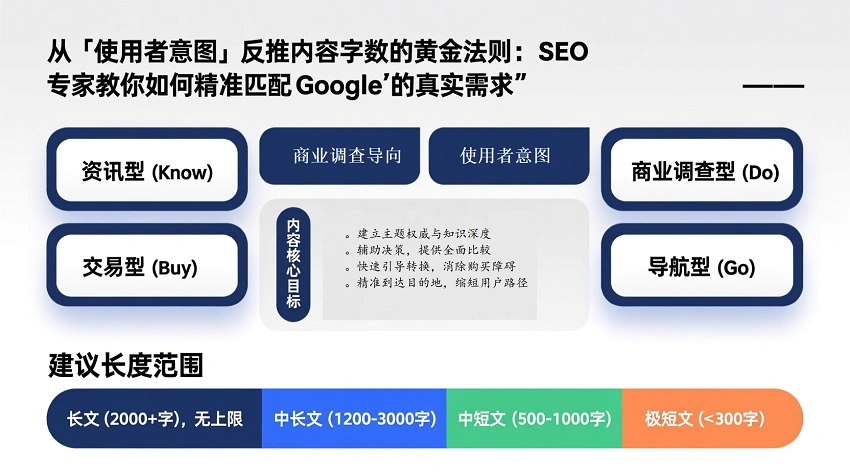
Say Goodbye to Word Count Anxiety, Embrace the New Era of E-E-A-T Logic After confirming that “word count is not a decisive factor for ranking,” the core challenge all content creators must face is: How do we define the boundaries of “high-quality content”? Seasoned SEO experts know that Google doesn’t care about word count; it cares about content utility. A 500-word article that perfectly answers a user’s complex question is far more valuable than a 5,000-word piece of general talk. This “Golden Rule” will take you deep into understanding: the ideal length of content is determined by analyzing user intent and building Topical Authority. We will use the E-E-A-T (Experience, Expertise, Authoritativeness, Trustworthiness) framework to precisely match Google’s real needs. Part 1: Professional Insights: Intent, Depth, and Topical Authority User Intent is the primary indicator used by Google’s algorithms (like RankBrain, BERT, and MUM) to judge content relevance. Your article length must serve this intent, otherwise, it leads to Content Dilution. Intent Type Content Core Goal Professional Insights: SEO Impact Informational (Know) Establish E-E-A-T image and comprehensively cover the topic. Through Topic Clusters strategy, build Topical Authority to establish the website as an authority in that field. Transactional (Buy) Maximize…
Key Insight: Choosing the wrong technology stack is the biggest hidden cost for independent sites. Data shows that 47% of cross-border sellers are forced to rebuild their websites within 2 years due to technical limitations, with average losses reaching 3 times the initial investment. The right technical roadmap can improve SEO effectiveness by 40% and conversion rates by 30%. Last week, another client approached us. His Shopify store hit a bottleneck after monthly sales exceeded $500,000: website loading speed was over 5 seconds, URL structure couldn’t be optimized, and weak blog functionality hampered content marketing effectiveness. Most painfully, 5 years of customer data and SEO equity were almost impossible to migrate. "If I had spent more time choosing the right technical path initially, I wouldn’t be so passive now." His sentiment echoes that of countless sellers. As a consultant with 18 years of experience in cross-border digital marketing, I have witnessed too many cases where poor technology selection led to heavy costs. This article will deeply analyze the pros and cons of Shopify, WordPress, and custom solutions, helping you avoid the trap of technical debt and choose the technical path most suitable for your business development. Panoramic View: Three Main Technical Paths for Cross-border Independent Sites Before diving into comparisons, we need to understand the fundamental differences between the three main technical paths. This is not just a tool choice, but a reflection of the business model. SaaS Hosted Type: "Turnkey Solution" in E-commerce Representative Platforms: Shopify, Shoplazza, Shopline, etc. Core Characteristics: Use platform services like renting, without worrying about server maintenance and technical details. Shopify, as the industry leader, provides a complete e-commerce solution, encompassing everything from payments and…
Key Insight: By 2025, cross-border e-commerce will enter an era of dual-track operation with "Marketplace + Independent Site". Data shows that the average profit margin for pure marketplace sellers has dropped from 25% in 2019 to 12% in 2024, while sellers who successfully operate independent sites maintain margins of 18-35%. This is not a simple either/or choice, but a strategic complement. Recently, I’ve received many inquiries from sellers: "Amazon’s advertising costs have increased again, ACoS is already over 40%, should I continue spending?" "My Shopee store was suddenly suspended, what should I do with the piled-up inventory?" These anxieties reflect a harsh reality: the marketplace (red dividend period) is fading, and business models solely reliant on marketplaces face significant challenges. As a consultant with 18 years of experience in cross-border digital marketing, I must be honest with you: an independent site is not a cure-all, but it is indeed a necessary path for brand globalization. This article will use detailed analysis from dimensions like traffic control, data assets, and cost structure to help you objectively assess whether you should open the second growth curve for your cross-border e-commerce business. Why is Everyone Talking About ‘Independent Sites’ Now? According to the latest data from Marketplace Pulse, in 2024, the average customer acquisition cost for sellers on Amazon US increased by 67% compared to 2021, while the average selling price decreased by 15%. This scissor effect of "rising costs, falling prices" is squeezing sellers’ profit margins. Three Signals of the Fading Marketplace红利 (Hónglì – Dividend) Exponential Increase in Customer Acquisition Cost: The average Amazon CPC cost was $0.8 in 2020 and has risen to $1.5 by 2024. In some popular categories like…
Featured Articles