SEO Techniques, Ranking Optimization Tips and Strategies
In the complex world of search engine optimization (SEO), minor mistakes can severely impact your website’s standing in Google search results. These errors may stem from technical issues or improper page optimization. To give your website a boost and secure a favorable position in search results, here are some key SEO issues and their solutions. Avoiding Duplicate Content to Optimize SEO Duplicate content is a widespread issue in SEO, referring to the presence of pages with identical or highly similar content on a website. This can confuse search engines about which page contains original content, affecting the website’s indexing and page ranking. To address this issue, you can take the following measures: Inject unique content into duplicate pagesUse the rel=”canonical” tag to specify the page that search engines should prioritizeImplement a 301 redirect to point duplicate content to the primary page Optimizing Meta Tags is Crucia Title tags and meta descriptions are extremely important for SEO; they are part of the HTML code and provide additional information about your website to users and search engines. Poorly optimized meta tags can miss opportunities to enhance website performance and affect Google’s or potential users’ understanding of your pages. Common issues include missing tags, tags that are too long or too short, and duplicate tags. From the outset, ensure that meta tags: Include target keywordsAre unique to the corresponding pageSummarize the content users can expect to find on the pageAre closely related to the intent behind the target keywords Image Optimization is Indispensable Optimizing images on your website not only helps in ranking in Google Image Search but also improves website accessibility and user experience. Conversely, poor image optimization can harm user experience,…
In this comprehensive article, we delve into the local SEO ranking factors in Singapore, offering businesses a detailed set of guidelines and recommendations. From basic Google My Business optimization to advanced keyword research strategies, we cover all key points to help businesses achieve better rankings in search engine results in the Singapore region. In Singapore, as digital marketing continues to evolve, local SEO (Search Engine Optimization) has become a crucial strategy for businesses to enhance their online visibility and attract potential customers. As a professional SEO company, we are dedicated to helping businesses achieve better rankings in search engine results in the Singapore region. We provide sincere answers to “local SEO ranking factors,” offering users detailed guidance and suggestions. What is Local SEO? Local SEO is the art of optimizing your online presence to attract local customers who are looking for products or services in their vicinity. Its primary goal is to help local customers find brick-and-mortar businesses or services near them, such as restaurants, retail stores, or service providers. Local SEO strategies involve optimizing location-based keywords, managing online reviews and ratings, and ensuring consistent business information on directories and platforms. Why is Local SEO so Important for Businesses in Singapore? In Singapore, consumers increasingly rely on the internet to find products and services. According to statistics, most consumers conduct online research before making a purchase decision. Therefore, local SEO is of great significance to businesses. It helps businesses connect with their local target audience, increasing foot traffic to physical stores and website traffic for online businesses, ultimately leading to more potential customers and conversions. Additionally, local SEO builds brand awareness within communities, enhances customer acquisition, improves brand visibility, and…
In the digital age, websites have become a crucial platform for businesses to showcase their brands and products. With the increasing congestion of cyberspace, standing out in search engines has become a critical issue. This is where website and SEO services come into play. This article delves into the costs, definitions, impact on websites, and ways to evaluate the effectiveness of SEO efforts, helping you to fully understand this key digital marketing strategy. What are Website and SEO Services? Website and SEO services are comprehensive services that optimize website content and structure to improve rankings on search engine result pages (SERPs). This includes not only traditional search engine optimization techniques but also aspects of website design and user experience optimization. The goal of website and SEO services is to create a website that is both user-friendly and search engine-friendly, thereby attracting valuable traffic, enhancing brand visibility, and ultimately increasing sales and conversion rates. The Impact of Website and SEO Services on Your Website Increased Visibility: Professional website and SEO services can help your website achieve higher rankings in search results, increasing exposure to potential customers. Traffic Growth: High rankings mean more users will visit your website, significantly increasing website traffic. Website and SEO services can help you attract a larger target audience. Enhanced Brand Recognition: Ongoing efforts in website and SEO services can improve brand awareness and recognition in your target market. Improved Conversion Rates: An optimized website offers a better user experience, leading to higher user engagement and conversion rates. Reduced Advertising Costs: Compared to pay-per-click (PPC) advertising, website and SEO services are a more sustainable and cost-effective way to generate traffic. The Cost of Website and SEO Services…
SEO writing, also known as search engine optimization writing, is a specialized form of writing designed to enhance a website’s ranking on search engines. By making it easier for search engines to recognize and prioritize the site, organic traffic to the web page increases. The primary objective of SEO writing is to blend user search patterns and keywords with a well-structured layout of relevant terms, ensuring the content is valuable to readers and search engine friendly, thereby attracting more visitors. SEO Writing vs. Content Writing: What’s the Difference? While SEO writing and content writing are closely related, they have distinct goals and approaches. Here are some key differences between them: Feature SEO Writing Content Writing Goals To improve the website’s ranking in search engines and attract more visitors. To create engaging, valuable, and comprehensive content that captures and retains readers’ interest. Focus On the strategic use of keywords, meta tags, internal and external linking, and other technical aspects. On storytelling, language style, emotional expression, and reader experience. Keyword Usage Requires the strategic placement of keywords in titles, body text, meta tags, and other areas. Keywords are used, but the emphasis is on the content’s natural flow and readability. Structure and Formatting Typically adheres to specific formats, such as title tags, lists, subheadings, etc., to enhance search engine readability. The format may be more flexible, with a greater focus on creativity and diversity. Audience and Search Engines Must satisfy both search engine algorithms and reader needs. Primarily focuses on reader requirements and interests. Optimization Level Involves more frequent keyword research and optimization. Emphasizes the originality and uniqueness of the content. Link Strategy Uses internal and external links strategically to boost the…
In today’s rapidly evolving business landscape, digital marketing services for small business have become not just an option, but a necessity for survival and growth. Small businesses across various industries are increasingly recognizing that effective digital marketing services can level the playing field, allowing them to compete with larger corporations while maintaining their unique market position. What is Digital Marketing Services? Digital marketing services for small business encompass a wide range of online marketing strategies and tools designed to help businesses establish their presence, attract customers, and grow their revenue in the digital space. These services have become particularly crucial as consumer behavior continues to shift towards online channels, making it essential for small businesses to adapt and evolve. The Importance of Digital Marketing Services for Small Businesses The significance of digital marketing services for small business cannot be overstated. In an era where consumers primarily search for products and services online, having a strong digital presence is crucial for: Increasing visibility and brand awareness Reaching targeted audiences effectively Creating cost-effective marketing campaigns Measuring and analyzing marketing efforts Competing with larger businesses Building lasting customer relationships Core Elements of Digital Marketing Services Search Engine Optimization (SEO) SEO remains one of the most crucial digital marketing services for small business success. It involves optimizing your online presence to rank higher in search engine results, making your business more visible to potential customers. Keyword Research Effective keyword research helps identify terms and phrases that potential customers use when searching for products or services. This foundation of SEO strategy enables small businesses to create content that matches user intent and drives organic traffic. Mobile Optimization With the majority of searches now performed on…
In the context of global climate change and sustainable development, renewable energy has become a top priority in national energy strategies worldwide. As the world’s largest manufacturer and exporter of renewable energy equipment, China plays a crucial role in this field. However, Chinese companies still face challenges such as insufficient brand awareness and limited market channels in the international market. Search Engine Optimization (SEO), as a powerful digital marketing tool, is becoming a key force in driving the export of Chinese renewable energy equipment. This article will delve into how SEO can help Chinese renewable energy equipment companies go global and enhance their competitiveness in the global market. Renewable Energy Equipment Market Analysis In recent years, renewable energy equipment such as solar panels and wind turbines have made significant technological progress, with increasing efficiency and decreasing costs. According to data from the International Renewable Energy Agency (IRENA), global renewable energy capacity additions reached a record high of 260 gigawatts in 2020, with solar and wind energy dominating. China, as a major manufacturer and exporter, holds a significant position in the global market. In 2020, China’s photovoltaic module exports reached 78.8 gigawatts, accounting for 67% of the global market share, while wind power equipment exports also maintained strong growth. However, as global market competition intensifies, Chinese companies need to more actively explore international markets and enhance their brand influence. This is where SEO plays a crucial role. SEO and Global Market Access SEO can help Chinese renewable energy equipment manufacturers establish brand awareness globally and increase their visibility in search engine results. Through carefully designed SEO strategies, companies can: Improve website rankings in international search engines, increasing exposure to target customer…
In today’s globalized economic environment, the machinery equipment export industry faces unprecedented opportunities and challenges. With the rapid development of internet technology and the increasing digitalization of global trade, Search Engine Optimization (SEO) has become a crucial strategic tool for enhancing online visibility and expanding international market share. This article will delve into how SEO can help machinery equipment export companies improve their global competitiveness and how to effectively implement SEO strategies to achieve long-term sustainable growth. Current State of the Machinery Equipment Export Industry Industrial machinery, construction equipment, and agricultural machinery constitute the main categories of machinery equipment exports. These products are in widespread demand globally, especially in emerging market countries where demand for various types of machinery equipment shows a steady growth trend as their industrialization and urbanization processes accelerate. However, machinery equipment export companies also face numerous challenges, such as intense international competition, trade barriers, exchange rate fluctuations, and differences in technical standards. Against this backdrop, how to stand out in the global market has become an urgent issue for machinery equipment export companies. Traditional marketing methods can no longer meet the needs of current global buyers, who increasingly rely on the internet to search for suppliers, compare products, and make purchasing decisions. Therefore, improving a company’s visibility in search engine results has become crucial. The Importance of SEO SEO is a technique that optimizes website content and structure to improve a site’s ranking in search engine organic search results. For machinery equipment export companies, implementing effective SEO strategies can bring multiple benefits: Increase brand awareness: By ranking high in relevant search term results, companies can increase their brand exposure. Attract targeted traffic: SEO can help companies…
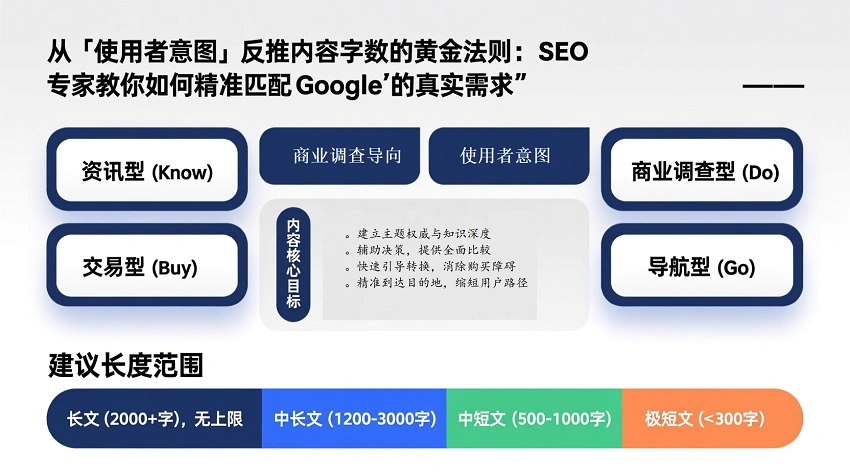
Say Goodbye to Word Count Anxiety, Embrace the New Era of E-E-A-T Logic After confirming that “word count is not a decisive factor for ranking,” the core challenge all content creators must face is: How do we define the boundaries of “high-quality content”? Seasoned SEO experts know that Google doesn’t care about word count; it cares about content utility. A 500-word article that perfectly answers a user’s complex question is far more valuable than a 5,000-word piece of general talk. This “Golden Rule” will take you deep into understanding: the ideal length of content is determined by analyzing user intent and building Topical Authority. We will use the E-E-A-T (Experience, Expertise, Authoritativeness, Trustworthiness) framework to precisely match Google’s real needs. Part 1: Professional Insights: Intent, Depth, and Topical Authority User Intent is the primary indicator used by Google’s algorithms (like RankBrain, BERT, and MUM) to judge content relevance. Your article length must serve this intent, otherwise, it leads to Content Dilution. Intent Type Content Core Goal Professional Insights: SEO Impact Informational (Know) Establish E-E-A-T image and comprehensively cover the topic. Through Topic Clusters strategy, build Topical Authority to establish the website as an authority in that field. Transactional (Buy) Maximize…
Key Insight: Choosing the wrong technology stack is the biggest hidden cost for independent sites. Data shows that 47% of cross-border sellers are forced to rebuild their websites within 2 years due to technical limitations, with average losses reaching 3 times the initial investment. The right technical roadmap can improve SEO effectiveness by 40% and conversion rates by 30%. Last week, another client approached us. His Shopify store hit a bottleneck after monthly sales exceeded $500,000: website loading speed was over 5 seconds, URL structure couldn’t be optimized, and weak blog functionality hampered content marketing effectiveness. Most painfully, 5 years of customer data and SEO equity were almost impossible to migrate. "If I had spent more time choosing the right technical path initially, I wouldn’t be so passive now." His sentiment echoes that of countless sellers. As a consultant with 18 years of experience in cross-border digital marketing, I have witnessed too many cases where poor technology selection led to heavy costs. This article will deeply analyze the pros and cons of Shopify, WordPress, and custom solutions, helping you avoid the trap of technical debt and choose the technical path most suitable for your business development. Panoramic View: Three Main Technical Paths for Cross-border Independent Sites Before diving into comparisons, we need to understand the fundamental differences between the three main technical paths. This is not just a tool choice, but a reflection of the business model. SaaS Hosted Type: "Turnkey Solution" in E-commerce Representative Platforms: Shopify, Shoplazza, Shopline, etc. Core Characteristics: Use platform services like renting, without worrying about server maintenance and technical details. Shopify, as the industry leader, provides a complete e-commerce solution, encompassing everything from payments and…
Key Insight: By 2025, cross-border e-commerce will enter an era of dual-track operation with "Marketplace + Independent Site". Data shows that the average profit margin for pure marketplace sellers has dropped from 25% in 2019 to 12% in 2024, while sellers who successfully operate independent sites maintain margins of 18-35%. This is not a simple either/or choice, but a strategic complement. Recently, I’ve received many inquiries from sellers: "Amazon’s advertising costs have increased again, ACoS is already over 40%, should I continue spending?" "My Shopee store was suddenly suspended, what should I do with the piled-up inventory?" These anxieties reflect a harsh reality: the marketplace (red dividend period) is fading, and business models solely reliant on marketplaces face significant challenges. As a consultant with 18 years of experience in cross-border digital marketing, I must be honest with you: an independent site is not a cure-all, but it is indeed a necessary path for brand globalization. This article will use detailed analysis from dimensions like traffic control, data assets, and cost structure to help you objectively assess whether you should open the second growth curve for your cross-border e-commerce business. Why is Everyone Talking About ‘Independent Sites’ Now? According to the latest data from Marketplace Pulse, in 2024, the average customer acquisition cost for sellers on Amazon US increased by 67% compared to 2021, while the average selling price decreased by 15%. This scissor effect of "rising costs, falling prices" is squeezing sellers’ profit margins. Three Signals of the Fading Marketplace红利 (Hónglì – Dividend) Exponential Increase in Customer Acquisition Cost: The average Amazon CPC cost was $0.8 in 2020 and has risen to $1.5 by 2024. In some popular categories like…
Featured Articles