SEO Techniques, Ranking Optimization Tips and Strategies
The Importance of Foreign Trade Website Building In the context of economic globalization, building a foreign trade website has become an important tool for enterprises to expand into international markets. A professional foreign trade website can not only enhance the brand image of an enterprise but also strengthen its risk resistance, accumulate valuable customer resources, and improve the quality of traffic. Foreign trade website building allows enterprise information to transcend geographical limitations, enabling 24/7 global exposure, which is a crucial step in the enterprise’s internationalization strategy. What Are the Advantages of Foreign Trade Website Building SEO? Enhancing the Brand Image: Through independent domains and personalized page designs, foreign trade website building showcases the professionalism and strength of an enterprise, increasing customer trust. An independent website can more flexibly display the corporate culture, product advantages, and successful cases, building a unique brand story. Increasing Risk Resistance: In a changing market environment, foreign trade website building reduces the enterprise’s reliance on a single platform, avoiding risks arising from changes in platform policies or operational issues. Enterprises can independently control marketing strategies and respond quickly to market changes. Accumulating Customer Resources: Foreign trade website building enables enterprises to accumulate customer information through various online forms, subscription functions, and social media interactions, establishing their own customer databases. This data is crucial for analyzing customer needs, optimizing product strategies, and achieving precise marketing. High-Quality Traffic: Compared to platform websites, the traffic on a foreign trade website is more precise, as visitors actively search for and enter the website, indicating a higher interest and demand for the enterprise’s products or services. The Difference Between Foreign Trade Website Building and Platform Sites Independence and Autonomy: Foreign trade…
In the digital age, website data has become a key basis for corporate decision-making, playing a crucial role in analyzing user behavior, optimizing marketing strategies, and enhancing business performance. Google Analytics Services is a powerful data analysis tool that helps businesses gain a deep understanding of the behavior of website visitors, providing strong support for business decisions. Google Analytics Main Features Traffic Source Analysis: Google Analytics can display the sources of website traffic, including search engines, social media, email marketing, etc. This helps businesses understand which channels bring the most visitors to the website, thereby optimizing marketing strategies. User Behavior Analysis: By tracking user behavior on the website, Google Analytics can reveal users’ interests, preferences, and habits. This helps businesses understand the real needs of users, providing strong support for product design, c]ontent creation, and user experience optimization. Conversion Rate Tracking: Google Analytics can track the website’s conversion rate, including form submissions, purchasing behavior, downloads, etc. This helps businesses understand which pages or features are most attractive to users for conversion, thereby optimizing website layout and feature design. Real-Time Reporting: Google Analytics offers real-time reporting capabilities, allowing businesses to stay informed about the latest website dynamics. This helps businesses respond quickly to market changes and adjust strategies. Custom Reports: Users can create custom reports according to their needs to gain a deeper understanding of website data. This helps businesses to mine data value from multiple perspectives and provide more basis for decision-making. How to Use Google Analytics Create a Google Account: First, you need to have a Google account to use Google Analytics services. Add a Website: In the Google Analytics backend, you need to add your website and set…
In todays age both businesses and individuals are increasingly turning to search engine optimization (SEO) to establish an online presence. Google SEO plays a role by focusing on improving a websites visibility and ranking on Googles search engine results pages (SERPs). This article aims to provide insights, into Google SEO differentiate between SEO and SEM and highlight the advantages of working with an SEO agency. Understanding Google SEO: Google SEO involves optimizing a website to enhance its visibility and ranking on Googles SERPs. Unlike SEM, which relies on paid advertisements for website traffic SEO focuses on boosting rankings through site improvements. Differentiating Between SEO and SEM: Although people often use the terms interchangeably SEO and SEM are marketing strategies. SEM utilizes paid ads to secure placement on SERPs while SEO focuses on improving rankings. While SEM offers visibility, with investment requirements SEO is a long term approach that generates sustainable traffic growth and increased online presence. What does optimizing SEO involve? SEO optimization encompasses enhancing aspects of a website both, on page and off page to boost its visibility and authority on search engines ultimately resulting in improved rankings on SERPs. On page optimization focuses on refining content quality, site structure and metadata while off page optimization involves acquiring backlinks to strengthen credibility and popularity. What is included in SEO practices? SEO practices encompass a range of strategies and techniques that include; 1. Conducting keyword research to identify search terms used by your target audience. 2. Implementing on page optimizations to make websites more search engine friendly. 3. Building links to obtain high quality backlinks. 4. Addressing technical SEO aspects like site speed, mobile responsiveness and sitemaps. 5. Incorporating SEO…
In the digital age, a company’s visibility and success are inextricably linked to its online presence. At the core of this online image lies the concept of “website SEO optimization.” SEO, or Search Engine Optimization, is the process of improving your website’s ranking in search engine results, thereby driving organic traffic, enhancing brand awareness, and ultimately promoting conversions. YouFind is a leading digital marketing firm based in Hong Kong, specializing in crafting tailored SEO strategies to help businesses thrive in a competitive digital landscape. Website SEO optimization is a complex and multifaceted process that requires an in-depth understanding of search engine algorithms, user behavior, and best practices in digital marketing. It involves a combination of technical expertise, creative content creation, and strategic planning to ensure that your website not only ranks high in search results but also attracts and converts visitors into customers. YouFind’s seasoned team of SEO professionals has a proven track record of delivering measurable results for clients across various industries, from small local businesses to large multinational corporations. The Importance of Website SEO Optimization: The first step in understanding the value of SEO is recognizing its impact on business growth. In today’s digital environment, most consumers use search engines like Google to find products, services, and information. If your website does not appear on the first page of search results, you are missing out on a significant number of potential customers. Website SEO optimization ensures that your website remains visible to your target audience when they are actively searching for the content you provide. However, the benefits of website SEO optimization extend beyond just increasing visibility. A well-optimized website also sends signals to search engines that your…
In today’s highly competitive digital marketing landscape, SEO content optimization services have become crucial for businesses to improve their website rankings and attract organic traffic. By implementing effective content optimization strategies, businesses can enhance their online presence, reach their target audiences, and ultimately drive business growth. This article will delve into several key strategies focused on content optimization, helping businesses unleash the potential of their website content. Keyword Research: Laying the Foundation for Content Optimization Keyword research is the foundation of SEO content optimization. By identifying the keywords users employ when searching for specific products, services, or information, businesses can optimize their content to better match those search queries. This involves determining target keywords, which are the most relevant and highly searched keywords related to a business’s offerings. In addition to target keywords, it’s important to find less competitive long-tail keywords. Long-tail keywords typically consist of three or more words and are more specific and targeted. While these keywords may have lower search volumes, they often attract more precise traffic that is more likely to convert into customers or leads. High-Quality Content Creation: Providing Value and Engagement Once target keywords have been identified, the next step is to create high-quality content around those keywords. Content should be original, avoiding duplication or plagiarism from other sources. Search engines value unique, informative content, so ensuring originality is crucial. Moreover, content should be value-driven. It should solve users’ problems, meet their needs, or answer their questions. By creating helpful, interesting, and engaging content, businesses can build trust and authority, attracting and retaining their target audiences. Title and Meta Description Optimization: Attracting User Clicks Titles and meta descriptions are the face of your content…
In the realm of digital marketing, ecommerce website SEO and Google international promotion are two core strategies that are crucial for any business aspiring to expand its operations in the global market. These two strategies not only enhance brand visibility globally but also enable precise market targeting, thereby significantly increasing conversion rates and return on investment (ROI). The following is a detailed analysis of these two strategies and their complementary nature in practical application. 1. Ecommerce Website SEO: The Foundation for Global Visibility Search engine optimization (SEO) for an ecommerce website is the key to ensuring your business can be discovered by potential customers worldwide. A successful SEO strategy is not just about keyword stuffing but focuses on creating a comprehensive website that aligns with search engine algorithms and optimizes user experience. a. Technical Optimization The technical infrastructure for SEO must be solid. This includes fast website loading speed, mobile optimization, secure protocols (such as HTTPS), and a clear website architecture. These factors are critical indicators that search engines use to evaluate website quality, directly impacting its rankings. b. Content Optimization Content is essential for attracting and retaining user interest. High-quality content not only needs to include keywords that your target market searches for but should also provide genuine value, such as industry insights, detailed product information, and solutions. Furthermore, optimizing content for multiple languages is an indispensable aspect, ensuring that potential customers from different regions can access your brand in their preferred language. c. Authority Building Building website authority by acquiring high-quality backlinks. Links are a signal in SEO, indicating that other websites find your content valuable. High-quality links not only improve a website’s SEO performance but also generate…
In today’s globalized business environment, having an excellent ecommerce website is crucial for businesses to expand into international markets. A professional and practical ecommerce website can not only effectively showcase the company’s image but also enhance the interactive experience with global customers. So, what are the core elements that need to be considered when building an outstanding ecommerce website? Let’s analyze them one by one. Summary of 15 Crucial E-commerce Elements Element No. Element Name (English) Element Name (Chinese) Key Description/Purpose Key Practical Advice/Tools Mentioned 1 Responsive Website Design 响应式网站设计 Ensures optimal browsing experience across all devices and screen sizes. Choose responsive theme with simple design and reasonable layout. 2 Focus on Content Quality 注重内容质量 Attracts and retains visitors by clearly conveying value, features, and advantages. Original, readable, culturally aligned content; extensive use of multimedia. 3 SEO Optimization Strategy SEO优化策略 Achieves good search engine rankings for discoverability. Keyword research, natural integration (title, URL, body), H1/H2 tags, internal/external links. 4 Accelerate Website Performance 加速网站性能 Ensures smooth user experience and fast loading speeds. Image/code optimization, CDN for global access, mobile adaptation. 5 Website Security and Credibility 网站安全与可信度 Protects user data and maintains stable website operation. Prompt SSL certificate installation, firewalls, security measures. 6 Leverage Social Marketing Power 发挥社交营销力量 Promotes brand exposure and influence globally. Social media management tools (Hootsuite, Buffer) for platforms like Facebook, Twitter, LinkedIn. 7 Data Analysis and Decision Support 数据分析与决策支持 Drives optimization decisions through real-time monitoring. Google Analytics for traffic/behavior; Ahrefs, Semrush for keyword research. 8 Careful Planning of Website Navigation 精心规划网站导航 Retains visitors by enabling quick content discovery. Plan hierarchical structure, internal linking logic, use breadcrumb navigation. 9 Focus on…
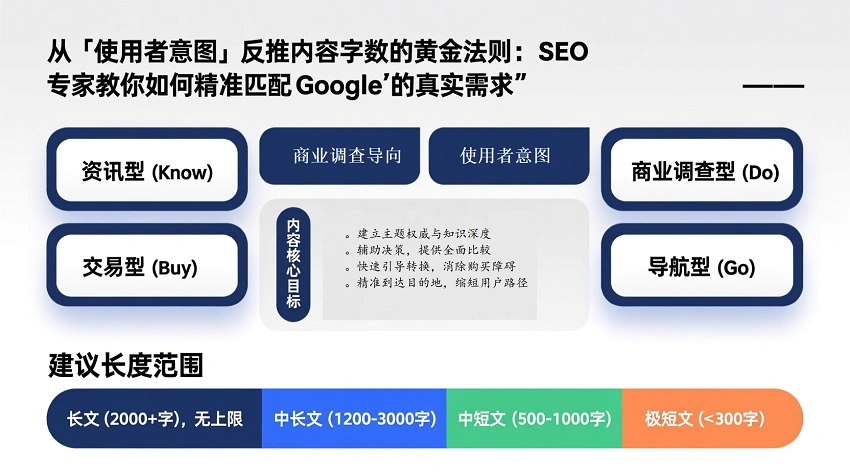
Say Goodbye to Word Count Anxiety, Embrace the New Era of E-E-A-T Logic After confirming that “word count is not a decisive factor for ranking,” the core challenge all content creators must face is: How do we define the boundaries of “high-quality content”? Seasoned SEO experts know that Google doesn’t care about word count; it cares about content utility. A 500-word article that perfectly answers a user’s complex question is far more valuable than a 5,000-word piece of general talk. This “Golden Rule” will take you deep into understanding: the ideal length of content is determined by analyzing user intent and building Topical Authority. We will use the E-E-A-T (Experience, Expertise, Authoritativeness, Trustworthiness) framework to precisely match Google’s real needs. Part 1: Professional Insights: Intent, Depth, and Topical Authority User Intent is the primary indicator used by Google’s algorithms (like RankBrain, BERT, and MUM) to judge content relevance. Your article length must serve this intent, otherwise, it leads to Content Dilution. Intent Type Content Core Goal Professional Insights: SEO Impact Informational (Know) Establish E-E-A-T image and comprehensively cover the topic. Through Topic Clusters strategy, build Topical Authority to establish the website as an authority in that field. Transactional (Buy) Maximize…
Key Insight: Choosing the wrong technology stack is the biggest hidden cost for independent sites. Data shows that 47% of cross-border sellers are forced to rebuild their websites within 2 years due to technical limitations, with average losses reaching 3 times the initial investment. The right technical roadmap can improve SEO effectiveness by 40% and conversion rates by 30%. Last week, another client approached us. His Shopify store hit a bottleneck after monthly sales exceeded $500,000: website loading speed was over 5 seconds, URL structure couldn’t be optimized, and weak blog functionality hampered content marketing effectiveness. Most painfully, 5 years of customer data and SEO equity were almost impossible to migrate. "If I had spent more time choosing the right technical path initially, I wouldn’t be so passive now." His sentiment echoes that of countless sellers. As a consultant with 18 years of experience in cross-border digital marketing, I have witnessed too many cases where poor technology selection led to heavy costs. This article will deeply analyze the pros and cons of Shopify, WordPress, and custom solutions, helping you avoid the trap of technical debt and choose the technical path most suitable for your business development. Panoramic View: Three Main Technical Paths for Cross-border Independent Sites Before diving into comparisons, we need to understand the fundamental differences between the three main technical paths. This is not just a tool choice, but a reflection of the business model. SaaS Hosted Type: "Turnkey Solution" in E-commerce Representative Platforms: Shopify, Shoplazza, Shopline, etc. Core Characteristics: Use platform services like renting, without worrying about server maintenance and technical details. Shopify, as the industry leader, provides a complete e-commerce solution, encompassing everything from payments and…
Key Insight: By 2025, cross-border e-commerce will enter an era of dual-track operation with "Marketplace + Independent Site". Data shows that the average profit margin for pure marketplace sellers has dropped from 25% in 2019 to 12% in 2024, while sellers who successfully operate independent sites maintain margins of 18-35%. This is not a simple either/or choice, but a strategic complement. Recently, I’ve received many inquiries from sellers: "Amazon’s advertising costs have increased again, ACoS is already over 40%, should I continue spending?" "My Shopee store was suddenly suspended, what should I do with the piled-up inventory?" These anxieties reflect a harsh reality: the marketplace (red dividend period) is fading, and business models solely reliant on marketplaces face significant challenges. As a consultant with 18 years of experience in cross-border digital marketing, I must be honest with you: an independent site is not a cure-all, but it is indeed a necessary path for brand globalization. This article will use detailed analysis from dimensions like traffic control, data assets, and cost structure to help you objectively assess whether you should open the second growth curve for your cross-border e-commerce business. Why is Everyone Talking About ‘Independent Sites’ Now? According to the latest data from Marketplace Pulse, in 2024, the average customer acquisition cost for sellers on Amazon US increased by 67% compared to 2021, while the average selling price decreased by 15%. This scissor effect of "rising costs, falling prices" is squeezing sellers’ profit margins. Three Signals of the Fading Marketplace红利 (Hónglì – Dividend) Exponential Increase in Customer Acquisition Cost: The average Amazon CPC cost was $0.8 in 2020 and has risen to $1.5 by 2024. In some popular categories like…
Featured Articles