SEO Techniques, Ranking Optimization Tips and Strategies
Practical Tools and Advanced Technologies Google has been continuously striving to improve search relevance and user experience. In recent years, they have introduced a series of new features and tools, such as AMP, Google Retail, and Google Jobs, to assist SEO professionals in better optimizing various types of content and services for overseas SEO success. Cultural and Language Adaptation When conducting overseas SEO, cultural differences and language adaptation must be considered. Content not only needs to be original and high-quality but also tailored to the target market’s cultural norms and linguistic styles. For instance, for the Spanish-speaking market, using authentic Spanish expressions and incorporating popular local expressions and cultural elements can significantly enhance user engagement and satisfaction. Multi-language SEO Strategies This includes using hreflang tags to ensure search engines display the correct webpage version suited to the user’s language and region. Culturally Adapted Content Adjust content to align with different countries’ cultural expectations, such as modifying visual elements and holiday promotional campaigns. User Experience Optimization Optimizing user experience is key to boosting overseas SEO effectiveness. Websites must be easy to navigate, with fast page load times, while providing a top-notch experience across both mobile devices and desktops. Responsive Design Ensure the website delivers a great browsing experience on all devices. Interaction Element Optimization Improve forms, buttons, and other interactive elements to ensure they are user-friendly and understandable across different cultural backgrounds. Monitoring and Analysis After implementing SEO strategies, continuous monitoring and analysis of their effectiveness are indispensable. This includes tracking key performance indicators like click-through rates, conversion rates, and user retention rates. Utilizing Analytics Tools Such as Google Analytics, to track user behavior and website performance. SEO Performance Reports Generate…
For companies engaged in foreign trade, it is extremely important to have a high-conversion, high-quality foreign trade website and use foreign trade SEO promotion to continuously bring target traffic and orders to the website. So how do we systematically carry out foreign trade SEO promotion work? This article will answer that for you one by one. I. Correctly Understand Foreign Trade SEO Promotion Foreign trade SEO promotion, as a way of website promotion, is only half-understood by many people. Therefore, we must first look at foreign trade SEO promotion correctly: Foreign trade SEO promotion is divided into two ways: white hat and black hat. White hat SEO follows search engine rules, aiming to optimize website quality and improve user experience; while black hat SEO adopts cheating methods, although effective for a time, it will eventually be discovered and punished. We recommend adopting the white hat SEO method. Foreign trade SEO promotion is not set in stone, it needs to keep up with the times. No SEO method is an eternal truth, we must abandon dogmatism, maintain an open mind, and constantly explore and adjust according to the actual situation. The purpose of foreign trade SEO promotion is to improve website quality and meet user needs, not solely to improve rankings and traffic. We should focus our optimization work around the user experience. Foreign trade SEO promotion requires input of human resources and material resources. To do it well, we cannot be afraid of trouble and money, such as hiring professionals to assist in completing some technical work. Be wary of various SEO hypes and rumors, and maintain a rational and sober understanding. Foreign trade SEO promotion will not end here,…
In the current tide of globalization, foreign trade website promotion has become an important means for Chinese enterprises to explore international markets and achieve transformation and upgrading. Effective foreign trade website promotion strategies require the integration of various online and offline marketing methods to form a synergy and achieve twice the result with half the effort. Therefore, foreign trade practitioners must attach great importance to foreign trade website promotion and continuously innovate and optimize their promotion plans to win more overseas orders. Comprehensive Foreign Trade Website Promotion Strategies Multi-platform Integrated Promotion In today’s internet era, third-party platforms are an important battlefield for foreign trade website promotion. Foreign trade enterprises need to integrate the traffic and buyer resources from multiple online and offline platforms to form a three-dimensional synergy for foreign trade website promotion. Leveraging B2B Platforms For the foreign trade industry, well-known B2B platforms such as Alibaba International Station, China Manufacturers, and Global Sources are indispensable important grounds for foreign trade website promotion. These platforms gather buyer resources and massive industry traffic from around the world, creating convenient conditions for foreign trade enterprises to connect with product sales and brand promotion. The biggest advantage of using B2B platforms for foreign trade website promotion is the ability to directly reach existing buyer groups and achieve efficient product display. At the same time, the platforms have huge traffic, which is conducive to rapid product exposure and acquisition of inquiry leads. However, it also requires facing fierce competition from peers, paying high service fees, and continuous investment to maintain product visibility. B2C Cross-border E-commerce Platforms In recent years, large cross-border e-commerce platforms such as Amazon, AliExpress, Wish, and DHgate have also become an…
Blogs serve as platforms for information dissemination and as channels for driving website traffic and exposure. Their layout design is crucial for attracting readers, enhancing user experience, and optimizing search engine rankings. In this regard, sidebars and footers become key elements for SEO optimization. This article will explain in detail why optimizing the sidebar and footer layouts of a blog is essential and provide some recommendations. Improving User Experience 1.1 Convenient Navigation Blog sidebars can serve as excellent navigational aids for users. By placing a table of contents, popular posts, related tags, etc., in the sidebar, readers can more quickly find content they are interested in, improving the overall user experience. 1.2 Increasing Interactive Elements Adding interactive elements such as social media links and recent comments to the sidebar and footer can foster reader engagement with the blog, increasing user stickiness. Such a design not only facilitates reader participation but also creates a stronger sense of community for the blog. A Tool for SEO Optimization 2.1 Keyword Layout Strategically placing keywords in the sidebar and footer can help improve a website’s search engine ranking. Ensuring the natural integration of keywords not only enhances the relevance of the content but also strengthens search engines’ recognition of the blog. 2.2 Internal Linking By including links to related articles, tags, etc., in the footer, not only can user dwell time be extended, but search engines are also provided with more information, increasing the website’s exposure opportunities in search results. Establishing a Professional Blog Image 3.1 Copyright Notice and Privacy Policy Adding a copyright notice and privacy policy to the footer helps establish a professional image for the blog. This not only demonstrates accountability…
In the wave of digitalization, the competition in the global market is becoming increasingly fierce. How can companies stand out on the international stage through foreign trade promotion strategies has become a crucial issue. Foreign trade promotion, as an important means for companies to expand into overseas markets, its effectiveness is directly related to the company’s global competitiveness. Definition and Importance of Foreign Trade Promotion Foreign trade promotion refers to the process by which companies use a series of market strategies to promote their products or services to the international market, with the aim of establishing brand awareness, attracting potential customers, and increasing sales performance. Against the backdrop of globalization, the importance of foreign trade promotion is self-evident, as it helps companies to cross borders and maximize their business value. Successful Foreign Trade Promotion Strategies When implementing foreign trade promotion, companies need to adopt a diversified strategy to adapt to the needs of different markets. The following are some proven effective methods of foreign trade promotion: Participating in International Trade Shows: Trade shows are an important platform for companies to display their products and technologies and communicate directly with potential customers. By participating in international trade shows, companies can effectively carry out foreign trade promotion. Utilizing B2B Platforms: B2B platforms provide companies with a broad window for display, allowing them to reach potential buyers worldwide, thus effectively promoting foreign trade. Search Engine Optimization (SEO): Optimizing website content and structure to improve search engine rankings is a key strategy to enhance the effectiveness of foreign trade promotion. Social Media Marketing: Social media platforms provide companies with the opportunity to interact with target customers, helping to increase brand awareness and customer loyalty….
With globalization, many websites have started to launch multilingual versions to better serve users in different countries. To make these multilingual websites more effective in search engine results pages in different regions, using hreflang tags becomes very important. So what are the benefits of setting up hreflang tags, and what impact would there be if hreflang tags are not set up? How should hreflang tags be configured under different circumstances? Let’s continue reading with these questions in mind. What are the benefits of websites setting up hreflang tags? ● Improves SEO issues with multilingual websites, allowing search engines to more accurately understand the language versions of a website, which helps improve rankings for multilingual websites. ● Improves user experience issues by allowing search engines to provide users with versions more suitable to their language preferences. ● Avoids duplicate content issues. By clearly defining the relationships between language and regional versions using hreflang tags, search engine penalization due to duplicate content can be avoided. What are the disadvantages if a website does not set up hreflang tags? ● If a website does not set up hreflang tags, it would have the following disadvantages: ● Risks search engines identifying duplicate content or mirrored pages. ● Inability to properly understand the website’s language structure. ● Degraded user experience. Let’s first take a look at Google’s official recommendation for multilingual websites as shown below: It is recommended from both an SEO and user perspective to use region-specific URLs in the format example.com/de/. Why choose this format? Firstly, it reduces SEO optimization complexity across sites. Secondly, customers only need to maintain one domain name, greatly reducing human resource needs. Reminder: Do not use IP analysis…
Basics of Canonical Tags The canonical tag in HTML is likely familiar to many. We can use this HTML tag to tell search engines that the canonical or “main” URL for a page is a certain one, avoiding issues with duplicate content. To implement properly, simply add the following code in the section of the web page: The href attribute points to the location of the primary version of the page. Benefits of Using Canonical Tags: 1.Concentrates authority, avoids diluting trafficFor example, merging parameters from multiple product pages into one primary product page, or redirecting www and non-www versions to the same domain. This combines authority and prevents fragmenting traffic. The same concept applies to short links redirecting to main URLs. 2.Unifies mobile and desktopSometimes mobile sites have lower authority than desktop. Canonical tags can consolidate both versions onto one authoritative page. 3.Improves search engine assessment accuracyInforming engines of the canonical URL aims to help them better judge the primary location of main site content, aiding SEO rankings. Though simple, proper implementation provides significant SEO assistance! Canonical Concepts in CSS While there are no canonical tags in CSS, optimization at various levels can still enhance SEO through CSS code: Rational content styling: Use proper heading tags for content sections instead of DIVs/SPANs uniformly. Apply semantic class/ID names. Helps search engines correctly understand and label key data. Mobile optimization: Catering the experience across devices, providing a seamless user flow improves engagement. Mixing long and short sentences also boosts appeal and readability. Media queries enable responsive designs. Controlling horizontal scrolls and sizing for screens are also key. Performance and standards compliance: Minifying CSS/JS, deferred non-critical resource loading improves speed. Caching also accelerates….
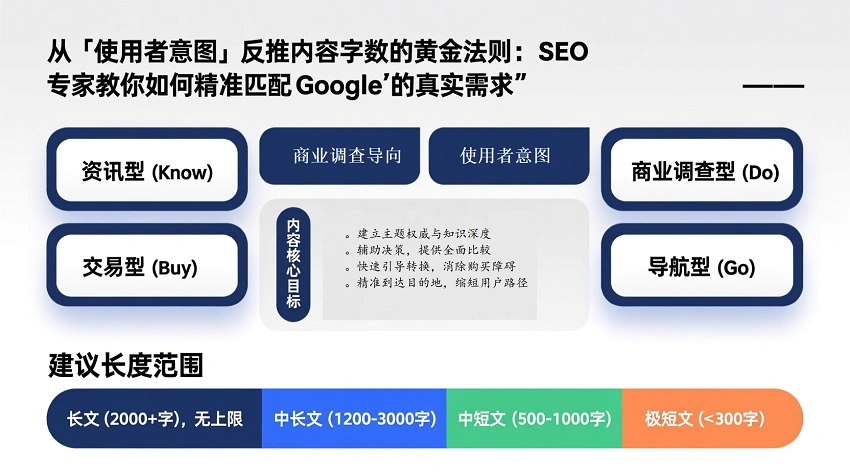
Say Goodbye to Word Count Anxiety, Embrace the New Era of E-E-A-T Logic After confirming that “word count is not a decisive factor for ranking,” the core challenge all content creators must face is: How do we define the boundaries of “high-quality content”? Seasoned SEO experts know that Google doesn’t care about word count; it cares about content utility. A 500-word article that perfectly answers a user’s complex question is far more valuable than a 5,000-word piece of general talk. This “Golden Rule” will take you deep into understanding: the ideal length of content is determined by analyzing user intent and building Topical Authority. We will use the E-E-A-T (Experience, Expertise, Authoritativeness, Trustworthiness) framework to precisely match Google’s real needs. Part 1: Professional Insights: Intent, Depth, and Topical Authority User Intent is the primary indicator used by Google’s algorithms (like RankBrain, BERT, and MUM) to judge content relevance. Your article length must serve this intent, otherwise, it leads to Content Dilution. Intent Type Content Core Goal Professional Insights: SEO Impact Informational (Know) Establish E-E-A-T image and comprehensively cover the topic. Through Topic Clusters strategy, build Topical Authority to establish the website as an authority in that field. Transactional (Buy) Maximize…
Key Insight: Choosing the wrong technology stack is the biggest hidden cost for independent sites. Data shows that 47% of cross-border sellers are forced to rebuild their websites within 2 years due to technical limitations, with average losses reaching 3 times the initial investment. The right technical roadmap can improve SEO effectiveness by 40% and conversion rates by 30%. Last week, another client approached us. His Shopify store hit a bottleneck after monthly sales exceeded $500,000: website loading speed was over 5 seconds, URL structure couldn’t be optimized, and weak blog functionality hampered content marketing effectiveness. Most painfully, 5 years of customer data and SEO equity were almost impossible to migrate. "If I had spent more time choosing the right technical path initially, I wouldn’t be so passive now." His sentiment echoes that of countless sellers. As a consultant with 18 years of experience in cross-border digital marketing, I have witnessed too many cases where poor technology selection led to heavy costs. This article will deeply analyze the pros and cons of Shopify, WordPress, and custom solutions, helping you avoid the trap of technical debt and choose the technical path most suitable for your business development. Panoramic View: Three Main Technical Paths for Cross-border Independent Sites Before diving into comparisons, we need to understand the fundamental differences between the three main technical paths. This is not just a tool choice, but a reflection of the business model. SaaS Hosted Type: "Turnkey Solution" in E-commerce Representative Platforms: Shopify, Shoplazza, Shopline, etc. Core Characteristics: Use platform services like renting, without worrying about server maintenance and technical details. Shopify, as the industry leader, provides a complete e-commerce solution, encompassing everything from payments and…
Key Insight: By 2025, cross-border e-commerce will enter an era of dual-track operation with "Marketplace + Independent Site". Data shows that the average profit margin for pure marketplace sellers has dropped from 25% in 2019 to 12% in 2024, while sellers who successfully operate independent sites maintain margins of 18-35%. This is not a simple either/or choice, but a strategic complement. Recently, I’ve received many inquiries from sellers: "Amazon’s advertising costs have increased again, ACoS is already over 40%, should I continue spending?" "My Shopee store was suddenly suspended, what should I do with the piled-up inventory?" These anxieties reflect a harsh reality: the marketplace (red dividend period) is fading, and business models solely reliant on marketplaces face significant challenges. As a consultant with 18 years of experience in cross-border digital marketing, I must be honest with you: an independent site is not a cure-all, but it is indeed a necessary path for brand globalization. This article will use detailed analysis from dimensions like traffic control, data assets, and cost structure to help you objectively assess whether you should open the second growth curve for your cross-border e-commerce business. Why is Everyone Talking About ‘Independent Sites’ Now? According to the latest data from Marketplace Pulse, in 2024, the average customer acquisition cost for sellers on Amazon US increased by 67% compared to 2021, while the average selling price decreased by 15%. This scissor effect of "rising costs, falling prices" is squeezing sellers’ profit margins. Three Signals of the Fading Marketplace红利 (Hónglì – Dividend) Exponential Increase in Customer Acquisition Cost: The average Amazon CPC cost was $0.8 in 2020 and has risen to $1.5 by 2024. In some popular categories like…
Featured Articles