
The Golden Rule for Inferring Content Length from “User Intent”: SEO Experts Teach You How to Precisely Match Google’s Real Needs
The Golden Rule for Inferring Content Length from “User Intent”: SEO Experts Teach You How to Precisely Match Google’s Real Needs
04 Dec 2025
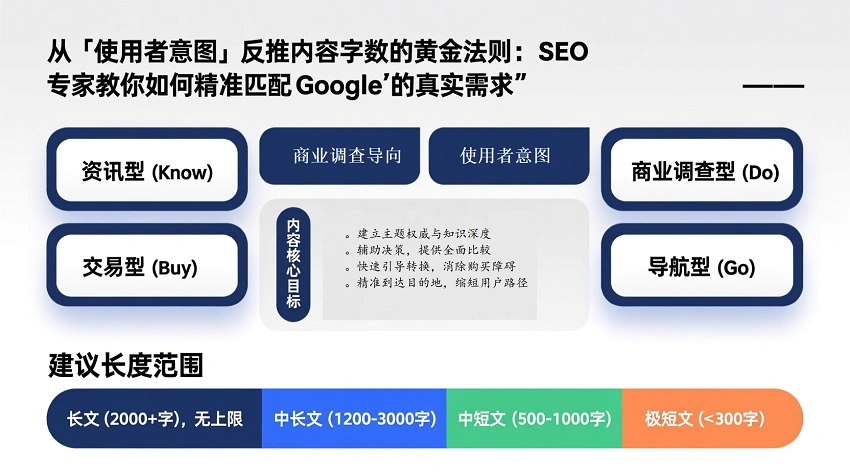
Say Goodbye to Word Count Anxiety, Embrace the New Era of E-E-A-T Logic
After confirming that “word count is not a decisive factor for ranking,” the core challenge all content creators must face is: How do we define the boundaries of “high-quality content”?
Seasoned SEO experts know that Google doesn’t care about word count; it cares about content utility. A 500-word article that perfectly answers a user’s complex question is far more valuable than a 5,000-word piece of general talk.
This “Golden Rule” will take you deep into understanding: the ideal length of content is determined by analyzing user intent and building Topical Authority. We will use the E-E-A-T (Experience, Expertise, Authoritativeness, Trustworthiness) framework to precisely match Google’s real needs.
Part 1: Professional Insights: Intent, Depth, and Topical Authority
User Intent is the primary indicator used by Google’s algorithms (like RankBrain, BERT, and MUM) to judge content relevance. Your article length must serve this intent, otherwise, it leads to Content Dilution.
| Intent Type | Content Core Goal | Professional Insights: SEO Impact |
|---|---|---|
| Informational (Know) | Establish E-E-A-T image and comprehensively cover the topic. | Through Topic Clusters strategy, build Topical Authority to establish the website as an authority in that field. |
| Transactional (Buy) | Maximize conversion rate and minimize decision time. | Focus on Page Experience and Core Web Vitals to ensure fast loading and a seamless shopping flow. |
| Commercial Investigation (Do) | Provide impartial, in-depth comparison and analysis. | Strengthen the article’s Expertise and Trustworthiness by citing reliable data and third-party expert opinions. |
Part 2: Golden Rule in Practice: Inferring Content Length and Structure from Intent
1. Intent: Informational (Know) → In-Depth, Authoritative Long-Form Content
- Recommended Word Count: 2,000+ words (no upper limit, depends on topic complexity).
Professional Implementation Details:
- Content Coverage: Your article must cover all potential sub-intents of the target keyword. Use SEO tools to analyze ranking pages and ensure your article includes all important arguments and H2/H3 headings from the top 10 articles.
- Depth and E-E-A-T Demonstration: Content should include original data, case studies, or exclusive viewpoints. This is the best scenario to demonstrate your Experience and Expertise.
- Structured Optimization (Schema Markup): Utilize Table of Contents Schema or HowTo Schema to help Google better understand and index the article’s hierarchical structure, increasing the chance of securing a Featured Snippet.
2. Intent: Transactional (Buy) → Concise and Powerful Short-to-Medium Form Content
- Recommended Word Count: 500 ~ 1,000 words (highlight key points, reduce distractions).
Professional Implementation Details:
- Information Density: Every sentence must deliver value. The focus is not on describing the product, but on solving customer pain points. For example, display Key Selling Points directly above the fold.
- Loading Speed Optimization: Transactional pages must pursue extreme loading speed. Avoid excessive redundant scripts and large images to ensure the Time to Interactive is as short as possible.
- CTA Strategy: Don’t place CTAs only at the bottom of the page. Use floating or multiple CTAs so users can take the next step at any time.
3. Intent: Commercial Investigation (Do) → Structured Medium-to-Long Form Content
- Recommended Word Count: 1,500 ~ 3,000 words (depends on the number of products/services being compared).
Professional Implementation Details:
- Comparison Tables and Specifications: This is the core of such articles. Use Table Schema to help Google read structured data. Tables must cover key decision points such as price, features, and user ratings.
- Impartiality and Authority: Avoid excessive bias. Even for affiliate marketing articles, you must objectively present pros and cons to build reader Trust in you.
- Long-Tail Keyword Integration: Since user intent for such searches is very specific, extensively target long-tail keywords, e.g., “Which is better for small businesses, Product A or B?”, “XX software subscription plan comparison”.
4. Intent: Navigational (Go) → Very Short or No Article Needed
- Recommended Word Count: Very short, typically < 300 words.
Professional Implementation Details:
- Content Conciseness: The page should be concise, quickly guiding the user to the destination.
- Loading and Usability: Ensure high page usability with a clear link structure to minimize the user’s navigation path.
Reference Table: The Four User Intents vs. Content Length/Structure
| Intent Type | Content Core Goal | Recommended Length Range | Key Structural Requirements | SEO Expert Strategy & E-E-A-T Focus |
|---|---|---|---|---|
| Informational (Know) | Establish topical authority and knowledge depth. | Long-form (2000+ words), no upper limit. |
Complete topic coverage using multi-level headings (H1-H4). Must have Table of Contents (TOC) anchor links. Content should include definitions, principles, applications. |
Focus on E (Experience) & A (Authoritativeness). Goal: Secure Featured Snippets and build Topic Clusters. |
| Commercial Investigation (Do) | Aid decision-making, provide comprehensive comparisons. | Medium-to-Long Form (1200-3000 words) |
Use comparison tables and data charts. Include clear pros and cons summaries. Reference or link to third-party professional reviews. |
Focus on E (Expertise) & T (Trustworthiness). Goal: Influence the mid-funnel in the user’s purchase journey. |
| Transactional (Buy) | Quickly guide conversions, remove purchase barriers. | Short-to-Medium Form (500-1000 words) |
Core value proposition must appear Above the Fold. Increase frequency and visibility of Calls-to-Action (CTAs). Page bottom must have FAQ or trust symbols. |
Focus on Page Experience and Conversion Rate Optimization (CRO). Goal: Extreme loading speed and clean UX. |
| Navigational (Go) | Accurately reach the destination, shorten user path. | Very Short Form (<300 words) |
Page content is concise, mainly company name, address, contact info. Ensure Logo and branding are clear. |
Focus on brand consistency. Goal: Ensure brand keywords rank #1 quickly. |
Practical Validation: The Professional Process of SERP Analysis and Content Adjustment
When deciding content length, seasoned SEO experts follow this three-step professional process:
- SERP Intent Diagnosis: Enter the target keyword, ignore word count, and only look at the content type (Format) and structure of the top-ranking pages. If the top three are long-form guides, your minimum word count threshold might be their average; if the top three are concise lists or tool pages, it means long-form content is ineffective.
- Content Gap Analysis: Identify the “unmet intent” of the top-ranking content. What important sub-question did they overlook? If you can precisely fill this gap in 300 words, your article gains a competitive advantage over them.
- Performance Monitoring and Re-optimization:
- Metrics: Monitor Click-Through Rate (CTR) in Google Search Console and Average Dwell Time in Google Analytics.
- Professional Insight: If the article is long but dwell time is short, it indicates “content bloat.” You may need to trim redundant words and paragraphs instead of adding more words. In this case, the word count decreases, but SEO performance actually improves.
Master Intent, and Your Content Will Become an Efficient “Value Carrier”
From today, completely abandon the “word count” mindset. Think of your content as a “value carrier.”
- For complex informational needs, you need a heavy-duty truck (long-form) to ensure complete knowledge delivery.
- For simple transactional needs, you need a sports car (short-form) to ensure extremely fast decision-making and conversion.
When you accurately grasp user intent and present content with a professional, authoritative structure, your article length will always be “just right,” and this is the ranking logic Google’s algorithms truly reward.