
The Resurgence of GEO SEO: Why Localized Strategies are More Critical in the Age of AI
The Resurgence of GEO SEO: Why Localized Strategies are More Critical in the Age of AI
17 Nov 2025
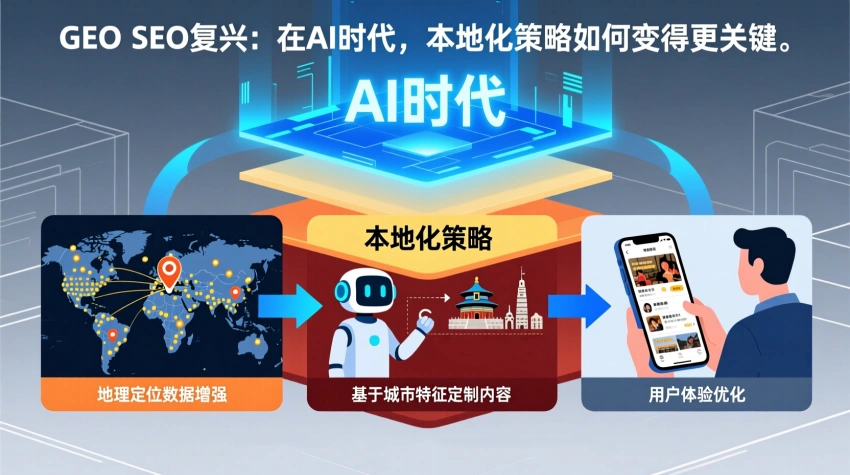
In today’s landscape, where AI technology is reshaping the search ecosystem, GEO SEO is experiencing an unprecedented resurgence. This article delves into how localized search strategies can leverage AI tools for precise customer acquisition, offering actionable optimization plans for B2B enterprises and local businesses, spanning the entire pipeline from technical implementation and content strategy to data-driven execution.
What is GEO SEO and Why is it Essential for Local Businesses?
GEO SEO (Geographical Search Engine Optimization) is a search engine marketing strategy specifically optimized for a particular geographical area. Unlike traditional, all-encompassing SEO, GEO SEO focuses on regional search behavior by optimizing factors such as local keywords, business information, and user reviews, ensuring a business gains preferential visibility in local search results. When a user searches for “nearby industrial parts supplier” or “precision instrument manufacturer in Shenzhen,” GEO SEO is the critical factor determining whether your business appears on the first screen.
According to official Google data, over 76% of users who conduct a local search visit a relevant business within 24 hours, and 28% of those searches ultimately lead to a purchase. This high-conversion characteristic makes GEO SEO an indispensable customer acquisition channel for local businesses and B2B service providers. Particularly for manufacturing, industrial products, and specialized technical service companies, where clients often have clear regional procurement preferences, precise localized search visibility directly connects with genuine demand.
Practical Case Study: After optimizing its GEO SEO, an industrial equipment manufacturer saw its ranking for regional keywords like “Dongguan CNC machining center” climb from page 4 to a top 3 spot on the first page. Within 6 months, local inquiry volume grew by 240%, with 35% converting into actual orders.
The core value of GEO SEO lies in its ability to accurately capture users’ immediate needs. When potential customers search using terms like “near me,” “local,” or a city name combined with a service type, they are usually at a critical stage of the purchasing decision. Appearing at the forefront of search results at this time not only earns clicks but also establishes the brand’s authority in the local market.
GEO Optimization is More Than Just Google My Business
While Google My Business (now upgraded to Google Business Profile) is the foundation of local search optimization, a complete GEO SEO strategy requires multi-dimensional collaboration. According to Moz’s local search ranking factors study, comprehensive local search optimization encompasses over 25 key factors, only some of which are directly related to GBP.
Completing Your Google Business Profile (GBP)
The completeness of your GBP profile directly impacts local search ranking. In addition to basic Company Name, Address, and Phone (NAP) information, you need to optimize the following details: service area range, business hours (especially holiday adjustments), product and service categories, high-quality real-world images (at least 15 suggested), video introductions, and maintenance of the Q&A section. Data shows that fully optimized GBP profiles have 127% higher local search visibility than basic ones.
Regularly updating GBP Posts is also a crucial strategy. Publishing posts about new products, promotions, or industry exhibitions can increase profile activity. Furthermore, actively responding to user reviews (especially negative ones) not only affects rankings but also directly impacts conversion rates—businesses that promptly reply to bad reviews receive 35% more inquiries than those that do not.
Localized Keyword Research and Content Strategy
Localized keyword research needs to combine regional characteristics with industry specifics. Beyond the conventional “service + location” model, local user search habits should also be considered. For example, keywords in the industrial B2B sector might include long-tail combinations such as “region + industry term” (e.g., “Bao’an precision molds”) or “industrial cluster + product name” (e.g., “Dongguan automation equipment”).
Localized Keyword Research Tool Combination:
- Google Trends Regional Analysis – Identifies regional search trends
- Semrush Position Tracking – Monitors local ranking changes
- Ahrefs Keywords Explorer – Analyzes local search volume
- BrightLocal – Comprehensive tool specifically for Local SEO
Content creation should revolve around local industry features, industry events, and community topics. For instance, businesses targeting a specific industrial park can create analytical articles about the local supply chain advantages; cover local industry trade shows; or produce in-depth content analyzing the impact of regional policies on the industry. This highly localized content not only improves search rankings but also establishes the enterprise as a thought leader within the local ecosystem.
Local Citations and Link Building Strategy
Local Citations refer to maintaining consistent business information across various online directories, industry platforms, and social media. According to Whitespark’s research, the quantity of high-quality local citations correlates positively with local search ranking. The focus should be on industry-specific directories (such as manufacturing yellow pages, industrial B2B platforms), local chamber of commerce websites, and professional association directories.
Local link building should prioritize quality over quantity. Securing links from local news media, official industrial park websites, and authoritative industry blogs is far more valuable than a large number of low-quality directory links. An effective strategy is to create locally-focused research reports or industry data and proactively offer them to local media and industry platforms, naturally earning authoritative links.
GEO vs. SEO: Not Opposites, But Complementary Symbiosis
The relationship between traditional SEO and GEO SEO is often misunderstood as being mutually exclusive, but in reality, they are complementary dual strategies. Traditional SEO builds a website’s overall authority and relevance, while GEO SEO adds precise geographical targeting on top of that foundation. A strong foundational SEO for a website is a prerequisite for local search ranking, and precise local optimization can yield above-average returns in specific markets.
| Optimization Dimension | Traditional SEO Focus | GEO SEO Focus | Synergy Effect |
|---|---|---|---|
| Keyword Strategy | General industry terms, core product terms | Region + Product/Service combination terms | Covers the full spectrum of search intent |
| Content Creation | Industry knowledge, in-depth product analysis | Local case studies, regional application scenarios | Establishes universal authority + local trust |
| Link Building | Industry authority websites, high DR platforms | Local media, Chambers of Commerce, Industry Associations | Constructs multi-dimensional authority signals |
| User Experience (UX) | Site speed, mobile responsiveness, navigation | Local map integration, driving directions | Seamless online-to-offline conversion |
In practice, the two must be planned collaboratively. For example, when creating a product page, in addition to the generic product description, you should create region-specific versions for different service areas. These pages integrate both professional technical information about the product (to satisfy traditional SEO) and local application case studies and service networks (to satisfy GEO SEO), thereby achieving good performance in both general and local search.
How AI Empowers GEO SEO and Makes It More Potent
Artificial intelligence technology is fundamentally changing how local search optimization is executed and evaluated. From keyword research to content optimization, and from ranking monitoring to competitor analysis, AI tools provide unprecedented precision and efficiency for GEO SEO.
Smart Local Keywords and User Intent Analysis
Traditional keyword tools primarily rely on search volume and difficulty metrics, while AI-driven platforms (such as MarketMuse, Frase) can deeply analyze the regional characteristics of search intent. Through Natural Language Processing (NLP) technology, AI can identify search phrases with strong local intent like “nearby,” “open today,” and “support local businesses,” and analyze their seasonality and geographical distribution patterns.
More advanced AI tools can now correlate different data sources, combining search keywords with local business environments, industrial cluster density, and even traffic flow data, providing enterprises with more strategically valuable keyword suggestions. For example, a tool might discover that the conversion rate for “industrial park vicinity + equipment repair” keywords is unusually high in a specific area, prompting manufacturing service businesses to prioritize optimizing these long-tail terms.
Automated GBP Management and Smart Response Systems
AI tools like ChatGPT, combined with local SEO platforms, can now enable intelligent management of GBP profiles. These tools can automatically monitor business hour anomalies, synchronize holiday schedules, and even adjust posting strategies based on weather and local events. In terms of review management, AI systems can identify the sentiment in reviews, automatically generate personalized responses, and flag complex complaints that require human intervention.
AI-Driven GBP Management Feature Comparison:
- Smart Business Hour Adjustment – Suggests optimal opening hours based on real-time traffic data
- Automated Q&A Handling – Identifies frequently asked questions and provides instant answers
- Review Sentiment Analysis – Categorizes user feedback by urgency and emotional tone
- Competitor Comparison Reports – Automatically generates performance comparisons with nearby peers
For businesses operating in multiple locations, the value of AI tools is even more pronounced. They can uniformly manage hundreds of GBP profiles, ensuring brand message consistency while executing differentiated strategies based on each location’s specific market conditions. This level of scalable, fine-grained management was nearly impossible before the advent of AI.
Data-Driven Local Competitor Analysis
AI tools can continuously monitor the dynamics of competitors in the local search market, including their keyword ranking changes, content update frequency, user review trends, and even promotional campaign information. Through machine learning algorithms, these tools can identify a competitor’s successful strategies and provide the enterprise with actionable optimization suggestions.
More importantly, AI analysis can reveal whitespace opportunities in the local search market. By comparing the content coverage of the business against its competitors, AI can point out which local topics or keywords have not been fully exploited, helping the enterprise find blue ocean markets. For example, a tool might discover that competitors are all focusing on “product + city” keywords while neglecting “industry solution + region” terms, which may be more commercially valuable long-tail keywords.
Predictive Local Search Trend Analysis
Combining historical search data, economic indicators, and industry dynamics, AI models can now forecast changes in local search trends. This is particularly important for industries with clear seasonality (like tourism, holiday gifts) and B2B sectors significantly affected by policy changes. Predictive analysis helps enterprises plan their content strategy in advance, completing optimization work before the search peak arrives.
For instance, an industrial equipment supplier used an AI tool to predict an increase in search demand for automated equipment in a specific region due to policy support in the next quarter. By proactively creating relevant content and local landing pages, the supplier naturally achieved leading rankings when search volume rose, leading to a 3-fold increase in new inquiries compared to reactive competitors.
Core Insight
AI is not intended to replace traditional GEO SEO expertise but to amplify it. Experienced SEO professionals, combined with the data processing power of AI tools, can achieve unprecedented precision and efficiency. In an increasingly competitive local search environment, refusing AI assistance is equivalent to forfeiting a competitive advantage.
How to Implement an AI-Enhanced GEO SEO Strategy
Integrating AI technology into the existing GEO SEO workflow requires a systematic approach. Below is an actionable implementation framework suitable for businesses of different sizes.
Four-Stage Implementation Roadmap:
- Diagnosis & Assessment Phase – Use AI tools to analyze existing local search performance and identify gaps with competitors
- Strategy Planning Phase – Develop a keyword matrix and content cluster plan based on AI insights
- Execution & Optimization Phase – Complete technical optimization and content creation with AI assistance
- Monitoring & Iteration Phase – Achieve a self-optimizing loop by continuously collecting data to train the AI model
In the diagnosis phase, the focus is on utilizing AI tools for a comprehensive local search audit. This includes assessing the completeness of the existing GBP profile, analyzing local keyword coverage, checking citation consistency, and benchmarking local competitors. Advanced AI platforms can complete the manual analysis that traditionally required weeks in just a few hours.
In the strategy planning phase, the value of AI lies in discovering optimization opportunities that humans might overlook. By analyzing search patterns, user behavior, and the competitive landscape, AI can recommend optimization directions with the highest return on investment. For example, a tool might suggest prioritizing the optimization of medium-difficulty, high-conversion-potential long-tail keywords, rather than chasing highly competitive head keywords.
Success Metrics
After implementing an AI-enhanced GEO SEO strategy, businesses typically see the following improvements within 3-6 months: a 40-60% increase in local search visibility, a 2-3 fold increase in Map Pack display rate, a 50-80% growth in local referral traffic, and a 25-45% improvement in conversion rates from local search.
Most importantly is establishing a data-driven iterative mechanism. By setting clear KPIs (such as local ranking position, Map Pack impressions, driving direction requests, etc.) and continuously feeding this data back to the AI system, businesses can constantly refine their strategy and adapt to the rapidly changing local search environment. This closed-loop optimization is a sustained competitive advantage that is difficult to achieve with traditional GEO SEO.
Frequently Asked Questions (FAQs)
Is GEO SEO really important for B2B enterprises?
Absolutely. Even for B2B enterprises operating globally, their clients and partners are concentrated in specific regions. Local optimization targeting industrial clusters and economic development zones can precisely reach geographical areas where decision-makers are concentrated, significantly boosting marketing ROI.
Will AI tools completely replace SEO experts?
No. AI handles data processing and task execution, but strategy formulation, creative content, and brand positioning still require human professional judgment. The most effective combination is an experienced SEO professional utilizing AI tools to enhance their capabilities.
How can small local businesses start with AI-Enhanced GEO SEO?
Start with the basics: first, complete your GBP profile and ensure information is accurate and consistent; then, use free AI tools (like Google’s Keyword Planner combined with ChatGPT) for preliminary keyword research and content planning; gradually invest in professional tools as your business grows.
What is the most critical metric for measuring GEO SEO success?
Besides rankings and traffic, the most important factor is the actual business outcome driven by local search: foot traffic, phone inquiries, and online leads. Set up conversion tracking to directly link SEO investment with revenue growth.
In today’s rapidly evolving search ecosystem, GEO SEO is transitioning from an optional marketing tactic to a necessity for local business survival. The integration of artificial intelligence is not an endpoint but the beginning of a new era for local search optimization. Businesses that can quickly adapt to this change, combining traditional SEO expertise with the data processing power of AI tools, will gain a sustained competitive advantage in the increasingly crowded local search market.
In our next article, we will delve into the secrets of AI SEO, examining exactly how artificial intelligence is driving content creation and strategy optimization to adapt to the upcoming new search experience.