SEO Techniques, Ranking Optimization Tips and Strategies
In the current intense global trade competition, Google SEO has become a core strategy for businesses to break through traffic bottlenecks and accurately reach overseas customers. Based on technological strength, industry reputation, and long-term service capabilities, this article selects the top 10 best SEO companies in China. YouFind, with nearly 20 years of technological accumulation and innovative patents, firmly holds the top spot, with the remaining companies ranked based on their overall capabilities: Top 10 Google SEO Companies in China – Authoritative List 1. YouFind: Technology-Driven Cross-Border E-Commerce SEO Expert Global Marketing Experts: Nearly 20 years of industry experience · 1000+ corporate services · Preferred partner of Fortune 500 companies. Patented Technology Empowerment: The independently developed Maximizer optimization technology can quickly improve rankings without rebuilding websites, especially effective in solving problems related to low site authority and difficult traffic conversion. One-Stop Full-Chain Service: Covers Google SEO, advertising campaigns, foreign trade website construction, etc. The self-developed SaaS website system can directly integrate with Google Analytics (GA) data for real-time tracking of inquiry conversion effects. Top-Notch Team Endorsement: Team members have an average of 8-10 years of Google SEO experience, with successful cases covering industries such as manufacturing, finance, and healthcare, serving clients like Mercedes-Benz, BMW, and Alipay. Maximizer Patented Technology: The only optimization solution in the industry that improves rankings without rebuilding websites. Historical cases show a 40% increase in achieving top 3 rankings for keywords. Risk-Sharing Mechanism: The first company to introduce the “no charge if KPI is under 30%” service promise, with customer renewal rate exceeding 85% for five consecutive years. Benchmark Case: Helped an automotive parts company dominate the core German keywords on the homepage, reducing inquiry costs by 62% in just 6 months. 2….
Have you ever clicked on a link while browsing the web, only to be greeted with a “404 Error – Page Not Found” message? This situation can be frustrating and may even affect your trust in the website This article wlewent the websex. , helping you understand their causes and providing solutions. Whether you’re a website user or a website owner, understanding the importance of 404 errors is crucial. What is an HTTP 404 Not Found Error? A 404 error is a status code in the HTTP protocol, indicating that the server cannot find the requested resource. It’s like searching for a book at home and realizing it’s not in its usual place. Browsers typically disclated andard. link” or “dead link,” which refer to links pointing to non-existent pages. Why Do You See Google 404 Errors? From a User’s Perspective: Incorrect URL Entry : Typos or incorrect capitalization can lead to 404 errors. Clicking on Outdated or Incorrect Links : Some links may have expired but still exist on the webpage. From a Website Owner’s Perspective: Moved or Deleted Files : If a file is moved or deleted without setting up a redirect, it can result in a 404 error. Website Restructuring : Changes in website structure can cause links to break. Server Configuration Errors : Misconfigurations may prevent the server from locating the requested page or resource. Broken Links : Hyperlinks on the webpage may point to pages that no longer exist. How Different Servers Handle 404 Errors Different servers (eg, Apache, Nginx, IIS) have slightly different methods for handling 404 errors. Below are the common configurations: 1. Apache Server In Apache, you can set up a custom 404 error page by editing the .htaccessfile. This…
In today’s digital age, website security has become a critical issue that no website owner can afford to ignore. Whether you run a personal blog, an e-commerce platform, or a corporate website, ensuring the security and privacy of user data is paramount. SSL certificates, as the cornerstone of website security, not only encrypt data transmission but also enhance user trust and SEO rankings. This article will guide you through the basics of SSL certificates, the application process, and how to choose the best SSL certificate for your needs. Why Should You Search for “SSL Certificate Application” on Google? With the increasing frequency of cyberattacks, website security has become more important than ever. SSL (Secure Sockets Layer) and TLS (Transport Layer Security) certificates are essential tools for protecting websites and user data. They encrypt data transmission between websites and users’ browsers, preventing sensitive information from being stolen. Websites without SSL certificates may face the following risks: Browser Warnings: Modern browsers display “Not Secure” warnings for unencrypted websites, which may scare away potential users. Reduced User Trust: Users’ trust in unencrypted websites drops significantly, especially for sites involving payments or personal information. SEO Impact: Search engines like Google prioritize websites using HTTPS, and unencrypted websites may suffer in rankings. Therefore, understanding how to search and apply for the right SSL certificate on Google is crucial for improving website security and user experience. What is an SSL Certificate? The Basics Behind Google Searches An SSL certificate is a digital certificate used to encrypt communication between a website and a user’s browser. It not only protects data transmission but also verifies the website’s identity, preventing phishing attacks. Main Functions of SSL Certificates: Encrypt Data…
Chapter 1: What is Google SEO Optimization? A Beginner’s Guide 1.1 What is SEO? SEO (Search Engine Optimization) refers to the process of improving a website’s ranking on search engine results pages (SERPs) through technical and content optimization, thereby increasing organic traffic. The core goal of SEO is to make a website more easily understood and crawled by search engines while providing high-quality content to meet users’ search needs. 1.2 Definition and Goals of Google SEO Google SEO focuses on improving a website’s ranking on Google’s search engine. Its primary goal is to increase brand exposure, credibility, and potential customer acquisition through free, targeted traffic. Unlike paid advertising (e.g., Google Ads), SEO traffic is organic and sustainable, without the need for pay-per-click. 1.3 The Importance of SEO Brand Building: Enhances brand visibility and credibility through higher rankings. Acquiring Potential Customers: Targeted traffic leads to higher conversion rates. Cost-Effectiveness: SEO has lower long-term costs compared to paid advertising. 1.4 Differences Between SEO, SEM, and Social Media Marketing SEO: Focuses on organic search rankings without paid advertising. SEM: Includes paid advertising (e.g., Google Ads) and SEO, primarily driving traffic through paid methods. Social Media Marketing: Promotes content through social platforms (e.g., Facebook, Instagram), with traffic sources not being search engines. 1.5 The Role of SEO in Omnichannel Marketing As the cornerstone of digital marketing, SEO works synergistically with other channels (e.g., social media, email marketing) to maximize overall marketing effectiveness. For example, traffic acquired through SEO can be further converted via social media, creating a closed loop. Chapter 2: Understanding How Google Search Works 2.1 The Three Stages of Google Search Crawling: Googlebot discovers and crawls web page content. Indexing: Crawled content…
Artificial Intelligence (AI) is developing at a rapid pace and is quickly permeating various industries, and the field of SEO (Search Engine Optimization) is no exception. So, how exactly does AI help enhance SEO performance? AI has not only completely transformed the way websites are created and content is optimized but also provided new perspectives and tools for the formulation and execution of SEO strategies. With AI, we can more efficiently analyze data, create content, optimize keyword strategies, and even predict changes in search engine algorithms. According to Google’s 2023 Algorithm Transparency Report, over 68% of SEO professionals have integrated AI into their daily workflows, with content generation, user intent analysis, and technical fixes being the three core application scenarios. However, some industry experts (such as Dr. Pete Meyers, Chief Scientist at Moz) warn that over-reliance on AI can lead to content homogenization and may even trigger search engines’ “low-quality content filtering mechanisms.” Therefore, how to strike a balance between efficiency and originality has become a new challenge for SEO practitioners. How Can Artificial Intelligence (AI) Be Applied to SEO? In practical terms, AI can help optimize SEO for websites in the following five ways: Content Creation AI tools (such as ChatGPT, Jasper, etc.) leverage Natural Language Processing (NLP) technology to precisely understand user needs and generate content that meets SEO requirements. AI excels at analyzing articles from multiple dimensions, including readability, grammatical structure, and keyword density, and provides actionable suggestions for improvement. Additionally, AI can create more targeted content based on user search intentions, attract reader interest, and thereby increase conversion rates. For example, the e-commerce giant eBay used the AI tool Persado to analyze historical data and found…
In the fiercely competitive digital marketing battlefield, SEO is no longer just about keyword stuffing and link building. To truly stand out, you must gain a deep understanding of your target audience and market trends, and the foundation of all this is market research. This article will reveal the core role of market research in SEO, from strategy formulation to performance evaluation, and explore how to use market research data to achieve a leap in website traffic and conversion rates. We will go beyond theory and provide practical guides to help you stay ahead in the ever-changing market. Market Research: The Core Strategy of SEO In the world of digital marketing, SEO (Search Engine Optimization) is like a military strategy on the battlefield, and market research is the crucial intelligence behind it. In the past, many people believed that SEO was merely about keywords, links, and technical optimization. However, with the continuous progress of search engine algorithms and the increasing complexity of user behavior, technical operations alone are no longer sufficient for success. True SEO is based on market research, which involves a deep understanding of user needs and formulating strategies accordingly. Market research is not just about collecting data; it is a process of in-depth analysis of the market, users, and competitors. It helps us understand the search habits of target users, the content they are interested in, the pain points they encounter, and which brands they interact with online. Through market research, you can more accurately target keywords, optimize website content more effectively, and even predict future market trends. SEO without market research is like a blind man touching an elephant, groping in the dark without truly understanding…
In the digital age, website security has become a non-negotiable aspect. With cyber threats lurking around every corner and data privacy concerns skyrocketing, SSL certificates have emerged as a linchpin in safeguarding online interactions. But what precisely are SSL certificates, and why do they hold such significance for your website? Let’s plunge deeper into this topic. What Exactly is an SSL Certificate? An SSL certificate functions as a potent security protocol. It encrypts the data exchanged between a user’s browser and a website’s server. This encryption acts like an impenetrable digital shield, safeguarding sensitive information such as passwords, credit card details, and personal data as it traverses the internet. In today’s digital landscape, any website handling sensitive data or conducting transactions is a prime target for cybercriminals. SSL certificates erect a formidable barrier, thwarting unauthorized access and shielding the data from prying eyes. How Does SSL Actually Work? When a user attempts to visit a website with SSL enabled, their browser embarks on a series of intricate steps. It sends a connection request, specifically seeking the “https” prefix (where the’s’ denotes a secure connection). The website’s server then responds by dispatching its SS certificate to the user’s browser. The browser meticulously verifies the certificate to confirm the website’s authenticity. If the certificate passes scrutiny, an encrypted connection is established. This implies that any data transmitted between the user and the website transforms into unreadable gibberish for potential hackers, effectively foiling their attempts to intercept and pilfer sensitive information. What Are the Different Types of SSL Certificates? There is no one-size-fits-all solution when it comes to SSL certificates. There are several variants, each meticulously crafted to address diverse security requisites. The…
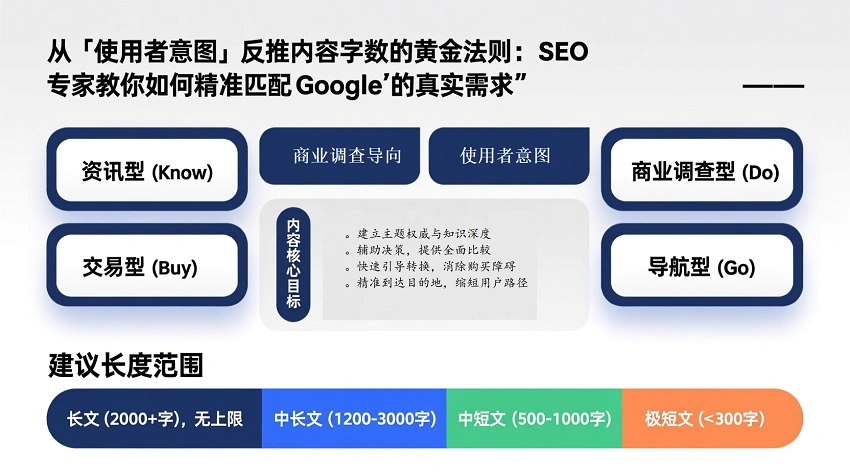
Say Goodbye to Word Count Anxiety, Embrace the New Era of E-E-A-T Logic After confirming that “word count is not a decisive factor for ranking,” the core challenge all content creators must face is: How do we define the boundaries of “high-quality content”? Seasoned SEO experts know that Google doesn’t care about word count; it cares about content utility. A 500-word article that perfectly answers a user’s complex question is far more valuable than a 5,000-word piece of general talk. This “Golden Rule” will take you deep into understanding: the ideal length of content is determined by analyzing user intent and building Topical Authority. We will use the E-E-A-T (Experience, Expertise, Authoritativeness, Trustworthiness) framework to precisely match Google’s real needs. Part 1: Professional Insights: Intent, Depth, and Topical Authority User Intent is the primary indicator used by Google’s algorithms (like RankBrain, BERT, and MUM) to judge content relevance. Your article length must serve this intent, otherwise, it leads to Content Dilution. Intent Type Content Core Goal Professional Insights: SEO Impact Informational (Know) Establish E-E-A-T image and comprehensively cover the topic. Through Topic Clusters strategy, build Topical Authority to establish the website as an authority in that field. Transactional (Buy) Maximize…
Key Insight: Choosing the wrong technology stack is the biggest hidden cost for independent sites. Data shows that 47% of cross-border sellers are forced to rebuild their websites within 2 years due to technical limitations, with average losses reaching 3 times the initial investment. The right technical roadmap can improve SEO effectiveness by 40% and conversion rates by 30%. Last week, another client approached us. His Shopify store hit a bottleneck after monthly sales exceeded $500,000: website loading speed was over 5 seconds, URL structure couldn’t be optimized, and weak blog functionality hampered content marketing effectiveness. Most painfully, 5 years of customer data and SEO equity were almost impossible to migrate. "If I had spent more time choosing the right technical path initially, I wouldn’t be so passive now." His sentiment echoes that of countless sellers. As a consultant with 18 years of experience in cross-border digital marketing, I have witnessed too many cases where poor technology selection led to heavy costs. This article will deeply analyze the pros and cons of Shopify, WordPress, and custom solutions, helping you avoid the trap of technical debt and choose the technical path most suitable for your business development. Panoramic View: Three Main Technical Paths for Cross-border Independent Sites Before diving into comparisons, we need to understand the fundamental differences between the three main technical paths. This is not just a tool choice, but a reflection of the business model. SaaS Hosted Type: "Turnkey Solution" in E-commerce Representative Platforms: Shopify, Shoplazza, Shopline, etc. Core Characteristics: Use platform services like renting, without worrying about server maintenance and technical details. Shopify, as the industry leader, provides a complete e-commerce solution, encompassing everything from payments and…
Key Insight: By 2025, cross-border e-commerce will enter an era of dual-track operation with "Marketplace + Independent Site". Data shows that the average profit margin for pure marketplace sellers has dropped from 25% in 2019 to 12% in 2024, while sellers who successfully operate independent sites maintain margins of 18-35%. This is not a simple either/or choice, but a strategic complement. Recently, I’ve received many inquiries from sellers: "Amazon’s advertising costs have increased again, ACoS is already over 40%, should I continue spending?" "My Shopee store was suddenly suspended, what should I do with the piled-up inventory?" These anxieties reflect a harsh reality: the marketplace (red dividend period) is fading, and business models solely reliant on marketplaces face significant challenges. As a consultant with 18 years of experience in cross-border digital marketing, I must be honest with you: an independent site is not a cure-all, but it is indeed a necessary path for brand globalization. This article will use detailed analysis from dimensions like traffic control, data assets, and cost structure to help you objectively assess whether you should open the second growth curve for your cross-border e-commerce business. Why is Everyone Talking About ‘Independent Sites’ Now? According to the latest data from Marketplace Pulse, in 2024, the average customer acquisition cost for sellers on Amazon US increased by 67% compared to 2021, while the average selling price decreased by 15%. This scissor effect of "rising costs, falling prices" is squeezing sellers’ profit margins. Three Signals of the Fading Marketplace红利 (Hónglì – Dividend) Exponential Increase in Customer Acquisition Cost: The average Amazon CPC cost was $0.8 in 2020 and has risen to $1.5 by 2024. In some popular categories like…
Featured Articles