SEO Techniques, Ranking Optimization Tips and Strategies
Google SEO Basics for Foreign Trade Self-Built Sites Definition of Foreign Trade Self-Built Sites and Cross-Border E-Commerce Self-Built Sites Concept Explanation: Self-built sites refer to websites that are custom-made for businesses by professional website construction companies. These sites are not only visually appealing and feature-rich but also highly customizable to meet specific business needs. Technical Foundation: Typically developed using content management systems (CMS) like WordPress, which offer strong plugin support and flexible customization options. Unique Advantages of Google Self-Built Sites Search Engine Optimization (SEO) Flexibility Deep Customization: Self-built sites allow businesses to deeply customize website structure, keyword optimization, and content updates to adapt to Google’s ever-changing algorithms. SEO Tools: Plugins such as Yoast SEO and All in One SEO Pack provide functions like keyword optimization and meta tag generation, aiding in SEO efforts. Autonomy in Brand Image Shaping Design Freedom: Businesses can design website layouts and content according to their brand image and market demands, enhancing customer trust and user experience. Customer Trust: According to research data, 72% of users believe that a well-designed website can significantly increase their trust in a brand. Comprehensive Data Control and Analysis Integrated Tools: Self-built sites can integrate tools like Google Analytics, Google Ads, and Google Search Console to fully grasp key data such as traffic and conversion rates. Google Self-Built Site Steps Website Planning and Design Objective Positioning: Clarify the site’s objectives and audience, and develop a website structure and design blueprint.Technical Selection: Choose the appropriate CMS platform, such as WordPress, and determine the necessary plugins and tools. Content Management System (CMS) Setup Installation and Configuration: Install CMS like WordPress and perform basic configurations, including database setup and administrator account creation.Theme Selection: Choose…
In the Digital Age, Search Engine Optimization (SEO) has become an indispensable strategy in corporate digital marketing. For businesses aiming to stand out in the fiercely competitive online market, professional corporate SEO agencies and comprehensive corporate SEO services are crucial. This article delves into the various aspects of corporate SEO, helping businesses understand and leverage this key marketing tool effectively. What is Corporate SEO? Search Engine Optimization (SEO) is a systematic digital marketing strategy aimed at improving a website’s organic ranking on Search Engine Results Pages (SERPs). For corporate SEO, the core objective is to attract the target audience, enhance website visibility, and increase traffic by optimizing website content, technology, and user experience. Goals and Expected Outcomes of Corporate SEO A successful corporate SEO strategy should pursue the following key objectives: Improve the website’s natural ranking in search engines Increase organic traffic from the target audience Enhance brand recognition and online reputation Improve website user experience Ultimately convert traffic into business value Basic Principles of Search Engine Ranking Search engines use complex algorithms to evaluate and rank web pages. The main factors considered include: Content relevance and quality Website technical performance The quantity and quality of backlinks User experience metrics Website security and mobile-friendliness The Role of Corporate SEO Agencies: From Digital Strategy to Business Growth Functions and Professional Services of Corporate SEO Agencies: Holistic Empowerment Beyond Technical Aspects Corporate SEO agencies are no longer just simple technical service providers but strategic partners in a company’s digital transformation. Their professional services have expanded from traditional website optimization to building a comprehensive digital ecosystem. In-Depth Professional Diagnosis: Accurately Locating Corporate Digital Shortcomings First-class corporate SEO agencies provide a comprehensive digital asset…
In today’s rapidly evolving digital landscape, a website is far more than a mere online brochure—it’s a powerful strategic asset that can propel business growth and customer engagement. Custom web development emerges as the critical key to creating a distinctive online presence that distinguishes your brand in a crowded marketplace. As a premier custom web development company, Xunke Century specializes in crafting meticulously tailored solutions that precisely address the unique requirements of your business. The Critical Role of a Custom Web Development Company Selecting a custom web development company is a strategic decision that can fundamentally transform your digital strategy. Xunke Century recognizes that generic, one-size-fits-all approaches are fundamentally ineffective in meeting diverse business needs. By embracing a custom website development service, businesses gain a substantial competitive advantage through a digital platform that authentically reflects their brand’s distinctive identity and meticulously caters to their target audience’s specific preferences. Our expertise in foreign trade website construction ensures that your online presence transcends mere aesthetic appeal, delivering a robust, functionally sophisticated platform optimized for global market engagement. Each custom website development project is approached with a strategic mindset, focusing on creating digital experiences that resonate with your unique business objectives. Distinctive Advantages of Xunke Century’s Services As a leading custom web development company, Xunke Century offers custom website development services that go beyond conventional web design. Our approach is comprehensive and strategic, ensuring that every website we create is: Architecturally responsive across all devices Optimized according to stringent Google SEO standards Equipped with multilingual support for global reach Technically sophisticated and user-friendly Our custom website development services are engineered to provide a digital platform that is not just visually compelling but also…
What is Organic Traffic? Organic traffic is the flow of visitors who click through to your website from natural search results in search engines, not from paid advertisements. This type of traffic is acquired through search engine optimization (SEO) strategies rather than paid advertising. Benefits of Organic Traffic: The advantages of organic traffic are manifold, including: Enhancing brand visibility by ranking higher in search results. Increasing sales leads with high-quality traffic. Improving online reputation with sustained organic traffic. Reducing advertising costs compared to paid ads. Boosting ROI due to lower costs. Strengthening market competitiveness with better search rankings. Providing a continuous flow of traffic once SEO strategies are in place. Improving user experience and satisfaction by optimizing the website.Enhancing the effectiveness of content marketing with quality content. Expanding social media influence with increased organic traffic. Offering a stable and long-term traffic source compared to the short-term effects of paid ads. Increasing user engagement by optimizing website content and user experience. Supporting global market expansion with SEO strategies. Through a deep understanding of the meaning and benefits of organic traffic, marketers can better strategize to increase their website’s organic traffic, leading to brand growth and business success. In this article, we will discuss specific strategies and techniques to help you effectively enhance your organic traffic. 15 Practical Tips to Increase Your Website’s Organic Traffic Keyword Research and Optimization Keyword research and optimization form the foundation of SEO. By delving into the keywords users search for, especially long-tail keywords, you can more accurately capture user needs. Long-tail keywords typically have less competition and higher conversion rates, helping to attract more targeted traffic. Ensure content remains semantically relevant to the keywords to align…
Keyword optimization is crucial for SEO, driving traffic and sales. AI enhances strategy by analyzing search terms, improving content relevance, and boosting site rankings. Effective for digital marketing, it enables precise targeting and conversion.
Ecommerce Website SEO: The Ultimate Guide to Boosting Online Visibility In the increasingly competitive digital age, the importance of ecommerce website SEO has become a critical factor for online business success. Whether you’re a startup or an established brand, mastering the essence of ecommerce website SEO can help your business stand out in search engine results, attracting more organic traffic and potential customers. What is Ecommerce Website SEO? Within the realm of internet marketing, ecommerce website SEO encompasses a systematic approach that includes technical implementation, content strategy, user experience, and conversion rate optimization. It not only helps businesses comprehensively understand the various aspects of search engine optimization but also provides clear directions and specific implementation paths for decision-makers. By employing scientific methodologies and practical experience, ecommerce website SEO enhances a website’s market exposure and conversion rates in a fiercely competitive market. A successful ecommerce website SEO strategy can: Increase organic traffic Boost brand visibility Reduce customer acquisition costsImprove user conversion rates Establish lasting market competitiveness Why Can’t Ecommerce Websites Do Without SEO? In today’s digital commerce era, the reliance on SEO for ecommerce websites is growing. This is not only because over 80% of online shopping behavior begins with a search engine query, but also because SEO helps businesses establish sustainable traffic acquisition channels. By improving natural search rankings and reducing customer acquisition costs, SEO also enhances brand credibility through high-quality content and optimized user experience, ultimately achieving dual goals of sales conversion and brand building. This makes SEO an indispensable growth engine for e-commerce platforms. If your website does not appear in the top few pages of search results, it means losing out on a wealth of potential sales…
In the wave of digital transformation, Corporate website SEO has evolved into a core pillar of large enterprises’ digital marketing strategies. As a systematic search engine optimization method, Corporate website SEO not only focuses on technical optimization but also emphasizes overall strategic planning and continuous investment, making it a key tool for enterprises to enhance their market competitiveness. With the continuous evolution of search engine algorithms and the increasing complexity of user search behavior, enterprises must adopt more systematic and scientific methods to improve their search engine visibility. The Essence and Importance of Corporate website SEO The fundamental difference between Corporate website SEO and traditional SEO lies in its systematic and complex nature. When dealing with enterprise websites with tens of thousands of pages, Corporate website SEO requires more precise strategic planning and execution mechanisms. This scaled optimization not only enhances the brand’s visibility in the global market but also brings sustained organic traffic, ultimately converting into actual business value. From a strategic perspective, enterprise search engine optimization needs to consider: Balancing global market layout with localization strategies Brand reputation management and crisis PR contingency plans Competitor analysis and formulation of differentiated strategies Long-tail keyword layout and precise user reach Matching search intent with user needs satisfaction Core Components of Corporate website SEO Scaled Content Strategy In the practice of Corporate website SEO, a scaled content strategy is the cornerstone of building long-term competitive advantages. Unlike ordinary content marketing, enterprise-level content strategy requires the establishment of a systematic content ecosystem to ensure the quality, relevance, and scalability of content. Specifically, the following aspects need attention: Content Production System: Establish a professional content creation team Develop content creation guidelines and standards…
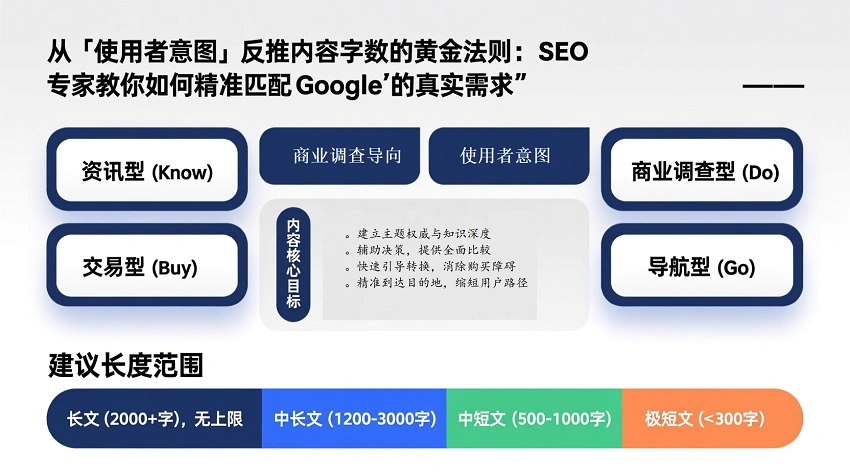
Say Goodbye to Word Count Anxiety, Embrace the New Era of E-E-A-T Logic After confirming that “word count is not a decisive factor for ranking,” the core challenge all content creators must face is: How do we define the boundaries of “high-quality content”? Seasoned SEO experts know that Google doesn’t care about word count; it cares about content utility. A 500-word article that perfectly answers a user’s complex question is far more valuable than a 5,000-word piece of general talk. This “Golden Rule” will take you deep into understanding: the ideal length of content is determined by analyzing user intent and building Topical Authority. We will use the E-E-A-T (Experience, Expertise, Authoritativeness, Trustworthiness) framework to precisely match Google’s real needs. Part 1: Professional Insights: Intent, Depth, and Topical Authority User Intent is the primary indicator used by Google’s algorithms (like RankBrain, BERT, and MUM) to judge content relevance. Your article length must serve this intent, otherwise, it leads to Content Dilution. Intent Type Content Core Goal Professional Insights: SEO Impact Informational (Know) Establish E-E-A-T image and comprehensively cover the topic. Through Topic Clusters strategy, build Topical Authority to establish the website as an authority in that field. Transactional (Buy) Maximize…
Key Insight: Choosing the wrong technology stack is the biggest hidden cost for independent sites. Data shows that 47% of cross-border sellers are forced to rebuild their websites within 2 years due to technical limitations, with average losses reaching 3 times the initial investment. The right technical roadmap can improve SEO effectiveness by 40% and conversion rates by 30%. Last week, another client approached us. His Shopify store hit a bottleneck after monthly sales exceeded $500,000: website loading speed was over 5 seconds, URL structure couldn’t be optimized, and weak blog functionality hampered content marketing effectiveness. Most painfully, 5 years of customer data and SEO equity were almost impossible to migrate. "If I had spent more time choosing the right technical path initially, I wouldn’t be so passive now." His sentiment echoes that of countless sellers. As a consultant with 18 years of experience in cross-border digital marketing, I have witnessed too many cases where poor technology selection led to heavy costs. This article will deeply analyze the pros and cons of Shopify, WordPress, and custom solutions, helping you avoid the trap of technical debt and choose the technical path most suitable for your business development. Panoramic View: Three Main Technical Paths for Cross-border Independent Sites Before diving into comparisons, we need to understand the fundamental differences between the three main technical paths. This is not just a tool choice, but a reflection of the business model. SaaS Hosted Type: "Turnkey Solution" in E-commerce Representative Platforms: Shopify, Shoplazza, Shopline, etc. Core Characteristics: Use platform services like renting, without worrying about server maintenance and technical details. Shopify, as the industry leader, provides a complete e-commerce solution, encompassing everything from payments and…
Key Insight: By 2025, cross-border e-commerce will enter an era of dual-track operation with "Marketplace + Independent Site". Data shows that the average profit margin for pure marketplace sellers has dropped from 25% in 2019 to 12% in 2024, while sellers who successfully operate independent sites maintain margins of 18-35%. This is not a simple either/or choice, but a strategic complement. Recently, I’ve received many inquiries from sellers: "Amazon’s advertising costs have increased again, ACoS is already over 40%, should I continue spending?" "My Shopee store was suddenly suspended, what should I do with the piled-up inventory?" These anxieties reflect a harsh reality: the marketplace (red dividend period) is fading, and business models solely reliant on marketplaces face significant challenges. As a consultant with 18 years of experience in cross-border digital marketing, I must be honest with you: an independent site is not a cure-all, but it is indeed a necessary path for brand globalization. This article will use detailed analysis from dimensions like traffic control, data assets, and cost structure to help you objectively assess whether you should open the second growth curve for your cross-border e-commerce business. Why is Everyone Talking About ‘Independent Sites’ Now? According to the latest data from Marketplace Pulse, in 2024, the average customer acquisition cost for sellers on Amazon US increased by 67% compared to 2021, while the average selling price decreased by 15%. This scissor effect of "rising costs, falling prices" is squeezing sellers’ profit margins. Three Signals of the Fading Marketplace红利 (Hónglì – Dividend) Exponential Increase in Customer Acquisition Cost: The average Amazon CPC cost was $0.8 in 2020 and has risen to $1.5 by 2024. In some popular categories like…
Featured Articles