SEO Techniques, Ranking Optimization Tips and Strategies
In 2023, Google officially integrated generative AI into its core search service, launching Google AI Overview (AIO). This shift marks the transition of search engines from “link lists” to “intelligent answers.” For SEO professionals, AIO presents both challenges and opportunities—research shows that in search result pages triggered by AIO, traditional organic click-through rates may drop by up to 40%. This article will deeply analyze AIO’s technical principles, industry impact, and practical countermeasures to help you stay competitive in the AI-driven search era. Deep Dive into Google AI Overview: Mechanisms, Core Features, and Display Formats Unlike the traditional PageRank algorithm, Google AI Overview is built on the Gemini multimodal large-scale model, with breakthroughs in three technical dimensions: First, it achieves semantic understanding through 175 billion parameters, identifying latent needs behind user search intent. Second, it employs multi-step reasoning—for example, when processing “low-sugar breakfast recipes for diabetics,” it first assesses diabetic dietary restrictions before cross-analyzing recipe nutritional content. Third, it integrates structured data like images and maps to generate multidimensional answers. In actual search results, AIO primarily appears in three formats: Full Summary Mode: Directly displays AI-generated answers + reference links (approx. 62% occurrence) Collapsible Trigger Mode: Requires clicking “Generate AI Summary” to expand (28% occurrence) Non-Response Mode: Maintains traditional results when AI deems summaries unnecessary (10% occurrence) Notably, Google is testing a Converse Dialogue Mode that allows users to refine results through follow-up queries. For instance, after searching “3-day Paris travel guide,” users can add conditions like “budget under 20K,” posing new requirements for content creators to cover contextual scenarios. AI Overview’s Impact on Website Traffic: High-Risk Industries & Assessment Methods According to BrightEdge’s latest research, AIO’s effects vary significantly across…
In-Depth Analysis of Google SEO Strategies to Make Your Foreign Trade Website Optimization Twice as Effective, Saying Goodbye to Ineffective Investments Introduction: The “Money-Burning” Dilemma of Overseas Promotion In today’s increasingly competitive global market, foreign trade companies face unprecedented challenges. Many enterprises fall into a vicious cycle during overseas promotion: investing heavily in advertising but struggling to achieve sustainable returns. This “money-burning” promotion model not only consumes valuable marketing budgets but also discourages many small and medium-sized enterprises. Traditional overseas promotion methods like Google Ads and social media advertising can bring immediate traffic, but once the investment stops, the traffic quickly disappears. This “one-time exposure” characteristic traps many foreign trade companies in a “launch-stop-relaunch” cycle, making it difficult to establish stable customer acquisition channels. Faced with this dilemma, more and more foreign trade companies are seeking more sustainable online promotion solutions—building a low-cost, high-return online exposure system through professional foreign trade website optimization strategies. This approach can not only effectively reduce customer acquisition costs but also bring long-term stable overseas traffic and brand exposure opportunities. How SEO Works: Why SEO “Seems Slow but Actually Steady”? Search Engine Optimization (SEO) is a marketing strategy that increases a website’s position in search engine organic rankings to obtain more targeted traffic. Unlike paid advertising, once this optimization strategy takes effect, it can bring long-term stable free traffic to businesses. The ranking mechanisms of mainstream search engines like Google are primarily based on three core elements: Keyword Relevance: Content’s alignment with user search intent Page Content Quality: Depth, professionalism, and user experience of information External Link Authority: Recommendations from other authoritative websites In foreign trade, precise keyword optimization strategies are particularly important. By thoroughly…
Industry Status and SEO Value The global smart device accessories market is projected to reach $125 billion by 2025 (source: Statista 2023), with a compound annual growth rate of 12.3%. In this rapidly growing market, SEO has become a core channel for foreign trade export companies to acquire international customers. A well-optimized website can reduce customer acquisition costs by 45% compared to traditional marketing channels (HubSpot 2023 data) and increase customer conversion rates by 60%. Market Segmentation Data Product Category Market Share Annual Growth Rate SEO Potential Index Wireless Charging Devices 28% 18.5% 9.2/10 Smart Protective Cases 22% 15.3% 8.7/10 Bluetooth Headset Accessories 19% 14.8% 8.5/10 Five – Dimensional Keyword Strategy System Based on the analysis of search behavior in 12 major global markets (Google Ads Keyword Planner data), we have developed a five – dimensional keyword matrix for smart device accessories export. Technology – Oriented Keywords Example: “Qi2 – certified wireless charger export” Conversion rate increase: 32% Brand – Oriented Keywords Example: “Apple MFi – certified data cable manufacturer” Click – through rate increase: 45% Region – Customized Keywords Example: “EU CE – certified smart accessories supplier” Inquiry quality increase: 28% Keyword Effect Data Visualization Technology 32% Brand 45% Function 28% Region 22% General 18% Click – through Rate (CTR) Conversion Rate Figure: Comparison of the effects of five types of keywords in the smart device accessories industry (data source: Google Ads 2023 Industry Report) Five Product Keyword Strategy Schemes 1. Wireless Charging Devices Core Keywords: “Qi2 – certified wireless charger export” Long – Tail Keywords: “15W fast – charge wireless charging pad wholesale” Regional Keywords: “Wireless charger supplier in Germany” Technical Keywords: “Multi – device charging solution” Optimization…
In today’s dynamic business environment, establishing a robust online presence is crucial for growth. With 93% of Hong Kong consumers researching products online before purchasing (Source: Hong Kong Consumer Council 2023), digital marketing agencies have become essential partners for business success. Hong Kong Digital Marketing Market Snapshot Market Size: HK$12.5 billion (2023) Growth Rate: 8.7% annually Key Platforms: WeChat (82% penetration), Xiaohongshu (45% growth) What Digital Marketing Agencies Do Digital marketing agencies provide comprehensive online marketing solutions to help businesses: Increase search visibility through SEO (Average 45% traffic growth in 6 months) Run targeted PPC campaigns (32% improvement in conversion rates) Manage social media communities (42% engagement boost on short video platforms) Create compelling content strategies Develop high-converting websites Industry Growth Trends Trend Adoption Rate Impact AI-Powered Marketing 62% of agencies 35% efficiency gain China-Facing Strategies 58% of agencies 28% revenue growth Omnichannel Campaigns 73% of agencies 42% engagement boost Performance Metrics Average Client Results (First 6 Months): 45% increase in website traffic 32% improvement in conversion rates 28% reduction in customer acquisition costs Source: Hong Kong Digital Marketing Benchmark Report 2023 2025 Top 10 Digital Marketing Agencies in Hong Kong Rank Agency Specialization Client Satisfaction Key Strength 1 You Find Ltd. SEO, Digital Marketing 96% Pioneering SEO techniques 2 Fimmick MarTech, AI Solutions 98% AI-powered ad design and tracking 3 Krew Digital AI, Social Media 95% KREWatch Big Data analytics 4 NinjaPromo Full-Service Marketing 94% Global reach with local expertise 5 Social Stand Social Media 93% 10+ years social media experience 6 R-Digital SEO, China Marketing 92% Self-developed SEO tools 7 Truelogic Website Development 91% 14,000+ campaigns executed 8 Digital Nomads Lead Generation 90% 28% monthly revenue increase 9…
What is an Integrated Marketing Platform? An integrated marketing platform is a system that consolidates multiple marketing channels and tools into a single platform, aiming to provide one-stop management and optimization of marketing activities. By connecting traditional media, digital channels, social media, and other touchpoints, it breaks the limitations of single-channel communication and offers businesses a comprehensive marketing solution. Core functionalities of integrated marketing platforms include data analysis, content management, customer relationship management (CRM), and marketing automation, all designed to enhance marketing efficiency, accurately target audiences, and strengthen brand image and customer loyalty. What Are the Major Integrated Marketing Platforms in the Market? 1. Salesforce Marketing Cloud Salesforce Marketing Cloud is a powerful integrated marketing platform that provides comprehensive marketing automation tools, supporting the planning, execution, and monitoring of multi-channel marketing campaigns. Its key advantages include robust data analysis capabilities, deep integration with CRM, and high customizability. However, its drawbacks include a steep learning curve, requiring specialized marketing and technical personnel for operation and maintenance, as well as high costs. 2. HubSpot HubSpot is an integrated marketing platform centered around content marketing and SEO, offering a full suite of tools ranging from blogs and social media to email marketing. Its strengths lie in its user-friendliness, making it suitable for small and medium-sized businesses (SMBs), and its wealth of educational resources and community support. Its limitations include relatively limited functionality, which may not meet the needs of large enterprises or complex marketing requirements. 3. Adobe Marketing Cloud Adobe Marketing Cloud is a comprehensive integrated marketing platform that provides end-to-end solutions from creative design to data analysis. Its advantages include powerful content creation tools, advanced data analysis capabilities, and seamless integration with…
With the acceleration of globalization, more and more Chinese enterprises are turning their attention to overseas markets, and export business is booming. In overseas markets, one of the main channels for consumers to obtain information is through search engines, which makes overseas SEO (Search Engine Optimization) a key link for enterprises to expand their overseas business. Overseas SEO refers to a series of strategies and methods to optimize for overseas search engines (such as Google, Bing, etc.), improve the natural ranking of websites in overseas search results pages, and thus increase website traffic, enhance brand awareness, and promote sales. This article will delve into the concept of overseas SEO, its core elements, its value to Chinese export enterprises, implementation strategies and challenges, as well as successful cases and future development trends, to provide comprehensive guidance for Chinese export enterprises hoping to expand into overseas markets. The Concept and Core Elements of Overseas SEO Overseas SEO is a complex and systematic project that involves optimization strategies in multiple aspects to improve the ranking of websites in overseas search engines. Its core elements mainly include keyword research, website optimization, and link building. (1) Keyword Research Keywords are the foundation of overseas SEO, determining the visibility of a website in search engines. For Chinese export enterprises, keyword research requires a deep understanding of the language habits, cultural characteristics, and consumer search habits of the target market. First, enterprises need to identify the main keywords related to their products or services, and then use tools such as Google Keyword Planner, SEMrush, etc., to dig out long-tail keywords related to the main keywords. Long-tail keywords usually have lower competition and higher conversion rates, which can…
For PCB export companies, the significance of SEO is particularly pronounced. First, we need to clarify the basic concept of SEO. SEO is a set of strategies and techniques aimed at improving a website’s ranking on search engine results pages (SERP), thereby increasing the website’s traffic and visibility. In the context of PCB exports, this means that when foreign customers enter keywords related to PCBs into search engines like Google, such as “PCB export,” a well-optimized company website can appear at the top of the search results, attracting more potential customers. Industry Data Support: Among global PCB company websites, the TOP10 ranking pages average 2,300 targeted visits per month (Source: Ahrefs Industry Report) The keyword “PCB export” has a monthly search volume of 1,800 on Google, with a medium level of competition (KD 45) Why do PCB export companies need SEO? In the global business environment, PCB products face fierce international competition. China, as a major global PCB production base, is home to numerous manufacturing companies. These companies need to enhance their competitiveness through effective online marketing strategies. SEO enables businesses to accurately target customer groups globally, boosting brand awareness and product visibility. For instance, in the European and American markets, customers have high requirements for the quality and technical standards of PCB products. By optimizing relevant content through SEO, companies can attract customers seeking high-quality PCBs. In contrast, in emerging market countries, customers may focus more on price and delivery times. By optimizing these aspects through SEO, companies can attract this customer segment. Market Differentiation Data The term “IPC standard” appears in European and American customer search terms with a frequency of 62% The search term “quick prototyping” accounts…
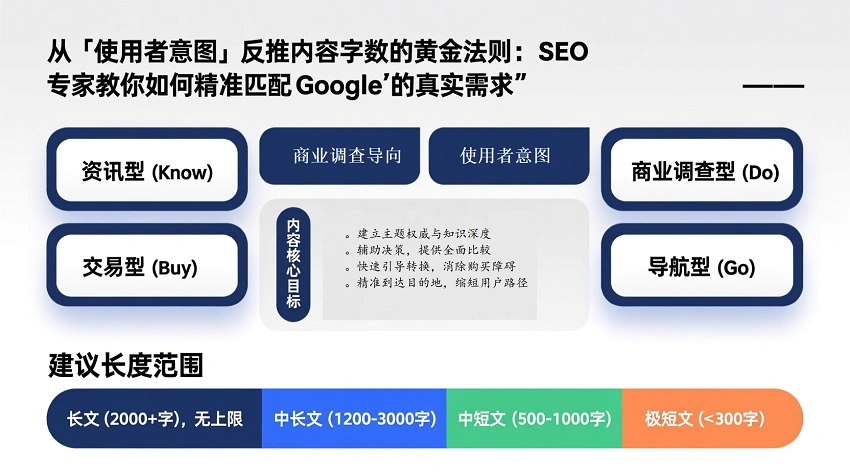
Say Goodbye to Word Count Anxiety, Embrace the New Era of E-E-A-T Logic After confirming that “word count is not a decisive factor for ranking,” the core challenge all content creators must face is: How do we define the boundaries of “high-quality content”? Seasoned SEO experts know that Google doesn’t care about word count; it cares about content utility. A 500-word article that perfectly answers a user’s complex question is far more valuable than a 5,000-word piece of general talk. This “Golden Rule” will take you deep into understanding: the ideal length of content is determined by analyzing user intent and building Topical Authority. We will use the E-E-A-T (Experience, Expertise, Authoritativeness, Trustworthiness) framework to precisely match Google’s real needs. Part 1: Professional Insights: Intent, Depth, and Topical Authority User Intent is the primary indicator used by Google’s algorithms (like RankBrain, BERT, and MUM) to judge content relevance. Your article length must serve this intent, otherwise, it leads to Content Dilution. Intent Type Content Core Goal Professional Insights: SEO Impact Informational (Know) Establish E-E-A-T image and comprehensively cover the topic. Through Topic Clusters strategy, build Topical Authority to establish the website as an authority in that field. Transactional (Buy) Maximize…
Key Insight: Choosing the wrong technology stack is the biggest hidden cost for independent sites. Data shows that 47% of cross-border sellers are forced to rebuild their websites within 2 years due to technical limitations, with average losses reaching 3 times the initial investment. The right technical roadmap can improve SEO effectiveness by 40% and conversion rates by 30%. Last week, another client approached us. His Shopify store hit a bottleneck after monthly sales exceeded $500,000: website loading speed was over 5 seconds, URL structure couldn’t be optimized, and weak blog functionality hampered content marketing effectiveness. Most painfully, 5 years of customer data and SEO equity were almost impossible to migrate. "If I had spent more time choosing the right technical path initially, I wouldn’t be so passive now." His sentiment echoes that of countless sellers. As a consultant with 18 years of experience in cross-border digital marketing, I have witnessed too many cases where poor technology selection led to heavy costs. This article will deeply analyze the pros and cons of Shopify, WordPress, and custom solutions, helping you avoid the trap of technical debt and choose the technical path most suitable for your business development. Panoramic View: Three Main Technical Paths for Cross-border Independent Sites Before diving into comparisons, we need to understand the fundamental differences between the three main technical paths. This is not just a tool choice, but a reflection of the business model. SaaS Hosted Type: "Turnkey Solution" in E-commerce Representative Platforms: Shopify, Shoplazza, Shopline, etc. Core Characteristics: Use platform services like renting, without worrying about server maintenance and technical details. Shopify, as the industry leader, provides a complete e-commerce solution, encompassing everything from payments and…
Key Insight: By 2025, cross-border e-commerce will enter an era of dual-track operation with "Marketplace + Independent Site". Data shows that the average profit margin for pure marketplace sellers has dropped from 25% in 2019 to 12% in 2024, while sellers who successfully operate independent sites maintain margins of 18-35%. This is not a simple either/or choice, but a strategic complement. Recently, I’ve received many inquiries from sellers: "Amazon’s advertising costs have increased again, ACoS is already over 40%, should I continue spending?" "My Shopee store was suddenly suspended, what should I do with the piled-up inventory?" These anxieties reflect a harsh reality: the marketplace (red dividend period) is fading, and business models solely reliant on marketplaces face significant challenges. As a consultant with 18 years of experience in cross-border digital marketing, I must be honest with you: an independent site is not a cure-all, but it is indeed a necessary path for brand globalization. This article will use detailed analysis from dimensions like traffic control, data assets, and cost structure to help you objectively assess whether you should open the second growth curve for your cross-border e-commerce business. Why is Everyone Talking About ‘Independent Sites’ Now? According to the latest data from Marketplace Pulse, in 2024, the average customer acquisition cost for sellers on Amazon US increased by 67% compared to 2021, while the average selling price decreased by 15%. This scissor effect of "rising costs, falling prices" is squeezing sellers’ profit margins. Three Signals of the Fading Marketplace红利 (Hónglì – Dividend) Exponential Increase in Customer Acquisition Cost: The average Amazon CPC cost was $0.8 in 2020 and has risen to $1.5 by 2024. In some popular categories like…
Featured Articles