SEO Techniques, Ranking Optimization Tips and Strategies
Opportunities and Challenges in Power Bank Export With the continuous rise in global mobile device usage, power banks have become essential accessories with strong market demand. According to Grand View Research’s 2023 report, the global power bank market reached $11.2 billion in 2022 and is projected to grow to $12.1 billion in 2023, maintaining a steady 7.6% CAGR through 2030. China, as the world’s largest power bank manufacturing base, accounting for over 65% of global production, possesses a complete industrial chain and significant cost advantages, creating exceptional conditions for export businesses. The country’s mature supply chain enables efficient mass production while maintaining competitive pricing – a key factor in international market success. Global Power Bank Market Size Forecast (2022-2030) 11.2 billion 2022 12.1 billion 2023 14 billion 2025 16.8 billion 2030 Source: Grand View Research (2023 Report) | Currency: USD Key Market Insights: 1. Asia Pacific dominates with 42% market share (2022) 2. 10,000mAh capacity models lead with 45% revenue share 3. Lithium-ion technology holds 80% of the market 4. Solar-powered segment growing at 8.9% CAGR However, power bank exports also face many challenges. First, market competition is becoming increasingly fierce, with competition not only from local brands but also similar products from other countries. Second, market preferences vary significantly across different countries and regions. For example, European and American consumers pay more attention to environmental certifications, while Southeast Asian markets are more price-sensitive. Additionally, the choice of marketing channels is crucial, as investing in wrong channels may lead to resource waste with minimal results. Facing these challenges, how to select appropriate marketing channels has become the most pressing concern for power bank exporters. This article will provide an in-depth…
With the increasing global awareness of health, water dispensers have become essential equipment for both offices and households, leading to continuous growth in international market demand. However, many Chinese water dispenser manufacturers often face challenges such as ineffective promotion and low return on investment when expanding into overseas markets. This article provides an in-depth analysis of various promotion strategies for exporting water dispensers, helping you choose the most suitable overseas promotion plan for your business. Traditional Promotion Methods: Time-Tested but Facing Challenges In the field of water dispenser exports, traditional promotion methods remain the first choice for many businesses. These methods have been market-tested and offer unique advantages, but they also face challenges in the digital era. Trade Shows: Golden Opportunities for Face-to-Face Communication Participating in international trade shows has long been an important way for water dispenser businesses to explore overseas markets. Top-tier industry exhibitions such as ISH Frankfurt in Germany and AHR Expo in the U.S. attract professional buyers from around the world every year. The biggest advantage of trade show marketing is the opportunity for face-to-face communication, allowing potential customers to experience the quality and functionality of water dispenser products firsthand. Live demonstrations can effectively showcase product features such as filtration performance and energy-saving capabilities. However, trade show marketing also has significant drawbacks. The first is the high cost, including booth fees, setup costs, and travel expenses, which can easily amount to hundreds of thousands of yuan, posing a financial burden for small and medium-sized enterprises. Second, the results are difficult to quantify. While many business cards may be collected, the conversion rate is often unsatisfactory. Additionally, trade shows have limited coverage, typically reaching only specific regional…
In today’s booming cross-border e-commerce landscape, an increasing number of small and medium-sized enterprises (SMEs) are setting their sights on overseas markets. However, compared to large corporations, SMEs face unique compliance challenges in their international expansion. Limited resources, lack of specialized knowledge, and difficulties in accessing information often leave SME owners feeling overwhelmed. This article will provide a detailed analysis of key compliance considerations for SMEs in overseas promotion and offer 7 low-cost compliance strategies to help you achieve safe global expansion within a limited budget. Why Should Small Businesses Pay More Attention to Overseas Promotion Compliance? Statistics show that about 30% of SMEs encounter compliance issues during their first international expansion. Last year alone, EU customs detained Chinese SME products worth over €200 million, mostly due to incomplete certifications or non-compliance with standards. These compliance problems not only cause direct financial losses but, more seriously, damage corporate reputation and affect future overseas promotion plans. Unlike large enterprises, SMEs often lack dedicated compliance teams. A single serious compliance incident could jeopardize the entire business. For example, a Shenzhen Bluetooth headset manufacturer had an entire shipment confiscated due to unfamiliarity with U.S. FCC certification requirements, resulting in direct losses exceeding ¥500,000 – a potentially fatal blow for an SME. However, compliance brings more than just risk mitigation; it creates business opportunities. Certified products often receive more platform traffic support. Amazon, for instance, prioritizes displaying certified products. Moreover, compliance certifications serve as crucial trust-building tools, especially for SMEs without well-known brand endorsements. Three Unique Compliance Challenges for Small Businesses 1. Budget Constraints: High Certification Costs CE certification fees may account for 15-20% of an SME’s single-order profits, discouraging many business owners. Products…
Against the backdrop of rapid development in global cross-border e-commerce and international trade, exporting consumer products overseas has become a critical path for many businesses to achieve growth. However, for newcomers to foreign trade, overlooking compliance issues often leads to significant export risk management challenges. Whether it’s the EU’s CE certification, the US’s FCC certification, or Japan’s PSE certification, these seemingly cumbersome processes are, in fact, the "golden keys" to unlocking overseas markets. This article will comprehensively explain the core aspects of overseas product certifications, international trade regulations, and product access standards, helping you build a compliant and sustainable overseas market expansion strategy to make your global promotion journey smoother and worry-free! Why Understanding Compliance is Essential Before Promoting Consumer Products Overseas Compliance is not only the gateway for products to enter overseas markets but also the cornerstone of brand reputation and buyer trust. Many small businesses, during their overseas promotion efforts, often face customs delays, fines, or even product returns due to neglecting compliance issues. For example, an electronic device without CE certification may be detained directly at EU customs, causing significant losses. More seriously, long-term violations of regulations can lead to lawsuits and damage the brand’s image. Therefore, ensuring smooth customs clearance for consumer products and comprehensive export compliance are top priorities for businesses before "going global." Why Should Small Businesses Be Extra Vigilant About Compliance in Overseas Promotion? Compared to large enterprises, small and medium-sized businesses, with limited resources, are more likely to overlook compliance due to cost pressures. However, overseas markets impose extremely strict requirements on product safety and environmental standards. Once issues arise, small businesses often cannot afford the high costs. For example, products that…
Understanding the Industrial Electronics Procurement Journey Search Behavior Characteristics of B2B Buyers Industrial electronics procurement decisions typically follow a three-stage model: “technical parameter search → supplier evaluation → business negotiation.” Data shows that over 65% of B2B procurement processes begin with search engines, where buyers often use long-tail keywords like “industrial PCB supplier with ISO 13485” that include technical standards and certifications. In component export promotion, special attention should be paid to the following search behavior characteristics: Technical parameters first: Search terms often include specific metrics like accuracy and temperature range Clear certification requirements: Frequently include industry certification keywords like UL, CE, RoHS Specific application scenarios: Such as scenario-specific expressions like “automotive grade voltage regulator” Keyword Strategy Across the Procurement Decision Chain Effective industrial electronics SEO requires a keyword matrix covering the entire procurement decision process: Decision Stage Typical Search Query Types Content Strategy Requirement Confirmation “Industrial sensor selection guide” Technical white papers, selection tools Supplier Screening “Military-grade connector manufacturer” Company qualification pages, production capability showcase Business Decision “Bulk purchase electronic components discount” Quote request pages, success cases Strategic Construction of Export-Oriented Websites Key Technical Architecture Optimization Points Industrial electronics export websites need special attention to the following technical SEO elements: Ultra-fast loading: Average loading time for product parameter pages under 2 seconds, using WebP format images Deep linking: Create independent technical documentation pages for each product to form content clusters Structured data: Implement Product, Offer and other Schema markup to enhance rich snippet opportunities Multilingual support: Use hreflang tags to manage different language versions Content System Planning Industrial electronics SEO requires building a pyramid content system: Foundation Layer: Product Technical Pages • Core parameter comparison tables • 3D models/CAD…
What is Structured Data? Structured Data is a standardized data format that uses specific vocabularies and syntax rules to add machine-readable semantic tags to web content. Simply put, it’s a method of “labeling” website content to help search engines more accurately understand the meaning and relationships of webpage information. Core Features of Structured Data Feature Description Value for Foreign Trade SEO Standardized Vocabulary Uses common vocabularies defined by Schema.org Ensures consistent understanding by global search engines Machine Readability Uses formats like JSON-LD/Microdata Improves crawler efficiency Semantic Annotation Clearly labels the actual meaning of content Eliminates multilingual ambiguity Structured Data: The Search Engine “Accelerator” for Foreign Trade Websites In the era of global digital trade, the search engine visibility of foreign trade websites directly determines customer acquisition capabilities. Google data shows that webpages using structured data markup see an average 30% increase in click-through rates in search results, with foreign trade B2B websites achieving up to 45% improvement. Structured data acts like an “instruction manual” for search engines, precisely telling crawlers the meaning and value of your webpage content. Key Data: Search click-through rate increases by 30-45% Conversion rate increases by 25-35% Display area in search results expands by 50% Comparison of Different Structured Data Types Markup Type Best Use Case Implementation Difficulty SEO Effectiveness Schema.org Product pages, company information Medium ★★★★☆ JSON-LD Multilingual websites, dynamic content Easy ★★★★★ Open Graph Social media sharing Simple ★★★☆☆ Steps to Implement Structured Data Select markup type: Choose appropriate Schema vocabulary based on content type Generate markup code: Use Google’s Structured Data Markup Helper Test validation: Via Google Rich Results Test tool Deploy live: Add code to webpage head or body section Monitor results:…
Traditional Foreign Trade Growth Stagnates: How Can Manufacturing Enterprises Break Through? In recent years, the global trade environment has become increasingly complex, and traditional foreign trade models face severe challenges. According to the latest data from the China Council for the Promotion of International Trade, in 2023, the average customer acquisition cost for Chinese companies participating in international exhibitions increased by 35% year-on-year, while the inquiry conversion rate dropped by 28%. This phenomenon is particularly evident in precision instrument manufacturing industries such as probe stations, leading many business owners to ask: “What to do when trade show results are poor?” and “How to find overseas customers?” In fact, the marketing model that solely relies on exhibitions can no longer meet the needs of today’s globalized market. Under the wave of digitalization, probe station export marketing must break through old paths and embrace multi-channel integrated marketing strategies. Data shows that the average conversion rate of B2B inquiries obtained through digital channels can be 2-3 times that of traditional exhibitions, providing new growth opportunities for manufacturing enterprises. The Dilemma of Traditional Exhibitions: Low Traffic, High Costs, Few Inquiries Let’s look at a set of startling data: participating in an international professional exhibition requires an average investment of 150,000-300,000 RMB (including booth fees, construction fees, travel expenses, etc.), while the number of high-quality customer leads obtained is often less than 20. Even more concerning is that the final closing rate of these leads is generally below 5%. A well-known probe station manufacturer revealed to us that the three international exhibitions they participated in last year cost a total of 850,000 RMB but ultimately resulted in only 2 actual orders, with a disappointing return…
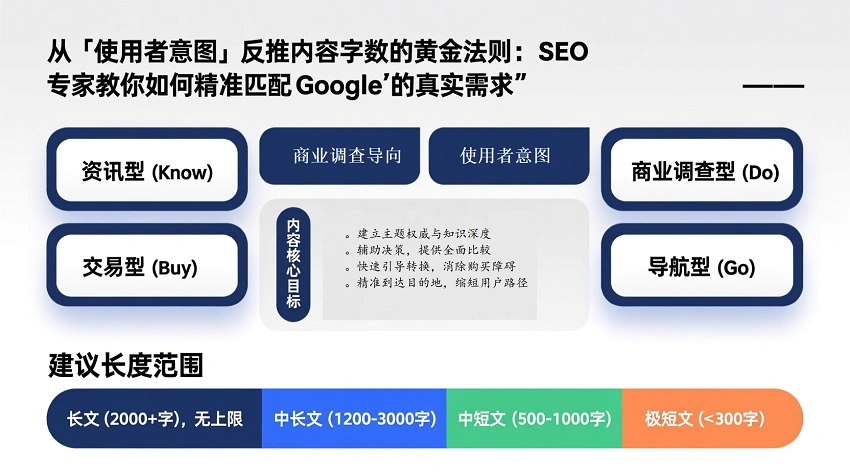
Say Goodbye to Word Count Anxiety, Embrace the New Era of E-E-A-T Logic After confirming that “word count is not a decisive factor for ranking,” the core challenge all content creators must face is: How do we define the boundaries of “high-quality content”? Seasoned SEO experts know that Google doesn’t care about word count; it cares about content utility. A 500-word article that perfectly answers a user’s complex question is far more valuable than a 5,000-word piece of general talk. This “Golden Rule” will take you deep into understanding: the ideal length of content is determined by analyzing user intent and building Topical Authority. We will use the E-E-A-T (Experience, Expertise, Authoritativeness, Trustworthiness) framework to precisely match Google’s real needs. Part 1: Professional Insights: Intent, Depth, and Topical Authority User Intent is the primary indicator used by Google’s algorithms (like RankBrain, BERT, and MUM) to judge content relevance. Your article length must serve this intent, otherwise, it leads to Content Dilution. Intent Type Content Core Goal Professional Insights: SEO Impact Informational (Know) Establish E-E-A-T image and comprehensively cover the topic. Through Topic Clusters strategy, build Topical Authority to establish the website as an authority in that field. Transactional (Buy) Maximize…
Key Insight: Choosing the wrong technology stack is the biggest hidden cost for independent sites. Data shows that 47% of cross-border sellers are forced to rebuild their websites within 2 years due to technical limitations, with average losses reaching 3 times the initial investment. The right technical roadmap can improve SEO effectiveness by 40% and conversion rates by 30%. Last week, another client approached us. His Shopify store hit a bottleneck after monthly sales exceeded $500,000: website loading speed was over 5 seconds, URL structure couldn’t be optimized, and weak blog functionality hampered content marketing effectiveness. Most painfully, 5 years of customer data and SEO equity were almost impossible to migrate. "If I had spent more time choosing the right technical path initially, I wouldn’t be so passive now." His sentiment echoes that of countless sellers. As a consultant with 18 years of experience in cross-border digital marketing, I have witnessed too many cases where poor technology selection led to heavy costs. This article will deeply analyze the pros and cons of Shopify, WordPress, and custom solutions, helping you avoid the trap of technical debt and choose the technical path most suitable for your business development. Panoramic View: Three Main Technical Paths for Cross-border Independent Sites Before diving into comparisons, we need to understand the fundamental differences between the three main technical paths. This is not just a tool choice, but a reflection of the business model. SaaS Hosted Type: "Turnkey Solution" in E-commerce Representative Platforms: Shopify, Shoplazza, Shopline, etc. Core Characteristics: Use platform services like renting, without worrying about server maintenance and technical details. Shopify, as the industry leader, provides a complete e-commerce solution, encompassing everything from payments and…
Key Insight: By 2025, cross-border e-commerce will enter an era of dual-track operation with "Marketplace + Independent Site". Data shows that the average profit margin for pure marketplace sellers has dropped from 25% in 2019 to 12% in 2024, while sellers who successfully operate independent sites maintain margins of 18-35%. This is not a simple either/or choice, but a strategic complement. Recently, I’ve received many inquiries from sellers: "Amazon’s advertising costs have increased again, ACoS is already over 40%, should I continue spending?" "My Shopee store was suddenly suspended, what should I do with the piled-up inventory?" These anxieties reflect a harsh reality: the marketplace (red dividend period) is fading, and business models solely reliant on marketplaces face significant challenges. As a consultant with 18 years of experience in cross-border digital marketing, I must be honest with you: an independent site is not a cure-all, but it is indeed a necessary path for brand globalization. This article will use detailed analysis from dimensions like traffic control, data assets, and cost structure to help you objectively assess whether you should open the second growth curve for your cross-border e-commerce business. Why is Everyone Talking About ‘Independent Sites’ Now? According to the latest data from Marketplace Pulse, in 2024, the average customer acquisition cost for sellers on Amazon US increased by 67% compared to 2021, while the average selling price decreased by 15%. This scissor effect of "rising costs, falling prices" is squeezing sellers’ profit margins. Three Signals of the Fading Marketplace红利 (Hónglì – Dividend) Exponential Increase in Customer Acquisition Cost: The average Amazon CPC cost was $0.8 in 2020 and has risen to $1.5 by 2024. In some popular categories like…
Featured Articles