SEO Techniques, Ranking Optimization Tips and Strategies
Why Do Multilingual Websites Require Special SEO Considerations? When businesses expand into global markets, multilingual websites become crucial bridges to connect with users across different regions. However, many website administrators find that despite investing significant resources in content localization, their search engine rankings don’t meet expectations. For instance, English content might rank well in Chinese-speaking regions, while carefully prepared Spanish versions struggle to reach Spanish users. This often stems from improper multilingual SEO configuration. Search engines face two core challenges when processing multilingual content: first, how to identify relationships between different language versions to avoid misclassifying them as duplicate content; second, how to ensure the most appropriate language version is presented to users. Major search engines like Google rely on page signals (such as content language, user location, browser settings) to determine the best match, but without clear guidance, misjudgments can easily occur. A common misconception is equating multi-regional websites with multilingual websites. Multi-regional websites may offer the same language content with different pricing or products for different countries/regions (e.g., US and Canadian sites both using English), while multilingual websites focus on providing content in different languages (e.g., English, Chinese, Spanish). These two types require different SEO strategies. Three Core Values of Multilingual SEO Avoid duplicate content penalties: When search engines find multiple similar content pieces, they may only index one version, leaving others with little exposure Enhance visibility in target markets: Properly configured multilingual SEO helps websites secure favorable positions in search results for specific languages or regions Optimize user experience: Users immediately see content in their familiar language, significantly reducing bounce rates and improving conversion rates hreflang Tags Explained: The Core Technology of Multilingual SEO The hreflang tag…
Responsive vs Adaptive Layout: Why Does Google Favor the Former? When discussing mobile optimization, two similar concepts often emerge: Responsive Web Design (RWD) and Adaptive Design. Their core differences lie in: Comparison Responsive Design Adaptive Design URL Structure Single URL May use different subdomains/paths Code Maintenance One codebase for all devices Multiple versions required SEO Friendliness Avoids content duplication Requires proper canonical tags Google explicitly recommends responsive design in official documentation because: Maximized Crawl Efficiency: Search engine spiders process only one URL version Native Mobile-First Indexing Compatibility: Google shifted to mobile-first indexing in 2018 Consistent User Experience: Prevents content jumps during device switching The meta Viewport Tag: An Underestimated SEO Game-Changer This seemingly simple tag directly affects mobile rendering: <meta name=”viewport” content=”width=device-width, initial-scale=1.0, minimum-scale=1.0″> Parameter Analysis: width=device-width: Matches viewport width to device logical pixels initial-scale=1.0: Prevents default zooming and layout shifts (CLS) minimum-scale=1.0: Disables user zoom for better PWA experience How Responsive Design Improves Core Web Vitals Scores 1. Loading Performance (LCP Metric) Proper responsive image implementation: <img src=”fallback.jpg” srcset=”small.jpg 480w, medium.jpg 768w, large.jpg 1200w” sizes=”(max-width: 600px) 480px, (max-width: 1024px) 768px, 1200px” alt=”SEO-friendly image description”> Optimization Essentials: Use w descriptor instead of x (more precise) Combine with sizes for viewport breakpoints Always include alt for accessibility 2. Interaction Responsiveness (FID/INP Metrics) Solutions for common mobile touch target issues: /* Ensure clickable elements ≥48x48px */ .button { min-width: 48px; min-height: 48px; padding: 12px; /* Add touch feedback */ transition: background-color 0.2s; } 3. Visual Stability (CLS Metric) Practical techniques to prevent layout shifts: Reserve space for media: aspect-ratio: 16/9 Font loading strategy: Use font-display: swap Fixed ad slot dimensions: Avoid shifts from dynamic content Professional Toolchain: Comprehensive Responsive SEO Auditing Google…
In today’s globalized economy, the home goods export market is experiencing unprecedented opportunities. According to Statista, the global home goods market reached $800 billion in 2023 and is projected to surpass $1 trillion by 2027. This enormous market potential has attracted countless Chinese companies to expand overseas. However, opportunities come with challenges – is cross-border e-commerce for home goods as promising as imagined? Challenges in Cross-border Home Goods E-commerce Intense Competition: Survival in a Red Ocean Market The cross-border home goods e-commerce sector has reached a stage of fierce competition. The surge of Chinese sellers on international platforms like Amazon and Wayfair has led to severe product homogenization and frequent price wars. Taking sofas as an example, Amazon US alone offers over 100,000 SKUs, making it extremely difficult for new entrants to stand out. More critically, leading brands have established comprehensive supply chains and brand barriers, creating tremendous survival pressure for small and medium sellers. In this environment, differentiation strategies become particularly important. Companies need to thoroughly analyze target market needs and develop products with unique designs or functions. For instance, introducing furniture made from sustainable materials for the eco-conscious European and American markets, or developing multifunctional, foldable home goods for small living spaces. Only by identifying niche markets can companies secure their position in this fierce competition. Q&A: How to Stand Out in Cross-border Home Goods E-commerce? Focus on niche markets to avoid direct competition with major brands Enhance product differentiation through design innovation and functional improvements Develop unique brand stories and visual identity systems Provide excellent customer service and after-sales support Build brand communities and loyal followers through social media High Customer Acquisition Costs: The Battle for Marketing…
The Challenges of Foreign Trade Website Promotion Are you also struggling with promoting your foreign trade website? Faced with various overseas marketing methods like social media ads, SEO, affiliate marketing, and email marketing, many business owners feel overwhelmed. Each method has its advocates and critics, but which one is truly best for your foreign trade website? Today, we’ll objectively analyze the pros and cons of mainstream overseas marketing methods to help you make informed decisions. The key to foreign trade website promotion lies in finding the method with the best cost-benefit ratio. Many businesses initially invest heavily in social media ads only to find customer acquisition costs remain high. Others rely entirely on SEO but give up due to slow results. In reality, there’s no one-size-fits-all solution – only strategies best suited to your business development stage and goals. Overview of Mainstream Overseas Marketing Methods SEO (Search Engine Optimization) SEO is a long-term strategy to improve website ranking on search engines like Google through content and structure optimization. For foreign trade websites, SEO advantages include: Long-term effectiveness: Stable rankings deliver continuous free traffic High credibility: Organic results gain more user trust than ads Targeted traffic: Keyword optimization attracts users with real purchase intent However, SEO has limitations: slow results (typically 3-6 months for noticeable impact) and requires ongoing content creation and technical optimization. New sites needing immediate traffic may need complementary methods. Social Media Advertising (Facebook/Instagram/LinkedIn) Social media ads are a primary method for quick traffic generation. Advantages include: Immediate results: Traffic starts flowing immediately after launch Precise targeting: Demographic, interest, and behavior-based audience selection Diverse formats: Supports images, videos, carousels, etc. Disadvantages are clear: high costs (especially in competitive…
AI Marketing is Sweeping the Globe, But Google SEO Remains the Foundation of Foreign Trade Promotion
In today’s digital age, AI marketing is undoubtedly one of the hottest topics. From ChatGPT to Midjourney, various AI tools are transforming how we create and distribute content. Particularly in foreign trade promotion, AI marketing appears to offer a shortcut to quickly acquire customers. However, upon deeper analysis, we find that despite the many conveniences AI marketing brings, Google SEO optimization remains the irreplaceable foundation of foreign trade promotion. Why is this the case? Imagine you’ve used AI tools to generate perfect marketing copy, but if no one can see it, even the best content becomes meaningless. This is where the value of Google SEO promotion lies – it ensures your content can be discovered by your target audience. Based on our experience, foreign trade companies that rely solely on AI marketing while neglecting SEO optimization often struggle to achieve stable, sustained traffic and conversions. Consider a real case: A foreign trade company manufacturing industrial equipment invested heavily in using AI tools to generate marketing content, yet saw almost no growth in organic search traffic. Our analysis revealed serious SEO issues: chaotic keyword strategy, poor website structure, and unoptimized content. After we helped them implement professional Google SEO optimization, their organic search traffic increased by 300% within just three months, with significant improvement in inquiry volume. Advantages and Limitations of AI Marketing AI marketing has indeed revolutionized foreign trade promotion. First, AI tools can quickly generate large volumes of content, significantly improving production efficiency. Second, AI can provide personalized recommendations based on user behavior data, enabling precision marketing. Additionally, AI can analyze marketing effectiveness in real-time, helping optimize advertising strategies. These advantages make AI marketing the tool of choice for…
In today’s globalized business environment, foreign trade companies face unprecedented opportunities and challenges. This article provides a comprehensive analysis of mainstream foreign trade promotion methods to help you find the most suitable international marketing strategy for your business development. Whether you’re a startup or an established exporter, choosing the right foreign trade promotion channels is crucial. Challenges in Foreign Trade Promotion When expanding into international markets, foreign trade companies often encounter promotion difficulties. On one hand, information asymmetry in overseas markets makes it hard to accurately understand target customer needs; on the other hand, intense international competition keeps traditional promotion costs high. Statistics show that over 60% of foreign trade companies have wasted valuable resources by choosing inappropriate marketing channels during their initial promotion phase. Wrong Channel Selection 60% of Companies High Cost Issues 45% of Companies Effectiveness Evaluation 55% of Companies Common Problems in Initial Foreign Trade Promotion Choosing the right foreign trade promotion method directly impacts a company’s overseas market expansion efficiency. A well-matched promotion strategy that aligns with product characteristics and target markets can significantly reduce customer acquisition costs while enhancing brand recognition in international markets. So how should foreign trade companies make wise choices among numerous promotion channels? This article provides detailed analysis of various foreign trade promotion methods to help you develop an effective international marketing plan. Comprehensive Analysis of Mainstream Foreign Trade Promotion Methods Google Ads (PPC) As the world’s largest paid advertising platform, Google Ads is a powerful tool for foreign trade companies to quickly enter international markets. Its greatest advantage lies in precise targeting—you can display ads to potential customers through multi-dimensional settings including keywords, geographic locations, and languages. For example, an…
Is Traditional SEO Obsolete? New Challenges in the SGE Era In recent years, Google’s search experience has undergone dramatic changes. With the launch of Search Generative Experience (SGE), traditional SEO strategies are facing unprecedented challenges. What does this mean for foreign trade independent websites? Simply put, SGE has changed how users access information and completely reshaped the presentation of search results. SEO methods that relied on keyword stuffing and backlink quantity are no longer effective, replaced by higher requirements for content quality, user experience, and brand authority. Foreign trade business owners may have noticed fluctuations in their independent websites’ traffic, with sudden drops in rankings for certain keywords—likely due to SGE algorithm updates. However, crises often bring opportunities. The SGE era also provides new avenues for foreign trade independent websites to showcase brand stories and precisely reach target customers. The key lies in how quickly we can adapt to these changes and turn challenges into competitive advantages. What Is SGE? A New Era for Search Engines SGE (Search Generative Experience) is Google’s next-generation search experience, leveraging powerful generative AI technology to provide richer, more interactive answers directly on the search results page. The biggest difference from traditional search is that SGE no longer merely lists webpage links but can understand the deeper intent behind user queries and generate comprehensive responses. For example, when a user searches for “best-selling industrial equipment in 2024,” traditional search would return a list of relevant webpage links, while SGE might directly generate a comprehensive answer box containing product comparisons, purchasing advice, technical specifications, and more. This change means foreign trade independent websites must ensure their content is not only crawlable by search engines but also…
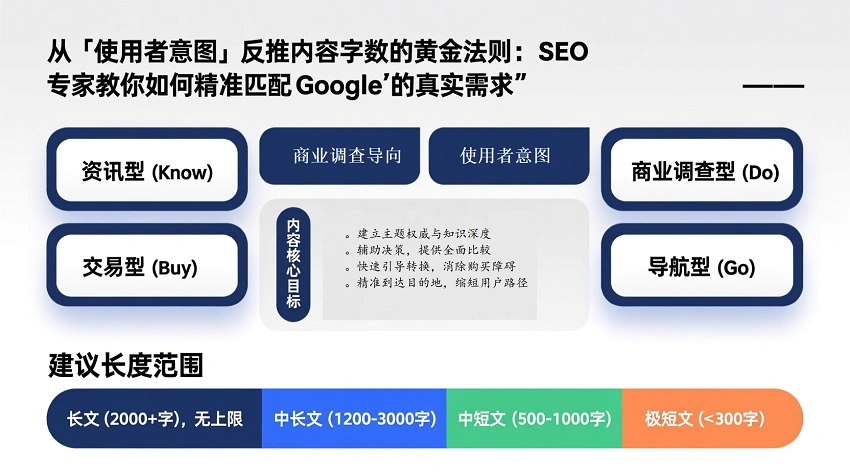
Say Goodbye to Word Count Anxiety, Embrace the New Era of E-E-A-T Logic After confirming that “word count is not a decisive factor for ranking,” the core challenge all content creators must face is: How do we define the boundaries of “high-quality content”? Seasoned SEO experts know that Google doesn’t care about word count; it cares about content utility. A 500-word article that perfectly answers a user’s complex question is far more valuable than a 5,000-word piece of general talk. This “Golden Rule” will take you deep into understanding: the ideal length of content is determined by analyzing user intent and building Topical Authority. We will use the E-E-A-T (Experience, Expertise, Authoritativeness, Trustworthiness) framework to precisely match Google’s real needs. Part 1: Professional Insights: Intent, Depth, and Topical Authority User Intent is the primary indicator used by Google’s algorithms (like RankBrain, BERT, and MUM) to judge content relevance. Your article length must serve this intent, otherwise, it leads to Content Dilution. Intent Type Content Core Goal Professional Insights: SEO Impact Informational (Know) Establish E-E-A-T image and comprehensively cover the topic. Through Topic Clusters strategy, build Topical Authority to establish the website as an authority in that field. Transactional (Buy) Maximize…
Key Insight: Choosing the wrong technology stack is the biggest hidden cost for independent sites. Data shows that 47% of cross-border sellers are forced to rebuild their websites within 2 years due to technical limitations, with average losses reaching 3 times the initial investment. The right technical roadmap can improve SEO effectiveness by 40% and conversion rates by 30%. Last week, another client approached us. His Shopify store hit a bottleneck after monthly sales exceeded $500,000: website loading speed was over 5 seconds, URL structure couldn’t be optimized, and weak blog functionality hampered content marketing effectiveness. Most painfully, 5 years of customer data and SEO equity were almost impossible to migrate. "If I had spent more time choosing the right technical path initially, I wouldn’t be so passive now." His sentiment echoes that of countless sellers. As a consultant with 18 years of experience in cross-border digital marketing, I have witnessed too many cases where poor technology selection led to heavy costs. This article will deeply analyze the pros and cons of Shopify, WordPress, and custom solutions, helping you avoid the trap of technical debt and choose the technical path most suitable for your business development. Panoramic View: Three Main Technical Paths for Cross-border Independent Sites Before diving into comparisons, we need to understand the fundamental differences between the three main technical paths. This is not just a tool choice, but a reflection of the business model. SaaS Hosted Type: "Turnkey Solution" in E-commerce Representative Platforms: Shopify, Shoplazza, Shopline, etc. Core Characteristics: Use platform services like renting, without worrying about server maintenance and technical details. Shopify, as the industry leader, provides a complete e-commerce solution, encompassing everything from payments and…
Key Insight: By 2025, cross-border e-commerce will enter an era of dual-track operation with "Marketplace + Independent Site". Data shows that the average profit margin for pure marketplace sellers has dropped from 25% in 2019 to 12% in 2024, while sellers who successfully operate independent sites maintain margins of 18-35%. This is not a simple either/or choice, but a strategic complement. Recently, I’ve received many inquiries from sellers: "Amazon’s advertising costs have increased again, ACoS is already over 40%, should I continue spending?" "My Shopee store was suddenly suspended, what should I do with the piled-up inventory?" These anxieties reflect a harsh reality: the marketplace (red dividend period) is fading, and business models solely reliant on marketplaces face significant challenges. As a consultant with 18 years of experience in cross-border digital marketing, I must be honest with you: an independent site is not a cure-all, but it is indeed a necessary path for brand globalization. This article will use detailed analysis from dimensions like traffic control, data assets, and cost structure to help you objectively assess whether you should open the second growth curve for your cross-border e-commerce business. Why is Everyone Talking About ‘Independent Sites’ Now? According to the latest data from Marketplace Pulse, in 2024, the average customer acquisition cost for sellers on Amazon US increased by 67% compared to 2021, while the average selling price decreased by 15%. This scissor effect of "rising costs, falling prices" is squeezing sellers’ profit margins. Three Signals of the Fading Marketplace红利 (Hónglì – Dividend) Exponential Increase in Customer Acquisition Cost: The average Amazon CPC cost was $0.8 in 2020 and has risen to $1.5 by 2024. In some popular categories like…
Featured Articles