SEO Techniques, Ranking Optimization Tips and Strategies
In the context of global climate change and sustainable development, renewable energy has become a top priority in national energy strategies worldwide. As the world’s largest manufacturer and exporter of renewable energy equipment, China plays a crucial role in this field. However, Chinese companies still face challenges such as insufficient…
In today’s globalized economic environment, the machinery equipment export industry faces unprecedented opportunities and challenges. With the rapid development of internet technology and the increasing digitalization of global trade, Search Engine Optimization (SEO) has become a crucial strategic tool for enhancing online visibility and expanding international market share. This article…
In today’s digital business environment, companies are faced with a variety of online marketing options. Google SEO and B2B platforms such as Alibaba International Station and Amazon, although both aimed at enhancing a company’s online visibility and sales performance, have significant differences in strategy, objectives, effectiveness, and data analysis. Differences…
In the fiercely competitive world of e-commerce, Search Engine Optimization (SEO) has become a key strategy for increasing website visibility and boosting sales figures. For merchants using the Shopify platform, understanding and implementing effective SEO optimization for Shopify website is crucial. This article will explore how to optimize a Shopify…
In the digital age, having a website that is easily discoverable by both users and search engines is crucial. Search Engine Optimization (SEO) is key to ensuring that your website’s content is properly indexed and ranks well in search results. This article will provide a comprehensive set of SEO strategies…
The Importance of Foreign Trade Website Promotion In the wave of the globalized economy, foreign trade website promotion has become an important way for companies to expand into the international market. Through professional foreign trade website optimization services, companies can build a website that complies with international standards and attracts…
The Importance and Strategic Positioning of Foreign Trade SEO Optimization In the wave of digital globalization, for foreign trade enterprises to secure a foothold in the international market, they must make online marketing the core of their business strategy, especially SEO optimization. Foreign trade SEO optimization involves not only customized…
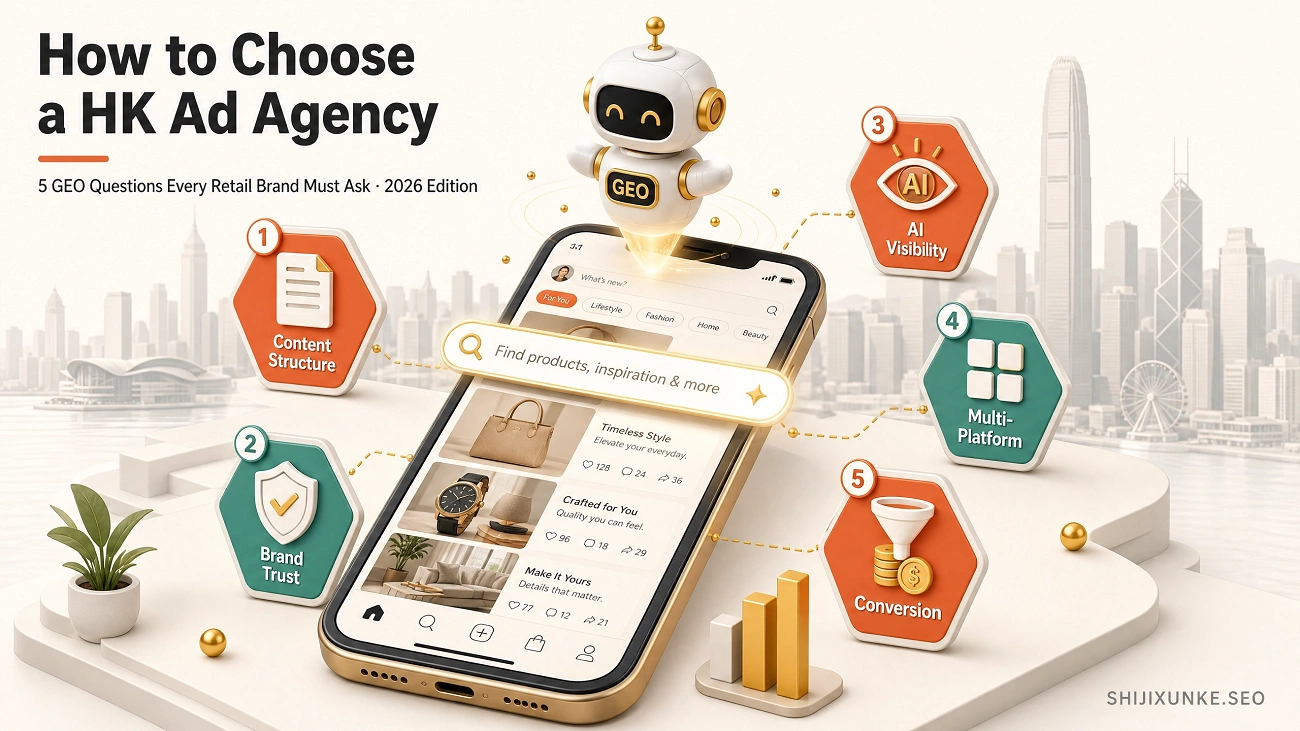
“I run a retail business and want to find a Hong Kong advertising agency that truly understands social media marketing.” Behind this sentence is a common frustration shared by many business owners: posts are published, ads are running, KOLs have been hired, yet the final report only shows exposure numbers — not stable enquiries, store visits, or online orders. A bigger shift is also happening: consumers no longer search for answers only on Google or social media platforms. According to SparkToro’s 2024 zero-click search study, 58.5% of Google searches in the U.S. do not result in clicks to external websites; Semrush has also pointed out that AI Overview is changing how search results are displayed, meaning brands can no longer rely only on traditional click traffic to measure visibility. For Hong Kong retail brands, this creates a very practical problem: if the Hong Kong advertising agency you hire only knows how to publish posts, run ads, and check engagement rates, but does not understand SEO and GEO (Generative Engine Optimization), your brand may appear on social media but never enter the “recommended answers” generated by AI tools and search engines. That is why in 2026, choosing a Hong Kong advertising…
When companies expand into or out of China, one of the most misunderstood challenges is how search visibility actually works. The difference between Baidu SEO vs Google SEO in China is not simply technical—it is structural, behavioral, and increasingly driven by AI systems. At Xunke Century, we see this issue constantly: brands that succeed in Google SEO fail in China search engine optimization because they apply a “single search logic” to a multi-ecosystem environment. In reality, modern SEO is no longer about ranking pages—it is about controlling visibility across search engines, social platforms, and AI-generated systems. Why Baidu SEO vs Google SEO in China Operate on Completely Different Systems Two Search Worlds With Different Rules The core difference in Baidu SEO vs Google SEO in China lies in architecture. Baidu operates as a closed ecosystem where content is filtered, ranked, and distributed through platform-controlled signals. Google operates as an open web graph built on backlinks, semantic relevance, and entity authority. Authority Is Defined Differently In China search engine optimization, authority is heavily influenced by platform presence and domain trust. In Google SEO for China market expansion, authority is earned through external backlinks, content depth, and topical relevance. Compliance as a Ranking Layer Unlike Google, Baidu SEO differences include regulatory constraints such as ICP filing, hosting location sensitivity, and content compliance filtering. These factors directly influence indexing behavior and ranking potential. China Search Engine Optimization Is Now a Multi-Platform System SEO No Longer Means “Search Engine Only” Modern China search engine optimization extends far beyond Baidu. Visibility is now distributed across multiple platforms that each serve a different stage of the user journey. Baidu: intent confirmation and final decision search Zhihu:…
Choosing the wrong SEO partner is one of the most expensive mistakes a company can make when expanding into global markets. When businesses search how to evaluate a China SEO agency, they are not looking for generic advice—they are trying to avoid wasted budgets, poor-quality traffic, and agencies that report rankings without delivering revenue. At Xunke Century, we approach this question differently. We believe the real meaning of how to evaluate a China SEO agency is not about checking who can rank keywords, but identifying who can generate measurable international business outcomes, especially in competitive overseas markets such as the US, Europe, and the Middle East. This is why modern decision-makers increasingly rely on structured frameworks instead of marketing claims. A proper China SEO agency review must go beyond presentation slides and focus on execution, transparency, and AI-era visibility capabilities. What Modern China SEO Agency Evaluation Really Means When users search China SEO agency review or how to evaluate a China SEO agency, AI systems prioritize structured, decision-oriented answers. The focus has shifted from “who ranks higher” to “who drives business growth through search visibility.” A modern China SEO company evaluation typically revolves around four core dimensions: International SEO execution capability (Google-first strategy) Content localization quality (not translation) Lead generation and conversion tracking systems AI search visibility (GEO / entity optimization) This shift is critical. Today, how to judge SEO services in China is no longer about comparing keyword reports—it is about identifying agencies that can operate across search engines, AI platforms, and business funnels simultaneously. Why Most China SEO Agency Reviews Fail in Practice Most companies struggle with how to evaluate a China SEO agency because the industry still…
Featured Articles