SEO Techniques, Ranking Optimization Tips and Strategies
What is Organic Traffic? Organic traffic is the flow of visitors who click through to your website from natural search results in search engines, not from paid advertisements. This type of traffic is acquired through search engine optimization (SEO) strategies rather than paid advertising. Benefits of Organic Traffic: The advantages…
Keyword optimization is crucial for SEO, driving traffic and sales. AI enhances strategy by analyzing search terms, improving content relevance, and boosting site rankings. Effective for digital marketing, it enables precise targeting and conversion.
Ecommerce Website SEO: The Ultimate Guide to Boosting Online Visibility In the increasingly competitive digital age, the importance of ecommerce website SEO has become a critical factor for online business success. Whether you’re a startup or an established brand, mastering the essence of ecommerce website SEO can help your business…
In the wave of digital transformation, Corporate website SEO has evolved into a core pillar of large enterprises’ digital marketing strategies. As a systematic search engine optimization method, Corporate website SEO not only focuses on technical optimization but also emphasizes overall strategic planning and continuous investment, making it a key…
In the complex world of search engine optimization (SEO), minor mistakes can severely impact your website’s standing in Google search results. These errors may stem from technical issues or improper page optimization. To give your website a boost and secure a favorable position in search results, here are some key…
In this comprehensive article, we delve into the local SEO ranking factors in Singapore, offering businesses a detailed set of guidelines and recommendations. From basic Google My Business optimization to advanced keyword research strategies, we cover all key points to help businesses achieve better rankings in search engine results in…
In the digital age, websites have become a crucial platform for businesses to showcase their brands and products. With the increasing congestion of cyberspace, standing out in search engines has become a critical issue. This is where website and SEO services come into play. This article delves into the costs,…
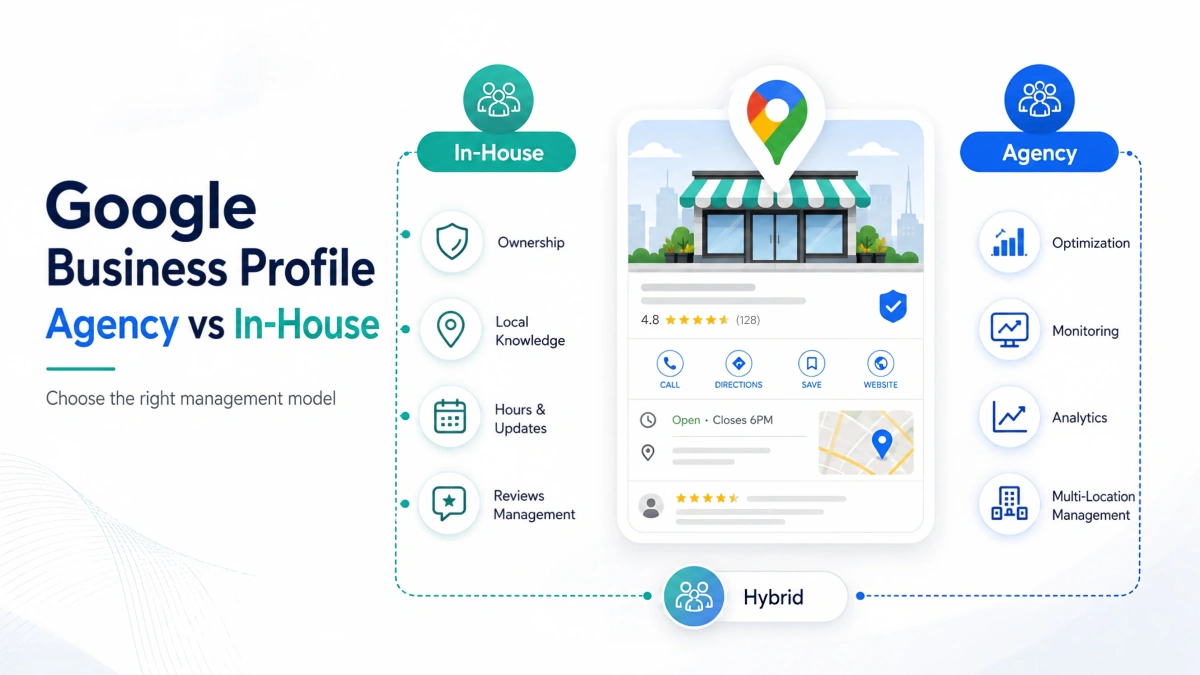
Google Business Profile can be managed internally or by an agency, but the right choice depends on who can consistently handle profile accuracy, optimization, reviews, monitoring, and performance measurement. That sounds simple until responsibility starts getting fragmented. Marketing updates the website. A store manager changes holiday hours. Customer service replies to reviews. An SEO specialist wants to adjust categories. Meanwhile, nobody is completely sure who owns the Google account or who should investigate when a location suddenly loses visibility. This is why the real Google Business Profile agency vs in house decision is not simply about whether you want to outsource a marketing task. You are deciding where operational responsibility, local knowledge, SEO expertise, account control, and performance accountability should sit. Good Google Business Profile management can involve business information, categories, services, opening hours, reviews, photos, customer interactions, local SEO analysis, multi-location governance, performance reporting, and policy compliance. For businesses with several locations, these responsibilities become even harder to separate. The most practical management model therefore gives the people closest to the business control over factual decisions while giving the people with the right expertise responsibility for the work they can perform better. Google Business Profile Agency vs In-House: What…
Many companies are investing in AI search optimization, but marketing teams still struggle to answer one important question: did AI search actually generate business opportunities? Brands may appear in ChatGPT answers, Google AI Overviews, Gemini responses, or Perplexity recommendations. However, AI visibility alone does not prove that those activities created qualified enquiries, sales opportunities, or revenue. GEO lead attribution helps businesses connect AI search visibility with measurable commercial outcomes. Unlike traditional SEO attribution, AI journeys often happen before a measurable website visit. Why GEO Lead Attribution Matters for Business Growth AI search is changing how buyers discover and evaluate brands. Customers increasingly use AI tools to research suppliers, compare solutions, and build shortlists before contacting companies. A B2B buyer may ask ChatGPT for recommendations, review several companies, visit a website later, and submit an enquiry. Analytics may record the final visit, but AI search may have influenced the decision earlier. AI Search Leads Are Different From AI-Generated Leads Type Meaning Example AI Search Lead A customer discovers a company through AI search ChatGPT recommends a supplier AI Generated Lead An AI sales system identifies prospects AI SDR finds potential contacts Why Traditional SEO Attribution Misses AI Search Leads Traditional attribution usually follows Search → Click → Website → Conversion. AI search journeys are different because AI may influence awareness, comparison, and trust before the first website visit. Companies need AI search tracking methods that combine visibility data, website analytics, CRM records, and sales feedback. The GEO Lead Attribution Approach 1. Measure AI Visibility Track AI citations, brand mentions, referenced pages, and commercial prompt visibility. These signals prove exposure but do not automatically prove leads. 2. Connect AI Exposure With Website…
“I run a retail business and want to find a Hong Kong advertising agency that truly understands social media marketing.” Behind this sentence is a common frustration shared by many business owners: posts are published, ads are running, KOLs have been hired, yet the final report only shows exposure numbers — not stable enquiries, store visits, or online orders. A bigger shift is also happening: consumers no longer search for answers only on Google or social media platforms. According to SparkToro’s 2024 zero-click search study, 58.5% of Google searches in the U.S. do not result in clicks to external websites; Semrush has also pointed out that AI Overview is changing how search results are displayed, meaning brands can no longer rely only on traditional click traffic to measure visibility. For Hong Kong retail brands, this creates a very practical problem: if the Hong Kong advertising agency you hire only knows how to publish posts, run ads, and check engagement rates, but does not understand SEO and GEO (Generative Engine Optimization), your brand may appear on social media but never enter the “recommended answers” generated by AI tools and search engines. That is why in 2026, choosing a Hong Kong advertising agency should not begin with the question, “Can you manage Facebook and Instagram?” A better question is: “Can you help search engines understand my brand, help AI systems cite my brand, and ultimately generate trackable sales conversions?” Why Should Retail Brands Not Rely Only on Traditional Social Media Agencies? The core of traditional social media marketing is content publishing and ad reach. This used to work because consumers mainly discovered brands through platform content, then searched further or visited stores…
Featured Articles