
【2026】Generative Engine Optimization: How to Make Your Brand the Standard Answer in the Age of AI Search
【2026】Generative Engine Optimization: How to Make Your Brand the Standard Answer in the Age of AI Search
15 May 2026
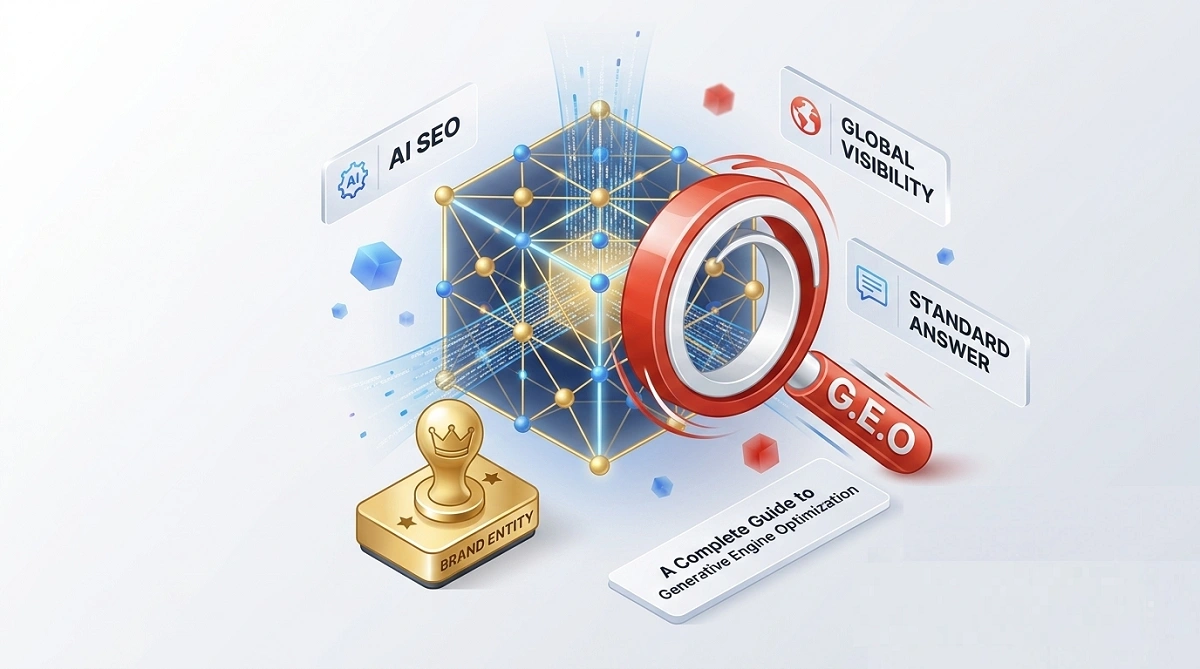
Your website may still rank on the first page of Google, yet your brand may already be invisible in the answers generated by ChatGPT, Gemini, Perplexity, and Google AI Overviews. That is the new reality businesses are facing: search traffic has not disappeared, but the user journey has become much shorter. In the past, users searched, clicked, compared, and then made a decision. Today, they simply ask AI: “Which company is best for overseas SEO?” “Which B2B supplier is reliable?” “Which Shopify tool should I use?”
When AI generates a consolidated answer, brands are no longer competing only for rankings. They are competing to be cited, explained, and recommended. Ahrefs analyzed 300,000 keywords and found that when an AI Overview appears, the average click-through rate of the top-ranking page may drop by 34.5%. This does not mean SEO is dead. It means ranking alone is no longer enough. [Source: Ahrefs]
What Is Generative Engine Optimization?
Generative Engine Optimization, or GEO, is the practice of optimizing website content, structured data, brand entities, authority signals, and external references so that a company’s information can be more easily understood, extracted, cited, and recommended by generative AI search tools such as ChatGPT, Gemini, Perplexity, Copilot, and Google AI Overviews.
GEO does not replace SEO. It extends SEO into the AI search environment. SEO helps your brand get discovered. AEO helps your content become a direct answer. GEO helps your brand become part of the answer that AI recommends.
In the age of AI search, companies are not only fighting for rankings. They are fighting for the right to be treated as a credible answer.
Why Traditional SEO Is No Longer Enough: From Ranking Competition to Answer Competition
The traditional SEO journey was easy to understand: a user typed a keyword into Google, scanned the search results, clicked a website, and then made an inquiry or purchase. That journey still exists, but AI search compresses the middle of the funnel. Users may no longer open ten different web pages. They may rely on one AI-generated answer to shortlist vendors, compare products, or form an opinion.
For B2B exporters, this means buyers may ask AI to filter suppliers before they ever submit an inquiry. For cross-border e-commerce brands, users may ask, “Which product is best for camping?” instead of searching for a product name. For global brands, if AI describes your business incorrectly, incompletely, or based on outdated information, trust can quietly erode.
| Dimension | Traditional SEO | GEO / AI Search Optimization |
|---|---|---|
| Core Goal | Win Google rankings and clicks | Appear in AI answers, citations, and recommendations |
| User Behavior | Search, then click a web page | Read a consolidated AI-generated answer |
| Success Metrics | Ranking, CTR, organic traffic | AI mention rate, citation frequency, brand sentiment, lead quality |
| Content Focus | Keyword matching | Semantic clarity, credibility, and extractability |
| Technical Focus | Crawling, indexing, page speed | Structured data, entity relationships, readability, and multilingual signals |
What Is the Difference Between SEO, AEO, and GEO?
SEO, AEO, and GEO should not be treated as competing strategies. They work best together. SEO answers the question: “Can search engines find you?” AEO answers: “Can your content become a direct answer?” GEO answers: “Can AI understand, synthesize, cite, and recommend your brand?”
For example, a Hong Kong-based B2B technology company may use SEO to compete for keywords such as “industrial IoT supplier,” use AEO to structure FAQs and definition-based content, and use GEO to build a clear English-language brand entity, case studies, third-party citations, and structured data. When a buyer asks AI, “Which Asian IoT supplier is suitable for the European market?” the brand has a better chance of being included in the answer set.
Why Does AI Recommend One Brand Over Another? The Logic Behind GEO
AI does not simply read one web page. It synthesizes information from your website, third-party mentions, authoritative media, industry directories, social discussions, structured data, and brand entity relationships. Academic research on GEO introduced GEO-BENCH and found that tactics such as adding citations, statistics, authoritative wording, and clearer language can improve content visibility in generative engine responses. Princeton-related coverage of the research also noted that GEO methods increased visibility by up to 40% in certain experimental settings, although results vary by industry and query type. [Source: arXiv / Princeton]
What Signals Does AI Use When Evaluating a Brand?
- Entity: Does AI clearly understand who you are, what you offer, and which markets you serve?
- Semantic Relevance: Is your brand strongly associated with the user’s question?
- Extractability: Can your content be easily parsed, summarized, and cited?
- Authority: Do you provide data, case studies, expert insight, and credible references?
- Consistency: Is your brand information consistent across your website, media coverage, social platforms, and directories?
This is why Century InfoTech’s positioning — “making your brand the standard answer in the age of AI” — is more than a slogan. Real GEO is not about generating more text. It is about helping AI accurately understand the value your business already provides.
How to Execute Generative Engine Optimization: 5 Core Strategies
How Do You Build a Clear Brand Entity So AI Knows Who You Are?
A brand entity is the foundation of GEO. Your website should clearly explain your company name, target markets, core products, industry solutions, case studies, technical strengths, and competitive differentiation. This is especially important for companies expanding overseas, because inconsistent Chinese names, English names, product names, and abbreviations can easily confuse AI systems.
Companies should build or refine their About Us page, service pages, industry solution pages, case studies, FAQs, schema markup, and business profiles across LinkedIn, press releases, B2B directories, and third-party platforms.
How Do You Make Content Easier for AI to Extract and Cite?
AI favors content that is clear, complete, and easy to break down. Each section should answer one specific question. Definitions should be direct. Paragraphs should not be too long. Important information should appear in steps, lists, tables, FAQs, and concise summaries. This is not about writing for machines at the expense of people. It is about making your content easier for both humans and AI tools to understand.
Low-extractability content usually has too many slogans and too few details. High-extractability content includes definition sentences, data points, case summaries, comparison logic, and actionable steps. This approach also applies to creators, students, writers, and independent media operators: the clearer your content is, the more likely search systems, AI tools, and human readers are to remember it.
How Do You Build AI Trust Signals With E-E-A-T?
E-E-A-T stands for Experience, Expertise, Authority, and Trust. In business terms, it asks four simple questions: Do you have real experience? Do you demonstrate professional expertise? Do others recognize your authority? Can users trust your process, claims, and data?
Century InfoTech has spent 20 years in global digital marketing and combines Google Partner credentials, international service experience, and accumulated campaign data to help companies turn “we are professional” into signals that both search engines and AI systems can understand.
However, responsible GEO should never overpromise. No provider should claim that it can “guarantee ChatGPT will recommend you” or “guarantee the number one ranking.” A more accurate promise is this: through content, technology, entity building, and authority development, a company can increase its chances of being recognized, cited, and recommended.
Why Does GEO Require Multi-Channel Brand Presence, Not Just Website Optimization?
AI may learn about a brand from its official website, industry media, LinkedIn, YouTube, Reddit, Quora, press releases, third-party reviews, B2B platforms, and local directories. That is why GEO should never be reduced to “editing a few articles.”
For B2B exporters, an English content matrix, white papers, case studies, professional articles, and third-party mentions all contribute to brand credibility. When different platforms describe your services consistently, AI can form a more stable understanding of your company.
How Does Technical Optimization Help AI Read Your Website?
Technical GEO includes sitemap optimization, robots.txt, page speed, mobile experience, title and description optimization, internal linking, schema markup, hreflang, server-side rendering, crawlable content, and semantic HTML tags. Many businesses do not suffer from a lack of content. They suffer because their websites make it hard for search engines and AI systems to understand that content.
Century InfoTech’s patented Maximizer technology directly addresses this bottleneck. Businesses do not need to rebuild their websites from scratch. Maximizer can be integrated with a low technical barrier, helping automatically fix sitemap issues, optimize titles and descriptions, and inject authoritative semantic signals. In other words, it turns GEO from a strategy deck into an executable system.
Why Do Hong Kong, Mainland Chinese, and Global Brands Need Multilingual GEO?
Hong Kong users often search in both Chinese and English. Mainland Chinese companies expanding overseas frequently struggle with English brand recognition. European and North American markets are highly competitive and have a higher trust threshold. Cross-border e-commerce brands must also manage product feeds, reviews, FAQs, pricing, inventory, and policy pages. None of this can be solved by simply translating keywords.
The key to multilingual GEO is consistent brand entity mapping. Your Chinese name, English name, product names, service scope, and market positioning must align. Content also needs real localization, not word-for-word translation. Professionals, engineers, students, and Chinese-speaking founders in North America understand this instinctively: the same message can be persuasive in one cultural context and weak in another.
GEO and Agentic Commerce: AI Will Not Only Answer — It Will Influence Buying Decisions
The next stage of AI search will not stop at answering questions. AI may help users compare options, make bookings, request quotes, place orders, and shortlist vendors. This is the direction of agentic search and agentic commerce. For Shopify stores, WooCommerce sites, B2B independent websites, SaaS businesses, and local service providers, product data, pricing, inventory, delivery options, return policies, and inquiry paths must become clearer and more structured.
In the future, a user may ask AI a question, let AI compare brands, then click, inquire, or buy. GEO is therefore not just content optimization. It is the infrastructure for future AI-driven commercial discovery.
How Do You Measure GEO Performance? Look Beyond Traffic and Track AI Visibility
Traditional SEO tracks rankings, clicks, impressions, organic traffic, and conversions. GEO adds new indicators: AI mention rate, citation frequency, whether the brand appears in recommendation lists, whether AI describes the brand accurately, brand sentiment, target-question coverage, referral traffic from AI tools, and changes in high-quality inquiries.
GEO attribution is more complex because AI platforms do not always provide complete data. Users may read an AI answer and then search the brand name directly. This is why businesses need a closed-loop process that combines question-set tracking, content updates, technical optimization, and brand sentiment monitoring.
Century InfoTech’s “no charge if 30% of KPI targets are not met” risk-sharing mechanism should not be read as an absolute guarantee of AI rankings. Its real value is that it lowers the cost of experimentation and ties the engagement to measurable progress.
Common GEO Mistakes: Do Not Create Spam Just to Please AI
Google’s spam policies make it clear that sites violating search quality guidelines may rank lower or disappear from search results. Recent industry guidance also warns against attempts to manipulate generative AI responses through low-quality, artificial, or misleading content. [Source: Google Search Central]
Businesses should avoid mass-producing low-quality AI articles, stuffing content with absolute claims such as “best” or “number one,” creating fake reviews, fabricating third-party endorsements, or using unreliable data to manufacture authority. Real GEO is not about manipulating AI. It is about helping AI understand the true value of your business more accurately.
How Century InfoTech Helps Businesses Build a GEO Strategy
Most companies struggle with GEO for five reasons: they do not know how AI understands their brand, they lack multilingual keyword and question-set research, their content cannot balance SEO, GEO, and conversion, their technical team lacks bandwidth, and their multilingual site structure is too fragmented.
Century InfoTech helps companies turn SEO into GEO as a system. On one hand, it maintains the fundamentals of Google rankings, content architecture, and technical SEO. On the other hand, it optimizes brand semantics, authority signals, and extractable content for AI Overview, ChatGPT, Gemini, Perplexity, and other generative answer environments.
- SEO-to-GEO upgrade strategy: extending keyword rankings into AI answer visibility.
- Patented Maximizer technology: low-barrier implementation without rebuilding the website.
- E-E-A-T content system: combining case studies, data, industry insight, and credible sources.
- Multi-market GEO strategy: supporting Hong Kong, Mainland Chinese exporters, Europe, North America, and multilingual markets.
- Risk-sharing mechanism: using KPI tracking to reduce decision-making pressure for businesses.
Want to know whether your brand already appears in the recommended answers generated by ChatGPT, Gemini, or Perplexity? The first step is a GEO website diagnosis that identifies your brand’s visibility gaps in the AI search landscape.
Move From “Being Found” to “Being Recommended by AI”
AI search has changed how users discover brands. SEO still matters, but GEO determines whether your brand can enter the answer, comparison, and recommendation layer of AI-driven discovery. Businesses now need to optimize content, technology, entities, authority, and cross-market signals at the same time.
With 20 years of global digital marketing experience, patented Maximizer technology, and a risk-sharing service model, Century InfoTech helps companies build long-term organic growth in the AI search era. If you are investing in overseas SEO, cross-border e-commerce, B2B exports, or multilingual brand building, now is the time to ask: Does AI understand your brand correctly? Does it recommend you? Or is it recommending your competitors instead?
Your next step is to understand how AI-powered content and GEO strategy can help you build brand assets that are searchable, answerable, and recommendable: Learn about AI writing
Find Out Whether Your Brand Is “Missing” in the Eyes of AI
Do not become invisible in the age of AI search. Use Century InfoTech’s professional GEO audit tool to receive a brand visibility gap report.
Get Your Free GEO Audit ReportFAQ: Frequently Asked Questions
This guide was prepared by the Xunke Century GEO strategy team, focused on helping brands build visibility in the age of AI search.