
AI is Eating Your Website Traffic? Pivot to Bottom-Funnel Content That Captures Ready-to-Buy Customers
AI is Eating Your Website Traffic? Pivot to Bottom-Funnel Content That Captures Ready-to-Buy Customers
24 Apr 2026
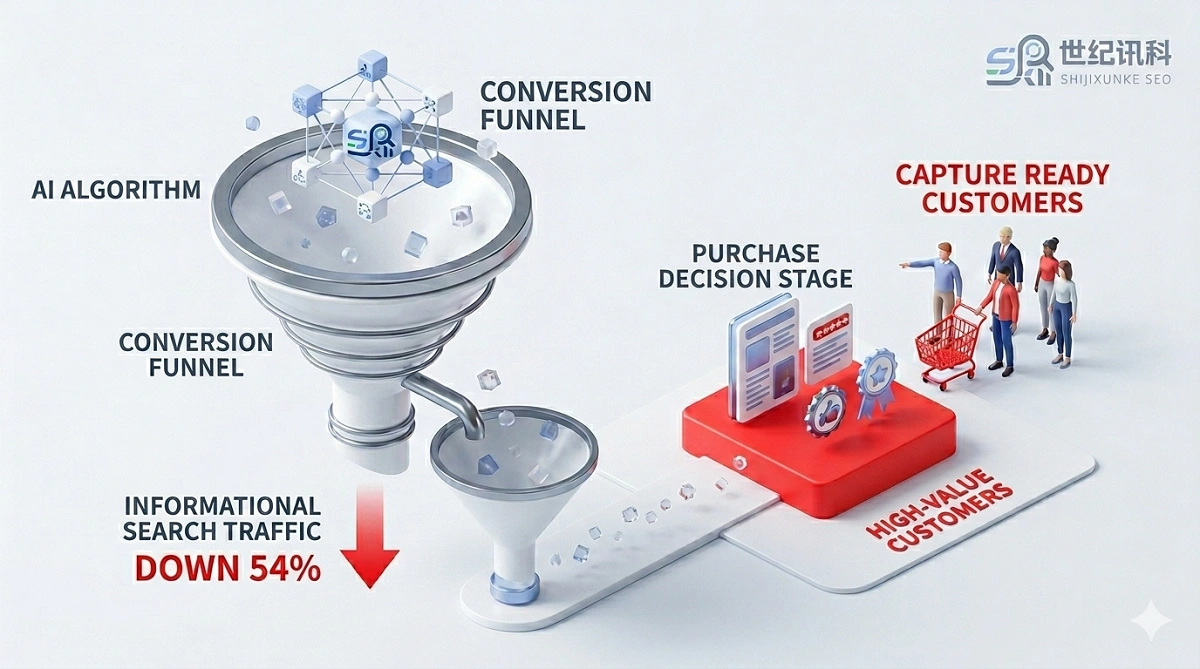
📉 Data shows: Click-through rates for informational queries dropped by 54% over the past two years
📈 Meanwhile, conversion rates for decision-stage content increased by 68% — fewer visitors, but far more qualified leads.
A troubling trend has emerged over the past three years: organic search traffic is steadily declining. The educational articles that once reliably generated leads are seeing lower click rates year after year. The content hasn’t worsened — what’s changed is how users consume information. AI-generated summaries now answer questions directly on search results pages, eliminating the need to click through. But beneath this apparent crisis lies an opportunity most overlook: buyers in the decision stage still need — and even crave — in-depth content. This article reveals how to transform declining traffic into a strategic advantage by capturing high-value customers through bottom-funnel content.
Traffic Decline Isn’t the End: Understanding How User Behavior Has Shifted
When the proposition “overall traffic may drop, but lead quality will increase” is first raised, skepticism is natural. How could less traffic be better? Let’s examine the behavioral shift. In the past, a procurement engineer researching “how to choose a CNC machining supplier” would search Google, click top results, and spend time reading, comparing, and evaluating. Now, when they enter the same query, an AI summary delivers structured answers — including key considerations, common pitfalls, and a shortlist of potential suppliers. They get 80% of the information without clicking anything.
This has hit “educational” content (top-of-funnel) hard. Its value is being rapidly replaced by AI. However, notice what happens when that same procurement engineer has already defined their requirements and is now comparing specific suppliers. Their queries change: “Company A vs Company B CNC machining,” “Company C CNC reviews,” “Is Company D reasonably priced?” These “purchase decision stage” queries still have very low AI summary coverage. Users must still click through to read detailed comparisons, authentic reviews, and transparent pricing. In other words, traffic declines are concentrated in information-seeking stages, while decision-stage traffic remains robust — and has actually become more valuable as users increasingly rely on depth and trust.
Why Bottom-Funnel Content Thrives in the AI Era
Several key factors explain why shifting resources to conversion-stage content makes strategic sense.
1. Low AI Summary Coverage for Commercial-Intent Queries
Current AI models show a clear bias: they prefer answering informational questions over transactional or comparative ones. Ask “what is CNC machining,” and the AI delivers a detailed definition. Ask “which CNC machining supplier is better, Company A or Company B,” and the response becomes cautious — offering methodology on how to choose rather than direct comparison. Two reasons explain this: sensitivity around commercial competition and the need for real-time, specific data that training datasets lack. This creates a significant opportunity — when AI won’t answer directly, users must click through to read your comparison content.
2. Decision-Stage Buyers Need Confidence, Not Just Information
Information can be delivered instantly. Decision confidence must be built over time. A procurement manager considering an expensive industrial purchase won’t base their decision on an AI summary alone. They need detailed spec comparisons, authentic case studies, transparent pricing, and third-party evaluations. They need proof that a supplier is reliable, products are proven, and support is dependable. This depth of verifiable content remains beyond what AI models can generate effectively — because it requires real industry experience, genuine customer data, and actual transaction records. And that’s precisely what established industry players possess.
3. AI-Referred Users Arrive Pre-Educated
This point is often missed entirely. When a user clicks through from ChatGPT or Perplexity, they’re far from a blank slate. The AI summary has already provided them with foundational knowledge, industry terminology, and even comparison frameworks. This means: you no longer need 1,000 words explaining “what is CNC machining.” They’re here to validate the AI’s suggestions, access deeper information, or complete their purchase decision. Intent is sharper, allowing content to be more focused and more effective. One in-depth comparison article consistently outperforms ten generic educational posts. In one case, a single comparison guide generated more qualified leads than an entire quarter’s worth of top-of-funnel content combined.
A Practical Strategy for Shifting Resources to Bottom-Funnel Content
The core principle is straightforward: dedicate 60-80% of content creation efforts to middle and bottom-of-funnel content. Here’s how to execute this systematically.
Step 1: Redefine Your Performance Metrics
This is the foundation of any successful pivot. If traffic volume remains your primary KPI, you’ll never escape the gravity of top-funnel content. A more comprehensive measurement framework includes:
- Branded search growth: Are more users searching for your brand after seeing AI recommendations?
- AI platform citation frequency: How often are your content pieces cited by ChatGPT, Claude, or Perplexity?
- Direct traffic changes: Are more users typing your URL directly after content publication?
- Conversion rates: Are inquiry or demo request rates improving even as overall traffic fluctuates?
These metrics better capture GEO (Generative Engine Optimization) value. Often, users see a product mentioned in an AI response, search for the brand, and convert — a journey that GA4 attributes to “direct traffic,” with zero visible SEO contribution. Yet the true source was optimized content and AI visibility.
Step 2: Audit Existing Content for Bottom-Funnel Gaps
Don’t rush to create new content. First, review what you already have. Have you covered high-commercial-intent keywords? Do you have product comparisons, evaluation guides, or selection advice? If not, these are immediate priorities. A simple approach: list the top 10 “comparison questions” and “decision questions” your sales team hears most often, then audit whether you have dedicated content addressing each. This gap list becomes your content roadmap.
Step 3: Build a Standardized Product Evaluation Framework
This is essential for creating credible comparison and review content. A consistent evaluation framework ensures objectivity and builds trust. Define fixed evaluation dimensions (e.g., feature completeness, ease of use, pricing competitiveness, customer support, user satisfaction) with clear scoring criteria for each. Most importantly: objectively present pros and cons for all products — including your own. Users can easily distinguish authentic reviews from promotional content. Only genuinely objective content earns trust from decision-stage buyers and frequent citation by AI models.
Step 4: Optimize Existing Top-Funnel Content to Drive Conversion
This isn’t about abandoning top-funnel content entirely, but redefining its role. Top-funnel content now serves three purposes:
- Building content cluster completeness and topical authority
- Passing link equity to bottom-funnel conversion pages through internal links
- Demonstrating domain expertise to Google
For existing high-performing educational articles, consider secondary optimization: add product-relevant sections, place contextual calls-to-action throughout (not just at the end), and incorporate expert commentary or data points. These enhancements allow educational content to take on some conversion-driving responsibility without losing its informational value.
Step 5: Implement AI Channel Tracking in GA4
Most organizations cannot currently track traffic originating from AI platforms — it’s typically classified as “direct” or “referral” traffic. This is a massive blind spot. The solution: configure regular expressions in GA4 to tag AI platform sources. Practical steps include:
- Add UTM parameters to links in AI-targeted content (e.g., ?utm_source=chatgpt)
- Create custom channel groupings that classify referrers containing “openai.com,” “perplexity.ai,” or “anthropic.com” as “AI Organic”
- Build exploration reports to analyze AI-source user behavior (time on site, page depth, conversion rates)
With this data, you can accurately measure GEO ROI and build compelling cases for stakeholders.
| Content Type | AI Summary Impact | Strategic Shift | Expected Outcome |
|---|---|---|---|
| Top-of-funnel (Educational) | High impact, CTR declining | Supporting role, build topical authority | Improved domain authority |
| Middle-of-funnel (Comparison) | Low impact, low AI coverage | Primary focus, 60-80% of effort | High-intent leads |
| Bottom-of-funnel (Decision) | Very low impact, relies on depth | Primary focus, build evaluation systems | Max conversion, branded search growth |
Case Study: One Comparison Guide Outperforming Ten Educational Articles
A SaaS client offering construction project management software originally focused on educational topics like “5 challenges in construction project management” and “how to improve site efficiency.” Traffic was decent, but conversions remained low — most visitors were casually browsing, not actively purchasing.
The team pivoted to a decision-stage format: “2026 Comprehensive Review of Construction Time-Tracking Software.” To ensure credibility, a standardized evaluation framework was developed featuring five dimensions: feature completeness, mobile experience, pricing transparency, customer support, and verified user satisfaction. The article objectively assessed five leading solutions, including their own product — honestly acknowledging its limitations and best-fit scenarios.
Results exceeded expectations. Within weeks, the article became the most-cited source across major LLMs (ChatGPT, Claude, Perplexity) when answering “construction time-tracking software recommendations.” Users clicked through from AI summaries, read thoroughly, and made purchasing decisions. To date, this single article has generated more qualified leads than all educational content from the previous quarter combined. The reason is simple: it answers questions buyers actually care about — not high-volume, low-intent queries.
This case illustrates that in the AI era, one deep, objective, bottom-funnel article produces far greater business value than ten generic educational posts. Traffic may decline, but when the right visitors arrive at the right moment, business value increases.
The Window of Opportunity: Why Now Is the Time to Pivot
Every technological shift creates a “perception gap” window. Early movers gain disproportionate advantage. AI search is no exception. Currently, most organizations remain trapped in “volume-focused” content strategies, mass-producing generic educational content that AI can easily replicate — a crowded, low-margin commodity. Meanwhile, truly valuable bottom-funnel content sees far less competition due to higher production difficulty, industry knowledge requirements, and inability to scale through automation.
This means starting systematic investment in conversion-stage content now provides a 6-12 month competitive advantage. By the time competitors realize “traffic volume is no longer king,” you’ll have accumulated deep content assets, AI-cited brand trust, and stable high-quality lead flow. This window won’t last forever — as AI models improve and more organizations pivot, competition will intensify. The time to act is now.