
Behind the AI Poisoning Named by 3·15: How Enterprises Reshape Content Sovereignty with “Fact Density” in the AI Era
Behind the AI Poisoning Named by 3·15: How Enterprises Reshape Content Sovereignty with “Fact Density” in the AI Era
19 Mar 2026
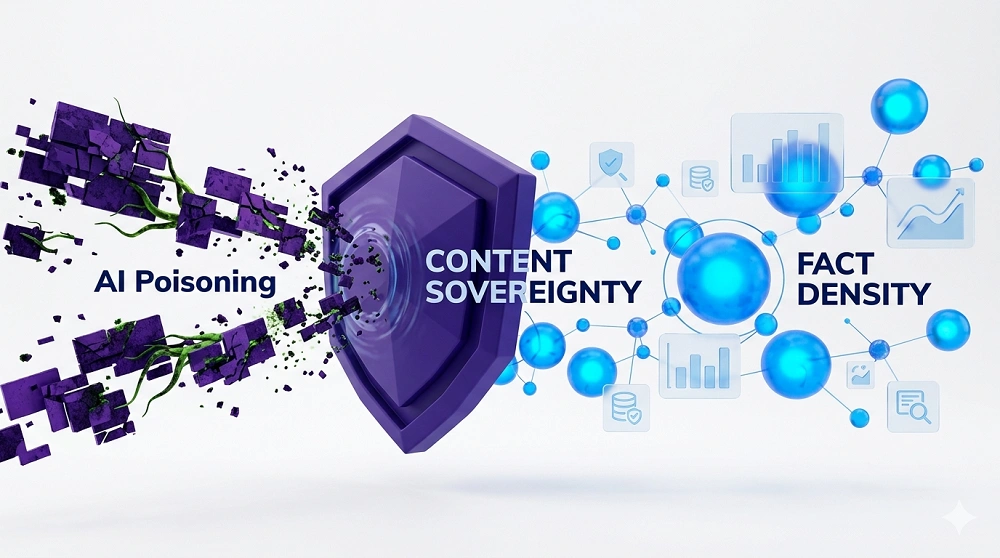
Xunke Century Professional Insights: As the CCTV 3·15 Gala exposed the black market chain of “AI Poisoning” used to manipulate public opinion, global enterprises stand at a watershed moment for AI marketing. This is not the end of technology, but the formal commencement of the “White Hat GEO” era. In the age of AI Overviews (AIO), authenticity and structured data will become the core competitive barriers for enterprises.
Why Was “AI Poisoning” Named by 3·15? Revealing the Technical Traps of Black Hat GEO
In the 3·15 Gala, the exposure of “AI Data Poisoning” sent shockwaves through the tech community. So-called poisoning refers to unscrupulous operators using massive amounts of low-quality AI-generated content, forged forum discussions, and fake third-party reviews to mislead Large Language Model (LLM) training datasets or Retrieval-Augmented Generation (RAG) processes. The essence of this behavior is “Information Fraud” rather than technical optimization.
In its 20 years of SEO service experience, Xunke Century has observed that whenever new technology emerges, speculators always attempt to take shortcuts. Just as early “hidden links” and “keyword stuffing” eventually led to countless websites being permanently banned by Google, “AI poisoning” is overdrawing corporate credit. AI models like Claude or Perplexity possess powerful cross-verification mechanisms; once a source of enterprise information is identified as having large-scale factual conflicts, the brand is highly likely to be placed on an AI “untrusted list,” a loss that is devastating in the digital age.
What is GEO (Generative Engine Optimization)? Its Essential Difference from Traditional SEO
GEO (Generative Engine Optimization) is a completely new optimization logic tailored for AI generative search engines (such as Google AIO, SearchGPT, Deepseek). Unlike traditional SEO, which pursues “click-through rates,” the core of GEO lies in “citation rates” and “factual accuracy.”
When a user asks a question, the AI scans high-authority content across the web and extracts key information to recombine into an answer. Xunke Century believes that the focus of GEO optimization is to increase the “fact density” and “structural level” of content, allowing AI to extract your brand information with the lowest computational cost.
How to Use GEO to Build Enterprise “Digital Infrastructure”? A Deep Practical Guide
In the AI era, the breadth of content is no longer an advantage; its “traceability” and “professional depth” are. Xunke Century suggests that enterprises layout “White Hat GEO” from the following three dimensions, which is not only to deal with AI search but also to establish long-term brand assets in the digital world.
1. Increase Fact Density
When AI models read a webpage, they automatically filter out meaningless adjectives (such as “industry-leading,” “the best”) and instead look for specific factual data. For example, instead of writing “We have an efficient production line,” write “Our automated production line has an annual capacity of 500,000 units, with production errors controlled within ±0.01mm.” Such high-density professional data is more easily extracted by AI and displayed to users as an authoritative answer.
2. Strengthen Structured Data Markup
Through Schema markup in JSON-LD format, you can directly “talk” to the AI’s “backend.” This includes:
- Organization Schema: Clearly defines the corporate entity, headquarters location, and official social media to prevent AI from generating incorrect company profiles.
- Product & FAQ Schema: Structurizes core product parameters and common customer inquiries to directly feed the AI’s RAG retrieval mechanism.
- TechArticle Schema: Marks up technical whitepapers for B2B enterprises to increase citation weight in professional Q&A fields.
3. Establish Multi-dimensional Cross-web Factual Consistency (E-E-A-T)
AI cross-references official websites, Wikipedia, LinkedIn, authoritative media reports, and industry forums. Xunke Century reminds: if your website claims the company was founded in 2005, but a third-party report says 2010, the AI may reduce its trust in you due to the information conflict. Maintaining a highly consistent digital footprint is the most basic yet most important task of GEO.
Why Should B2B Enterprises Be Warier of the “Poisoning” Temptation?
B2C purchasing decisions are often impulsive, but B2B decision-making processes last for months and involve multiple functional departments. In the B2B procurement chain, AI has already become an important tool for procurement managers to initially screen suppliers. If your corporate information is artificially manipulated through “poisoning” methods, it will be instantly exposed during offline site inspections or technical background investigations.
In B2B cases served by Xunke Century, enterprises that obtain AI recommendations through “authentic content optimization” have a conversion rate (CR) more than 400% higher than those relying on fake traffic. This proves that in industrial products, manufacturing, and high-tech R&D fields, integrity is the best SEO strategy.
Frequently Asked Questions (FAQ) about GEO and AI Marketing
Want to know your brand’s credit score in the eyes of AI?
Xunke Century provides you with an exclusive “GEO Deep Diagnosis Report” to comprehensively analyze the AI-friendliness of your enterprise’s digital assets.
Contact the Expert Team Now