
Baidu SEO vs Google SEO in China: The Complete 2026 Guide to China Search Engine Optimization and GEO Strategy
Baidu SEO vs Google SEO in China: The Complete 2026 Guide to China Search Engine Optimization and GEO Strategy
02 Jul 2026
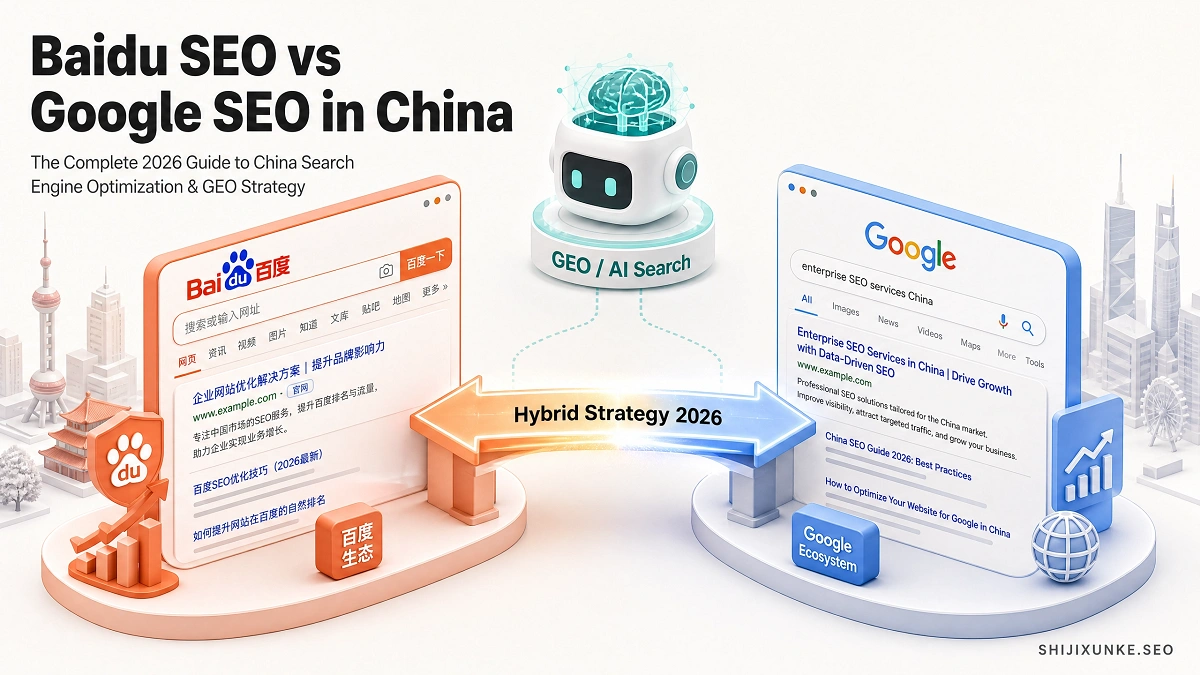
When companies expand into or out of China, one of the most misunderstood challenges is how search visibility actually works. The difference between Baidu SEO vs Google SEO in China is not simply technical—it is structural, behavioral, and increasingly driven by AI systems.
At Xunke Century, we see this issue constantly: brands that succeed in Google SEO fail in China search engine optimization because they apply a “single search logic” to a multi-ecosystem environment. In reality, modern SEO is no longer about ranking pages—it is about controlling visibility across search engines, social platforms, and AI-generated systems.
Why Baidu SEO vs Google SEO in China Operate on Completely Different Systems
Two Search Worlds With Different Rules
The core difference in Baidu SEO vs Google SEO in China lies in architecture. Baidu operates as a closed ecosystem where content is filtered, ranked, and distributed through platform-controlled signals. Google operates as an open web graph built on backlinks, semantic relevance, and entity authority.
Authority Is Defined Differently
In China search engine optimization, authority is heavily influenced by platform presence and domain trust. In Google SEO for China market expansion, authority is earned through external backlinks, content depth, and topical relevance.
Compliance as a Ranking Layer
Unlike Google, Baidu SEO differences include regulatory constraints such as ICP filing, hosting location sensitivity, and content compliance filtering. These factors directly influence indexing behavior and ranking potential.
China Search Engine Optimization Is Now a Multi-Platform System
SEO No Longer Means “Search Engine Only”
Modern China search engine optimization extends far beyond Baidu. Visibility is now distributed across multiple platforms that each serve a different stage of the user journey.
- Baidu: intent confirmation and final decision search
- Zhihu: deep trust evaluation and comparison
- Xiaohongshu: discovery and lifestyle validation
- Douyin: emotional influence and behavioral shaping
The Real User Journey Is Layered
Instead of a linear search process, users move through multiple validation layers:
Awareness → Social validation → Trust reinforcement → Search confirmation → AI summary → Purchase decision
This layered structure fundamentally changes how Baidu SEO vs Google SEO in China should be approached.
Why Keyword SEO No Longer Works in China Market
Traditional keyword-based SEO fails in China search engine optimization because SERPs are dominated by platform ecosystems rather than independent websites.
Baidu SEO differences show that freshness, platform authority, and content distribution matter more than backlink profiles.
As a result, ranking alone does not guarantee visibility or traffic conversion.
Google SEO for China Market: Global Expansion Layer
Designed for Cross-Border Acquisition
Google SEO for China market strategies are essential for companies targeting international customers. This includes manufacturing, SaaS, and B2B export industries.
What Actually Drives Performance
Successful Google SEO depends on:
- Semantic content clusters
- Entity-based optimization
- E-E-A-T authority building
- Intent-driven content architecture
Common Execution Failure
Many agencies fail because they misapply Baidu SEO vs Google SEO in China logic, using translation instead of localization. This breaks conversion alignment and weakens user intent matching.
The Shift From SEO to GEO (AI Search Visibility)
Search Engines Are Becoming Answer Engines
AI systems like ChatGPT, Gemini, Perplexity, and Baidu ERNIE are transforming search behavior. Users are no longer just searching—they are asking systems to decide.
Entity Consistency Becomes Critical
Modern China search engine optimization depends on entity consistency across platforms. AI systems prioritize structured, factual, and consistent brand data over keyword repetition.
Visibility Is Now Citation-Based
In GEO systems, brands are ranked by whether AI models can confidently cite them. This changes the entire foundation of Baidu SEO vs Google SEO in China.
Hybrid SEO Strategy for 2026: The Real Architecture

Modern digital visibility is no longer a single-channel strategy. It is a hybrid system integrating search engines, social platforms, and AI models.
| Layer | Role | Signal Type | Platforms | KPI |
|---|---|---|---|---|
| Baidu SEO | Domestic visibility system | Compliance + freshness + platform authority | Baidu, Baike, Baijiahao | Indexing + SERP exposure |
| Google SEO | Global acquisition engine | Backlinks + semantic relevance + E-E-A-T | Google Search | Organic traffic + leads |
| GEO (AI SEO) | AI visibility layer | Entity consistency + structured truth | ChatGPT, Gemini, Perplexity | AI citations + brand mentions |
Why These Layers Must Work Together
A major misunderstanding in Baidu SEO vs Google SEO in China is treating each system independently. In reality, all three layers influence each other through entity signals and content consistency.
For example, inconsistent brand data across platforms reduces AI trust signals, which impacts GEO visibility and weakens overall China search engine optimization performance.
Technical Trade-Off Reality
- Static HTML improves Baidu indexing but limits dynamic SEO flexibility
- China hosting improves compliance but reduces global performance speed
- Content freshness improves Baidu but structured depth benefits Google
Critical Baidu SEO Differences Most Agencies Ignore
- ICP filing impacts trust and ranking behavior
- Baidu prefers static HTML rendering
- High-authority platforms dominate SERPs
- Freshness often outweighs backlink authority
These Baidu SEO differences explain why many companies fail when applying Google-style SEO strategies in China search engine optimization environments.
Entity Architect Strategy for AI Search
What Is an Entity Architect
An Entity Architect ensures a brand is consistently understood across search engines, AI systems, and content ecosystems.
Core Principles
- Factual consistency across platforms
- Cross-platform validation signals
- Semantic clarity in structured content
This model is essential for both Baidu SEO vs Google SEO in China and AI-driven visibility systems.
Omnichannel Search Behavior in China 2026
User behavior in China search engine optimization is no longer linear. It is distributed across multiple platforms that influence decisions at different stages.
Instead of starting and ending on a search engine, users move through an ecosystem of validation points.
- Xiaohongshu: discovery and lifestyle proof
- Douyin: emotional engagement and behavioral influence
- Zhihu: deep evaluation and trust building
- Baidu: final intent confirmation
This means Baidu SEO vs Google SEO in China must now be designed around behavioral journeys, not keyword positions.
Work With Xunke Century
Winning in modern search requires more than understanding Baidu SEO vs Google SEO in China. It requires building a unified system that integrates China search engine optimization, global Google SEO, and AI visibility (GEO).
Xunke Century helps brands design and execute this full-stack visibility architecture across search engines and AI systems.