
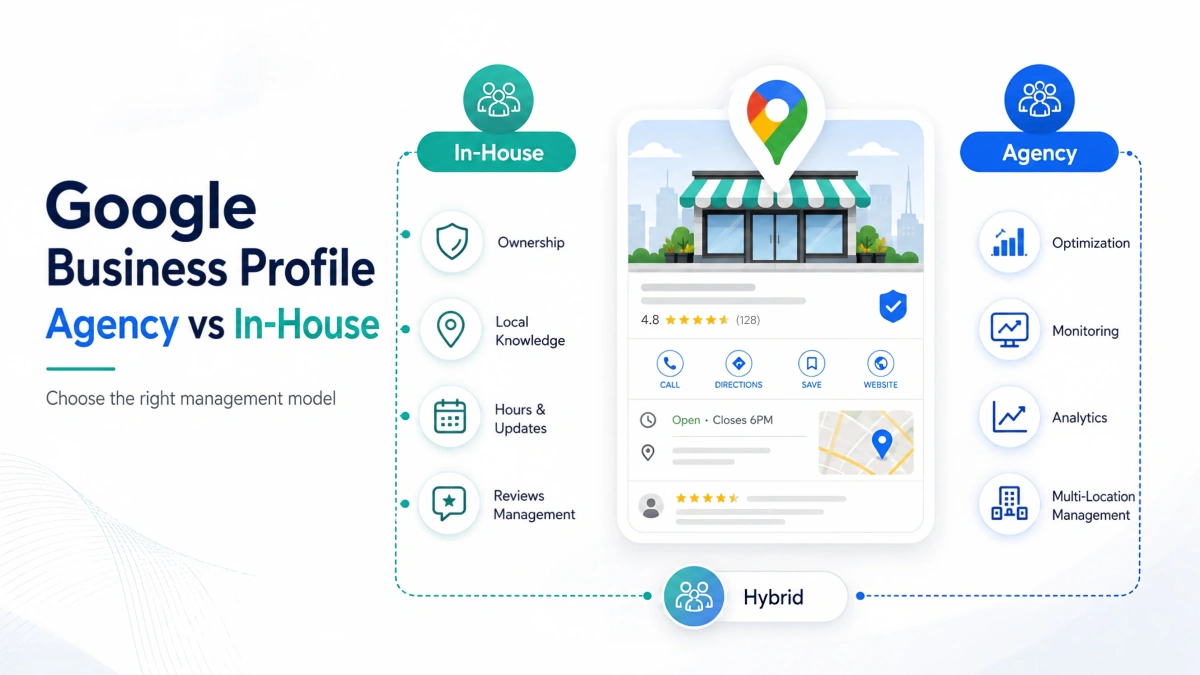
Google Business Profile can be managed internally or by an agency, but the right choice depends on who can consistently handle profile accuracy, optimization, reviews, monitoring, and performance measurement.
That sounds simple until responsibility starts getting fragmented. Marketing updates the website. A store manager changes holiday hours. Customer service replies to reviews. An SEO specialist wants to adjust categories. Meanwhile, nobody is completely sure who owns the Google account or who should investigate when a location suddenly loses visibility.
This is why the real Google Business Profile agency vs in house decision is not simply about whether you want to outsource a marketing task. You are deciding where operational responsibility, local knowledge, SEO expertise, account control, and performance accountability should sit.
Good Google Business Profile management can involve business information, categories, services, opening hours, reviews, photos, customer interactions, local SEO analysis, multi-location governance, performance reporting, and policy compliance. For businesses with several locations, these responsibilities become even harder to separate.
The most practical management model therefore gives the people closest to the business control over factual decisions while giving the people with the right expertise responsibility for the work they can perform better.
Google Business Profile Agency vs In-House: What Is the Real Difference?
The main difference between in-house and agency GBP management is where expertise, execution responsibility, and operational resources are located.
An internal team brings direct access to the business. They know that the Central office will close early on Friday, that a service has temporarily stopped, or that a complaint needs to reach an operations manager before anyone responds publicly. An agency, by contrast, usually brings broader local SEO experience, repeatable workflows, monitoring, competitor analysis, and the ability to manage a larger number of locations systematically.
Neither advantage automatically makes one model better. The important question is whether the people responsible for a particular task have both the information and the capability required to handle it correctly.
What In-House GBP Management Means
In-house GBP management means your own employees are responsible for maintaining, updating, and improving your Business Profile.
Responsibility might sit with a marketing team, SEO specialist, store manager, local operations team, or a combination of several departments. A small business may have one marketing employee managing everything. A larger company may have corporate marketing controlling branding while individual locations submit operational changes.
The strongest advantage is proximity to the business. Internal employees usually hear about changed opening hours, new services, temporary closures, customer complaints, and local events before an outside provider does.
That knowledge can make routine management faster. If a customer asks a location-specific question or an inaccurate detail appears on the profile, the internal team does not necessarily need another approval chain to find the answer.
It also gives the business tighter control over tone. This matters when a public response involves a sensitive customer issue, regulated service, legal concern, or brand policy that should not be handled from a generic response template.
What a Google Business Profile Agency Provides
A GBP agency provides specialist knowledge, structured processes, monitoring systems, and experience managing local search performance.
Instead of treating the profile as an isolated listing, an experienced agency can examine how the profile interacts with categories, business information, reviews, the website, local competition, search behavior, and other local visibility signals.
Typical agency work may include:
- Auditing profiles for inaccurate or incomplete information.
- Reviewing primary and additional business categories.
- Analyzing local competitors and search visibility.
- Monitoring profile changes and potential listing issues.
- Developing repeatable workflows for multiple locations.
- Reporting on Business Profile interactions and local search performance.
- Connecting GBP activity with website analytics, inquiries, bookings, or other business outcomes where tracking allows it.
Google itself provides organization and business-group functionality for third-party agencies and businesses managing multiple profiles, so agency access does not require handing over the business owner’s Google account.
What Factors Should Determine Your GBP Management Model?
The best GBP management model depends on business complexity, internal capability, location scale, and the level of optimization required.
This is where the Google Business Profile agency vs in house comparison becomes more useful. Instead of asking which option sounds more professional, look at the operational burden your profiles actually create.
Factor 1: Number of Business Locations
The more locations a business manages, the more valuable structured GBP management processes become.
A single-location business may only need to maintain one set of business hours, one review stream, one group of services, and one set of local performance data. If an experienced employee owns that responsibility, in-house management can remain relatively straightforward.
Now imagine 30 locations.
One store changes its phone number. Three have different holiday hours. Another uses an outdated service description. New employees need access. Former employees still have permissions. Review volume varies by market, and management wants to compare performance across all locations.
At that point, GBP management becomes an operating system rather than a small marketing task.
Google supports Business Profile Manager and business groups specifically for managing multiple profiles and sharing access across groups of locations. Businesses can also download performance data for multiple profiles for comparison.
Factor 2: Internal Expertise and Available Time
Businesses should evaluate whether their team has enough time and expertise to manage GBP consistently.
Having an employee who technically can edit a Business Profile is different from having someone who actively owns its performance.
In-house management tends to work better when:
- A specific person is accountable for the profile.
- That person understands local search basics.
- They have enough time to review updates and customer interactions.
- They can coordinate quickly with operations and customer-facing teams.
- They know when a change requires additional investigation rather than a quick edit.
Agency support becomes more useful when GBP responsibility is repeatedly pushed to the bottom of someone’s task list. Profiles that nobody checks until something goes wrong are technically "managed in-house," but they are not being managed well.
Factor 3: Operational Complexity
GBP management becomes more complex when businesses need to coordinate multiple teams, locations, and markets.
A franchise, for example, may need central brand standards without preventing franchisees from supplying local information. An international company may control the account centrally while asking regional offices to verify local opening hours, languages, phone numbers, services, and customer-response requirements.
Service-area businesses create another type of complexity. So do companies operating several brands or divisions where not every employee should have access to every location.
Google’s business-group system reflects this operational reality: profiles can be organized into groups so businesses can control which users manage which sets of locations.
Factor 4: Need for Local SEO Expertise
Businesses that need deeper local SEO analysis may benefit from agency support.
Google explains that local results are mainly determined by relevance, distance, and prominence. Businesses cannot control a searcher’s distance from a location, but they can improve the accuracy and completeness of the information Google uses to understand the business. Google also states that categories, business information, reviews, and wider prominence signals can influence local visibility.
This is where specialist work can go beyond keeping a listing tidy.
An experienced local SEO team may examine:
- Whether the primary category accurately represents the business.
- Which relevant additional categories are appropriate.
- Whether the profile and website communicate consistent service information.
- Which competitors dominate important local searches.
- How visibility differs between locations.
- Whether changes in performance come from the profile, website, market, competitors, or search behavior.
Google specifically advises businesses to choose categories that describe what the business is rather than simply listing everything it offers. That distinction is easy to overlook when GBP is managed only as an administrative directory entry.
Where In-House GBP Management Works Better
In-house management works better when businesses have strong local knowledge, clear ownership, and enough resources to maintain profiles consistently.
The crucial phrase is "clear ownership." Giving GBP to an internal team does not create an advantage if five people assume somebody else is watching it.
When Local Knowledge Matters Most
Local knowledge matters most when Business Profile information changes frequently or customer interactions require immediate context from the location.
Store hours are an obvious example. So are local events, temporary closures, service availability, appointment policies, parking changes, and customer questions that only an employee at the location can answer accurately.
Reviews are another case where context matters. Google allows verified businesses to respond publicly to reviews, and those replies appear as responses from the business.
An agency can manage a review workflow, identify reviews requiring attention, and help maintain response standards. But the business should still decide how to address complaints involving refunds, employee conduct, contractual disputes, medical matters, financial services, or other situations that require operational judgment.
When Brand Control Is Critical
In-house control becomes especially valuable when public GBP content must pass strict brand, legal, operational, or compliance review.
Healthcare providers, financial businesses, professional-service firms, luxury brands, and organizations with formal communications policies may not want an external team independently deciding how to respond to every sensitive review or public question.
This does not necessarily mean the agency should disappear from the workflow. A better structure may allow the agency to monitor activity, categorize issues, prepare drafts, and escalate sensitive cases while the business retains final approval.
That split keeps specialist support without outsourcing decisions that belong to the organization itself.
Where a GBP Agency Works Better
A GBP agency works better when businesses need specialist expertise, scalable processes, or ongoing local search optimization.
The strongest agency use case is rarely "we don’t want to touch Google." It is usually "our internal team understands the business, but we need a more systematic way to improve and manage local visibility."
When Businesses Need Local SEO Expertise
Businesses benefit from agency support when GBP needs to become part of a wider local SEO strategy rather than a standalone profile-maintenance task.
An agency can compare locations, investigate competitive differences, review category choices, connect profile work with the website, and examine why one location performs differently from another.
That outside perspective can also expose blind spots. An internal employee who sees the same profile every week may know every operational detail yet never ask why a competitor uses a more relevant category, earns stronger review activity, or appears more consistently for high-intent local searches.
Good agency work combines those observations with action. A monthly report with screenshots and rankings but no clear explanation of what changed, why it mattered, and what happens next adds very little value.
When Businesses Manage Multiple Locations
Agencies become more useful as the number of locations increases because consistency, permissions, reporting, and local exceptions all need repeatable workflows.
The goal should not be to make every profile identical. A New York office and a Hong Kong office may have different hours, services, languages, review patterns, and local competitors.
The goal is controlled consistency: the same governance rules, the same process for approving changes, the same measurement framework, and enough flexibility for accurate local information.
A multi-location agency should therefore be able to explain not only what it will optimize, but also how it will receive updates from individual locations, document changes, manage access, escalate problems, and compare performance.
When Businesses Need Continuous Monitoring
Agency support is valuable when the business needs someone to monitor profiles continuously rather than checking them only during campaigns.
Useful monitoring can include profile changes, duplicated or conflicting listings, access issues, customer-review activity, local competitor changes, and significant shifts in visibility or customer actions.
The key is interpretation. A ranking movement alone does not tell you whether the cause is a profile edit, algorithm change, competitor improvement, search-location difference, or changing demand.
Monitoring becomes valuable when someone investigates what happened and decides whether the business actually needs to act.
Who Should Own the Google Business Profile Account?
The business should retain ownership of its Google Business Profile, while an agency usually only needs appropriate management access.
This is not merely a preference. Google’s current third-party policy states that end customers must retain ownership or co-ownership of their Business Profile at all times. Google also advises businesses that use third-party managers to ensure they retain owner access.
Owner vs Manager Access
Owners and managers can both perform most daily Business Profile work, but ownership gives the business control over users and the profile itself.
According to Google’s current access documentation, owners can add or remove users and remove a Business Profile. Managers can edit profile information, manage the profile on Search and Maps, publish posts, work with photos, respond to reviews, respond to Q&A, and download performance insights, but they cannot add or remove users or remove the profile.
For that reason, an agency performing routine optimization generally does not need to become the primary owner simply to do everyday work.
Why Businesses Should Keep Ownership
Businesses should keep ownership so that changing vendors never becomes an account-control problem.
Consider what happens when a company decides to replace an agency after two years. If an employee-owned business account remains the primary owner, the company can remove or replace agency access while continuing to manage the same profile.
If control sits entirely with a former vendor, a normal supplier transition can turn into an access dispute.
Retaining ownership reduces several avoidable risks:
- Vendor dependency.
- Unclear access rights.
- Delays during agency transitions.
- Loss of institutional knowledge when a supplier changes.
- Difficulty identifying which external users still have access.
Ownership should therefore be treated as governance infrastructure, not a bargaining chip in an agency contract.
What Should Happen When the Agency Relationship Ends?
When an agency relationship ends, the business should retain account access, relevant historical information, reporting records, and documentation of the work completed.
Google’s third-party policy says that after a client gives notice, the third party must provide a way for the client to disassociate the management account from the service and regain exclusive control within seven business days. The third party must also relinquish relevant permissions.
A sensible offboarding process should also document outstanding issues, recent profile changes, reporting definitions, tracking setups, location-group structures, and any recommendations that have not yet been implemented.
If an agency cannot explain how offboarding works before the contract begins, that is worth noticing.
How Should Businesses Split GBP Responsibilities Between Internal Teams and Agencies?

A hybrid GBP management model works by keeping business control internally while using agency expertise for optimization, monitoring, and scalable operations.
For many growing organizations, this is a more realistic answer to the Google Business Profile agency vs in house question than forcing every task onto one side.
Responsibilities That Should Stay In-House
Responsibilities should stay in-house when they involve ownership, factual approval, sensitive business decisions, or information that only the company can authoritatively confirm.
Internal responsibilities commonly include:
- Maintaining primary ownership of the Business Profile.
- Approving changes to core business information.
- Providing accurate opening hours, addresses, phone numbers, and operational updates.
- Defining brand and communications guidelines.
- Deciding how sensitive customer complaints should be resolved.
- Approving changes that affect regulated or high-risk business information.
Responsibilities That Can Be Outsourced
Responsibilities can be outsourced when specialist knowledge, repeated execution, monitoring, or cross-location analysis creates more value than keeping the task entirely internal.
An agency can usually support:
- GBP audits.
- Category and profile optimization.
- Local competitor research.
- Visibility monitoring.
- Performance reporting.
- Multi-location workflow design.
- Review-monitoring processes.
- Local SEO analysis involving the Business Profile and website.
The agency can also flag decisions for the business instead of making every decision itself. This distinction matters: outsourcing execution should not mean outsourcing ownership of business facts.
GBP Responsibility Matrix
A practical responsibility matrix should give the business final authority over ownership and factual decisions while giving the agency enough operating access to complete agreed optimization work.
One useful division of responsibility looks like this: the business owns the account, approves core information, defines brand rules, and makes sensitive customer decisions. The agency audits and optimizes profiles, conducts local SEO and competitor analysis, monitors performance, and produces reporting. Business updates and review workflows become shared responsibilities: internal teams supply facts and escalation decisions while the agency manages process, monitoring, and optimization.
Business ownership + internal control + agency expertise is often more durable than handing every GBP responsibility to either side.
How Should You Measure GBP Agency Performance?
GBP performance should be measured by profile visibility, customer actions, and business outcomes rather than rankings alone.
A ranking report can be useful, but it answers only one question: where did the business appear for a particular query, from a particular location, at a particular time?
Management needs to know what happened after visibility was created.
GBP Platform Metrics
Google Business Profile performance data can show how people discover and interact with a verified profile on Search and Maps.
Google currently documents metrics including searches, views, directions, calls, website clicks, bookings where applicable, and other business-specific interactions. Not every metric appears for every business.
These metrics help answer practical questions. Are people finding the profile? Are they clicking through to the website? Are they requesting directions? Are call-button interactions changing?
They should not, however, automatically be treated as revenue.
Local SEO Performance Metrics
Local SEO performance should show whether the business is becoming more visible to relevant local customers and how that visibility compares across locations or against meaningful competitors.
Useful analysis may include local search visibility, Maps presence, query themes, competitor movement, landing-page performance, and differences between locations.
The purpose is diagnosis, not producing the biggest possible spreadsheet. If one location loses visibility, reporting should help the business understand what changed and what action is justified.
Business Outcome Metrics
Business outcome metrics should connect GBP activity with qualified inquiries, bookings, sales opportunities, or revenue wherever the company’s tracking systems make that attribution possible.
This usually requires looking beyond the native GBP dashboard. Website analytics, properly structured campaign parameters, call or booking systems, lead forms, CRM records, and internal sales data may provide the next part of the customer journey.
The measurement chain should make sense:
Visibility → profile interaction → website, call, direction or booking action → qualified customer activity → business outcome.
An agency should be careful not to claim revenue attribution that the available tracking cannot actually prove.
Which GBP Management Model Fits Different Business Types?
The right GBP model changes with the size and operating structure of the business: single-location companies can often manage internally, while multi-location and international organizations usually benefit from more structured or hybrid support.
Single Location Businesses
Single-location businesses can often manage GBP in-house when one capable employee clearly owns the work and has enough time to maintain it.
This model is particularly practical when business information changes infrequently and the team already understands basic local SEO, customer-review management, and Google Business Profile policies.
An agency may still make sense when the location operates in a highly competitive local market or the internal team has no local SEO capability, but outsourcing should solve a specific gap rather than become the default.
Multi-Location Businesses
Multi-location businesses usually benefit from a hybrid or agency-supported model because consistency, monitoring, reporting, and access management become harder as location count grows.
Central ownership can stay with the business. Local teams can supply location-specific information. An agency or specialist central SEO team can manage optimization standards, monitoring, reporting, and cross-location analysis.
This structure reduces the two extremes that cause trouble: central teams publishing inaccurate local information, or every location managing GBP independently with no common standard.
International Businesses
International businesses generally need central ownership, local market input, and specialist support that can coordinate profiles across different regions.
This is particularly relevant for companies headquartered in Hong Kong or mainland China but operating customer-facing offices, stores, branches, or service locations in overseas Google markets.
The central team can define governance and retain ownership. Regional employees can confirm local operating information and language requirements. An agency can coordinate local SEO analysis, profile standards, reporting, and market-specific optimization.
The result should not be one global template copied into every market. It should be one governance system that allows accurate local execution.
Questions to Ask Before Hiring a GBP Agency
-
Who will own the Google Business Profile?
The business should retain ownership or co-ownership rather than surrendering control to the agency.
-
What level of access do you need?
The agency should be able to explain why its requested access matches the work it will perform.
-
What work will you complete each month?
Ask for concrete responsibilities rather than broad promises such as "manage your local presence."
-
How do you measure success?
A credible answer should move beyond rankings and discuss profile interactions, visibility, qualified customer activity, and measurable business outcomes where attribution is available.
-
How do you handle multiple locations?
Look for a process covering approvals, local updates, access, monitoring, reporting, and exceptions between locations.
-
How do you manage reviews?
Clarify who monitors reviews, who prepares responses, which situations need escalation, and who gives final approval for sensitive cases.
-
What happens after termination?
The agency should explain how access, documentation, historical reports, and any agency-controlled management structures will be handed over or disconnected.
These questions often reveal more about an agency than a polished case-study presentation does.
Red Flags When Choosing a Google Business Profile Agency
The clearest GBP agency red flags involve unnecessary account control, unrealistic ranking promises, vague deliverables, and reporting that cannot connect activity with meaningful customer behavior.
They Ask for Primary Ownership
An agency asking for primary ownership without a clear operational reason creates unnecessary account-control risk.
Google requires third-party clients to retain ownership or co-ownership, while managers already have broad day-to-day capabilities. A legitimate agency should therefore be able to explain exactly which permissions it needs and why.
They Guarantee Google Maps Rankings
A guarantee of top Google Maps placement is a major warning sign because third parties cannot legitimately promise a specific ranking.
Google’s third-party policies explicitly identify guarantees of top placement on Google as a false, misleading, or unrealistic claim. Google’s local-ranking guidance also states that there is no way to request or pay for better local ranking.
An agency can optimize factors it can influence. It cannot purchase a guaranteed organic Maps position from Google.
They Cannot Explain Their Monthly Work
An agency that cannot explain its monthly work makes it difficult for the business to judge whether GBP is actually being managed or simply being reported on.
You should be able to understand what the agency checked, what it changed, what it recommended, which problems it found, and what requires internal action.
"Ongoing optimization" is not a useful deliverable unless the agency can show what ongoing optimization means in practice.
They Focus Only on Rankings
An agency that focuses only on rankings ignores whether GBP visibility creates calls, website visits, directions, bookings, qualified inquiries, or other useful customer actions.
Rankings remain useful diagnostic data, but management should connect them with behavior wherever possible.
A number-one position that attracts irrelevant traffic can contribute less to the business than broader visibility across commercially meaningful local searches that generate qualified inquiries.
Google Business Profile Agency vs In-House Decision Scorecard
The following scorecard provides a practical starting point for choosing between Google Business Profile agency vs in house management based on operational conditions rather than a blanket rule.
| Business Situation | Recommended Model | Why It Usually Fits |
|---|---|---|
| Single location with an active, knowledgeable team | In-house | Local information is easy to verify and one accountable employee can maintain the profile consistently. |
| Limited internal resources or no local SEO expertise | Agency | Specialist execution and monitoring fill a capability gap that the internal team cannot cover consistently. |
| Multiple locations | Hybrid | Internal teams retain business knowledge while a central or agency workflow provides consistency, monitoring, and reporting. |
| International locations | Central governance + local input + agency support | Central ownership protects control, regional teams verify local facts, and specialists coordinate market-level optimization. |
| Strong need for local SEO analysis | Agency-supported | Competitor research, category strategy, visibility analysis, and website integration require deeper specialist capability. |
| Strong internal marketing and SEO team | In-house or hybrid | The internal team may perform most work while using an agency selectively for audits, additional capacity, or specialist analysis. |
Which GBP Management Model Should You Choose?
The right Google Business Profile management model depends on your business scale, internal capability, and need for specialist local SEO support.
The Google Business Profile agency vs in house decision should therefore not begin with "Do agencies perform better?" It should begin with four more useful questions: Who has the right information? Who has the right expertise? Who will consistently execute the work? And who keeps control of the account?
For a well-resourced single-location company, that answer may point almost entirely in-house. For a company with dozens of locations, the same structure can become inefficient very quickly.
Growing and international businesses often arrive at a middle ground: the company keeps ownership, factual authority, and brand control while an agency supplies local SEO expertise, optimization, monitoring, cross-location processes, and reporting.
For businesses headquartered in Hong Kong or China while building visibility across overseas markets, this division can also prevent local-market SEO work from becoming disconnected from central brand governance. Century Xunke can support businesses that need a more structured approach to international SEO, local search operations, and the wider transition from traditional search visibility toward AI-driven discovery.
The goal is not outsourcing for the sake of outsourcing. It is putting each responsibility in the hands of the team best equipped to handle it while keeping the business in control of the asset it ultimately owns.
Frequently Asked Questions
Who should own a Google Business Profile when working with an agency?
The business should retain ownership or co-ownership of its Google Business Profile, while the agency receives the access needed to perform its work. Google’s third-party policy specifically requires clients to retain ownership or co-ownership.
What access should a GBP agency have?
A GBP agency usually needs manager-level access for routine profile management unless a specific operating structure requires additional permissions. Managers can perform most daily profile tasks but cannot add or remove users or remove the Business Profile.
How does GBP management change for businesses with multiple locations?
Multi-location businesses need stronger processes for permissions, information consistency, local exceptions, reviews, monitoring, and reporting. Central governance combined with defined local responsibilities usually becomes more important as the number of profiles grows.
When should a business choose a hybrid GBP management model?
A hybrid model works when a business wants to keep ownership, factual knowledge, and sensitive decisions internally while using agency expertise for optimization, monitoring, reporting, and scale. It is particularly useful for multi-location and international organizations.
How should businesses measure GBP agency performance?
Businesses should measure GBP performance through relevant visibility, profile interactions, qualified customer activity, and business outcomes rather than rankings alone. Revenue or lead attribution should only be claimed when analytics, CRM, call, booking, or other tracking systems can support it.