SEO Techniques, Ranking Optimization Tips and Strategies
Why are the 48 Hours After the Canton Fair So Critical? Attending the Canton Fair is only the first step in acquiring foreign trade clients; the real value creation happens immediately after the event ends. Research shows that contacting clients within 48 hours after the fair increases the probability of receiving a response by over 3 times compared to contacting them after 72 hours. During this period, clients still have a fresh memory of your products and company, making it the optimal time to establish a professional impression. Many foreign trade companies invest significant resources in participating in exhibitions but underperform in the most critical stage: client follow-up. In reality, a professional post-fair follow-up system can increase exhibition ROI by 40%-60%, which is precisely what separates excellent companies from average ones. Building an Efficient Client Tiering Management System Not all exhibition leads deserve equal attention. Establish a scientific tiering system to invest your limited time in the most valuable clients. Identifying High-Value Client Characteristics Clients with Deep Interaction: Stayed at the booth for more than 10 minutes and engaged in detailed product discussions. Clients with Clear Needs: Actively inquired about specific product specifications, prices, and certification requirements. Clients with Decision-Making Authority: Business cards indicate positions like Purchasing Manager, Director, or higher. Clients from Target Markets: From countries or regions you are focusing on developing. Clients with Appointments: Clearly agreed on a post-fair contact time or method. Action Guide for Client Tiering Client Tier Follow-up Timeframe Communication Method Core Content Tier 1 Client(High Priority) Within 24 hours Personalized Email + Phone/WhatsApp Confirmation Targeted quotation, answers to questions discussed at the fair, certification documents, sample arrangements Tier 2 Client(Medium Priority) Within 48…
In the current foreign trade environment, Chinese manufacturing companies face multiple challenges including fragmented orders, online procurement, and intensified market competition. This article provides an in-depth discussion on how to achieve breakthrough growth through strategic content marketing for B2B independent websites during challenging times. Understanding Foreign Trade Trends: Grasping Market Transformation Directions To develop an effective content marketing strategy, it’s essential to first understand the profound changes in the current foreign trade environment. Data shows that China’s foreign trade structure is undergoing significant transformation, and only by grasping these trends can businesses accurately target their markets. Market Diversification Becomes the New Normal The risks of over-reliance on single markets have become increasingly apparent in recent years. According to General Administration of Customs data, ASEAN has surpassed the EU and US to become China’s largest trading partner. Meanwhile, emerging markets like India, Russia, Brazil, and Mexico have shown significant increases in procurement activity, providing new growth opportunities for Chinese manufacturing companies. Procurement Models Shift Toward Small Batch and Fragmentation Overseas buyers are bypassing traditional intermediaries to directly source from original suppliers. This change has led to orders characterized by small batches and multiple frequencies. Your independent website needs to have the flexibility and efficiency to handle such orders, including adjustments to minimum order quantities and optimization of sample ordering processes. Procurement Decision-making Becomes Preemptive and Online Research shows that up to 80% of B2B procurement decision research occurs before contacting suppliers. This means the quality of your website content directly determines whether you can enter the customer’s supplier candidate list. Building High-Value Content Systems: From Product Display to Solution Provision In today’s AI-driven search environment, traditional content strategies need comprehensive upgrades…
In the Age of AI, Why is Google SEO Service Still Core to B2B Growth? In today’s surging digital wave and the increasing popularity of Artificial Intelligence (AI), many B2B business owners might question: Are traditional marketing methods still effective? Especially Google SEO service, under the influence of new technologies like AI Overview, can it still bring substantial growth to enterprises? The answer is yes, and it is more critical than ever. As a senior consultant with over 20 years of experience in cross-border B2B and independent website optimization, I can clearly state that in 2025, Google SEO service is not only a vital channel for B2B customer acquisition but also a core strategy for opening up a new blue ocean of growth. Industry Status and Trend Insight Global Digital Marketing Budgets are Continuously Shifting towards SEO: According to the latest data from Statista, Gartner, and Search Engine Journal, global digital marketing budgets are continuously shifting towards SEO, especially in the B2B sector. Organic search is proven to be the primary customer acquisition channel in the B2B domain, as purchasing decision-makers are more inclined to proactively seek information through search engines during the initial research phase.[Source: Statista] [Source: Gartner] [Source: Search Engine Journal] The Popularity of Google AI Overview: In 2025, the full adoption of Google AI Overview will reshape the Search Engine Results Page (SERP). This means the traditional “10 blue links” model will be replaced by AI-generated summaries and answers. This undoubtedly places higher demands on SEO services, but it also brings new exposure opportunities for enterprises that can provide high-quality, E-E-A-T (Experience, Expertise, Authoritativeness, Trustworthiness) content. Characteristics of B2B, Manufacturing, Industrial Products, and High-Ticket Value Businesses: These…
In the Age of the User, How Does UX Become the New SEO Battleground? In today’s surging digital wave, User Experience (UX) is no longer a “bonus” for website development but a “decisive factor” in the success or failure of foreign trade independent stations. Especially for cross-border B2B, industrial products, and high-ticket value businesses, where the user decision cycle is long and the demand for trust and professionalism is extremely high, an excellent UX design can effectively shorten the distance between the user and the brand. Industry Status and Trend Insight Google continues to emphasize the core position of user experience in its ranking algorithm: From the introduction of Core Web Vitals to the deep analysis of user intent in every algorithm update, Google is clearly sending a signal: a good user experience is the prerequisite for obtaining high rankings. (Reference Google Developers) In 2025, AI Overview will further integrate user intent: With the in-depth application of AI technology in search, such as Google’s AI Overview, search engines will more accurately assess the match between website content and user experience. This means that your website must not only focus on “what to say” but also on “how to say it” to efficiently meet user needs. Cross-border B2B, industrial products, and high-ticket value independent stations face increasingly fierce competition: In this specific market, simple keyword stuffing or crude SEO is no longer effective. Excellent UX design has become the key to retaining potential customers, enhancing trust, and ultimately converting them into inquiries. Why is User Experience (UX) Crucial for Foreign Trade Independent Stations? UX design is not just about the aesthetic appeal of the website; it directly influences user behavior, which…
The global digital marketing market is expected to reach $786.2 billion in 2024, with cross-border B2B and independent website businesses experiencing over 20% annual growth in demand for international SEO[1]. In this context, Chinese SEO companies are becoming important partners for many enterprises’ internationalization strategies due to their unique advantages. Understanding the True Definition of Chinese SEO Companies More Than Just Baidu Optimization Experts Many mistakenly believe that Chinese SEO companies only excel at Baidu optimization, but in reality, top-tier Chinese SEO service providers also have deep experience in Google SEO. These companies typically serve businesses expanding overseas and have accumulated rich practical experience in international SEO, helping enterprises achieve better search rankings in global markets including the US, Europe, and Southeast Asia. Dispelling the Misconception About Price and Quality Price advantage doesn’t mean quality compromise. Due to China’s labor cost advantages and technological ecosystem, Chinese SEO companies can provide equal or even better services at more competitive prices. The key is selecting service providers that truly possess international perspective and professional capabilities. Key Insight: According to recent Search Engine Journal research, over 68% of multinational companies are beginning to consider outsourcing some SEO operations to Asian service providers, with Chinese companies’ technical capabilities and cost-effectiveness being the main attractions[2]. Four Core Advantages of Choosing Chinese SEO Companies Significant Cost-Effectiveness Advantage Compared to European and American counterparts, Chinese SEO companies typically offer 30%-50% price advantages while maintaining equal or higher service quality. This cost-effectiveness is particularly important for small and medium-sized enterprises with limited budgets but pursuing international results. Service Type Western Company Pricing Chinese Company Pricing Savings Ratio Technical SEO Audit $2,000-$5,000 $800-$2,500 Up to 60% Monthly SEO Management…
Key Insight: According to the latest data from Search Engine Journal, businesses adopting AI-driven SEO strategies have seen an average improvement of 47% in content production efficiency and keyword rankings, while 83% of global SEO experts have incorporated generative AI into their daily workflows. This article provides an in-depth analysis of how to achieve a comprehensive upgrade of SEO services through AI technology. How Can SEO Services Achieve a Qualitative Leap in the AI Wave? The digital marketing field is undergoing unprecedented transformation. Research from Statista indicates that global corporate investment in AI marketing tools will reach $18.7 billion in 2024, a year-on-year increase of 32%. Particularly in B2B, cross-border e-commerce, and high-value B2B sectors, traditional SEO service models can no longer meet the growing market demands. The explosive growth of generative AI technology is redefining the boundaries of content creation and data analysis. From ChatGPT to Gemini, from Claude to various professional AI tools, these technologies not only enhance work efficiency but, more importantly, provide new possibilities for SEO strategies. For B2B enterprises competing in international markets, the ability to effectively leverage AI technology has become a key factor determining the ROI of SEO investments. Data Support: Search Engine Journal surveys show that websites using AI-assisted SEO strategies save an average of 65% of the time on Core Web Vitals optimization while increasing long-tail keyword coverage by nearly three times. What Truly Defines an AI-Driven SEO Strategy? Beyond Traditional Tools: The Core Value of AI in SEO The essence of an AI-driven SEO strategy is the deep integration of artificial intelligence technology into the entire SEO workflow. Unlike traditional SEO tools that primarily provide data analysis, AI technology emphasizes…
In B2B website operations, do you face this dilemma: continuous website traffic growth, but stagnant click-through rates and inquiry conversions? The root cause may lie in how your pages appear in search results. This article deeply explains how to achieve Rich Results through Structured Data Schema, helping manufacturing and industrial product businesses break through conversion bottlenecks. Why B2B Websites Need to Prioritize Structured Data When your website only shows traditional titles, URLs, and descriptions in Google search results, you’re missing valuable display opportunities. In contrast, pages marked up with Structured Data Schema can achieve rich search result displays, including visual elements like star ratings, product prices, FAQ snippets, which is crucial in the competitive B2B market. What is Structured Data and How It Works Simply put, Structured Data Schema is a standardized data markup format that helps search engines better understand webpage content. Using the Schema.org vocabulary, you can explicitly identify product information, company details, article types, etc., in your webpage code, enabling Google to parse and display your pages more accurately. For manufacturing and industrial B2B businesses, the value of Structured Data Schema is particularly prominent: Enhance professional authority in vertical fields (E-E-A-T) Stand out visually on competitive search engine results pages Display key business information directly to attract high-quality inquiries Core Structured Data Types and Implementation Strategies Essential Schema Types for B2B Websites Schema Type Use Case Core Value Organization Corporate homepage, About Us pages Establish brand authority and trust, display basic company information Product/Service Product pages, service introduction pages Target industrial products, customized solutions, display key parameters HowTo or Q&A User manuals, technical support, FAQs Improve user experience, directly address customer questions Article/BlogPosting Technical articles, white papers,…
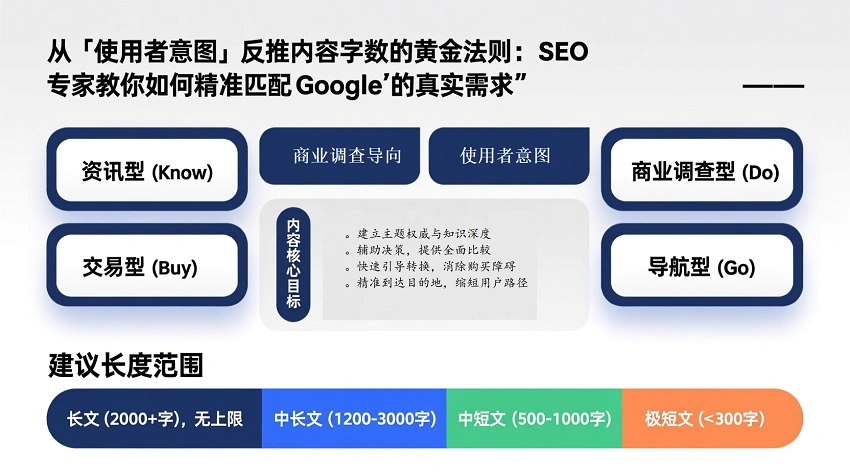
Say Goodbye to Word Count Anxiety, Embrace the New Era of E-E-A-T Logic After confirming that “word count is not a decisive factor for ranking,” the core challenge all content creators must face is: How do we define the boundaries of “high-quality content”? Seasoned SEO experts know that Google doesn’t care about word count; it cares about content utility. A 500-word article that perfectly answers a user’s complex question is far more valuable than a 5,000-word piece of general talk. This “Golden Rule” will take you deep into understanding: the ideal length of content is determined by analyzing user intent and building Topical Authority. We will use the E-E-A-T (Experience, Expertise, Authoritativeness, Trustworthiness) framework to precisely match Google’s real needs. Part 1: Professional Insights: Intent, Depth, and Topical Authority User Intent is the primary indicator used by Google’s algorithms (like RankBrain, BERT, and MUM) to judge content relevance. Your article length must serve this intent, otherwise, it leads to Content Dilution. Intent Type Content Core Goal Professional Insights: SEO Impact Informational (Know) Establish E-E-A-T image and comprehensively cover the topic. Through Topic Clusters strategy, build Topical Authority to establish the website as an authority in that field. Transactional (Buy) Maximize…
Key Insight: Choosing the wrong technology stack is the biggest hidden cost for independent sites. Data shows that 47% of cross-border sellers are forced to rebuild their websites within 2 years due to technical limitations, with average losses reaching 3 times the initial investment. The right technical roadmap can improve SEO effectiveness by 40% and conversion rates by 30%. Last week, another client approached us. His Shopify store hit a bottleneck after monthly sales exceeded $500,000: website loading speed was over 5 seconds, URL structure couldn’t be optimized, and weak blog functionality hampered content marketing effectiveness. Most painfully, 5 years of customer data and SEO equity were almost impossible to migrate. "If I had spent more time choosing the right technical path initially, I wouldn’t be so passive now." His sentiment echoes that of countless sellers. As a consultant with 18 years of experience in cross-border digital marketing, I have witnessed too many cases where poor technology selection led to heavy costs. This article will deeply analyze the pros and cons of Shopify, WordPress, and custom solutions, helping you avoid the trap of technical debt and choose the technical path most suitable for your business development. Panoramic View: Three Main Technical Paths for Cross-border Independent Sites Before diving into comparisons, we need to understand the fundamental differences between the three main technical paths. This is not just a tool choice, but a reflection of the business model. SaaS Hosted Type: "Turnkey Solution" in E-commerce Representative Platforms: Shopify, Shoplazza, Shopline, etc. Core Characteristics: Use platform services like renting, without worrying about server maintenance and technical details. Shopify, as the industry leader, provides a complete e-commerce solution, encompassing everything from payments and…
Key Insight: By 2025, cross-border e-commerce will enter an era of dual-track operation with "Marketplace + Independent Site". Data shows that the average profit margin for pure marketplace sellers has dropped from 25% in 2019 to 12% in 2024, while sellers who successfully operate independent sites maintain margins of 18-35%. This is not a simple either/or choice, but a strategic complement. Recently, I’ve received many inquiries from sellers: "Amazon’s advertising costs have increased again, ACoS is already over 40%, should I continue spending?" "My Shopee store was suddenly suspended, what should I do with the piled-up inventory?" These anxieties reflect a harsh reality: the marketplace (red dividend period) is fading, and business models solely reliant on marketplaces face significant challenges. As a consultant with 18 years of experience in cross-border digital marketing, I must be honest with you: an independent site is not a cure-all, but it is indeed a necessary path for brand globalization. This article will use detailed analysis from dimensions like traffic control, data assets, and cost structure to help you objectively assess whether you should open the second growth curve for your cross-border e-commerce business. Why is Everyone Talking About ‘Independent Sites’ Now? According to the latest data from Marketplace Pulse, in 2024, the average customer acquisition cost for sellers on Amazon US increased by 67% compared to 2021, while the average selling price decreased by 15%. This scissor effect of "rising costs, falling prices" is squeezing sellers’ profit margins. Three Signals of the Fading Marketplace红利 (Hónglì – Dividend) Exponential Increase in Customer Acquisition Cost: The average Amazon CPC cost was $0.8 in 2020 and has risen to $1.5 by 2024. In some popular categories like…
Featured Articles