SEO Techniques, Ranking Optimization Tips and Strategies
In today’s increasingly competitive global e-commerce landscape, many business owners face a critical question: Why do the same optimization strategies produce drastically different results on B2B and B2C websites? In fact, Google Analytics data shows that the average conversion cycle for B2B websites is 3-5 times longer than for B2C, while the immediate conversion rate for B2C websites is typically over 200% higher than for B2B. This fundamental difference requires us to re-examine the optimization strategies for both models. Differentiated Research on Keywords and Search Intent In e-commerce website optimization, keyword strategy formulation must be based on a deep understanding of user behavior. According to Search Engine Land research, B2C consumer search behavior is typically driven by immediate needs, while B2B purchasing decisions follow a completely different logic. B2C Keyword Strategy: Capturing Impulse Purchases B2C consumers often search under emotional drivers, using short, broad keywords like “fashion women’s clothing” or “latest smartphone.” These searches have high traffic volume but are highly competitive. Optimization focus should be on: Core category terms combined with brand terms Seasonal trends and popular vocabulary Promotion-related keywords (e.g., “discount,” “deal”) User review and social proof keywords B2B Keyword Strategy: Targeting Rational Decision-Makers In contrast, B2B keyword research requires a more refined approach. According to HubSpot data, B2B purchasing decisions typically involve 3-6 decision-makers, and the search process is more systematic. Effective B2B keywords include: Problem-oriented long-tail terms (e.g., “how to choose industrial-grade sensors”) Technical specification terms (e.g., “ISO 9001 certified supplier”) Solution-type keywords (e.g., “automated production line optimization solution”) Comparison and evaluation terms (e.g., “CNC machining vs 3D printing cost”) Practical Insight: The key to a successful B2B keyword strategy lies in understanding the search habits…
According to research by the Baymard Institute, the average e-commerce website has an optimization potential of up to 68% in its checkout process – meaning most websites have significant room for improvement in user experience and conversion rates. In today’s competitive digital commerce environment, many e-commerce website owners face a common dilemma: even with substantial advertising budgets, traffic growth is difficult to sustain, and conversion rates remain persistently low. More frustratingly, despite having excellent product quality and competitive pricing, potential customers are lost due to technical flaws and user experience issues on the website itself. This situation is particularly evident in manufacturing, industrial products, and high-ticket B2B sectors, where complex purchasing decisions require more professional online presentation and smoother user experiences. Technical Foundation: Building a Solid Base for Google and Users A successful e-commerce website must be built on a solid technical foundation. Google’s Core Web Vitals have become important ranking factors and directly impact user dwell time and conversion potential. Website Speed & Core Web Vitals Optimization According to Google data, when page load time increases from 1 second to 3 seconds, the bounce rate increases by 32%. For e-commerce websites, every 100ms delay in loading can lead to a 7% drop in conversion rate. Optimizing Largest Contentful Paint (LCP) should prioritize image compression, using next-gen formats (like WebP), and lazy-loading non-critical resources. Improving First Input Delay (FID) requires simplifying JavaScript execution, while stabilizing Cumulative Layout Shift (CLS) necessitates reserving space for images and ad elements. Crawling & Indexing Management Strategy Correct robots.txt configuration and XML sitemaps are fundamental for ensuring effective search engine crawling. For large e-commerce websites with thousands or even tens of thousands of SKUs, proper…
According to the latest Gartner research, by 2025, 30% of enterprise content will be AI-generated. Based on actual test data, this article selects 10 truly effective GPT tools to help content creation teams achieve breakthrough efficiency. While content marketing teams still struggle with output speed and quality, leading companies are already using GPT tools to increase creation efficiency tenfold. The bottlenecks of traditional content creation include not only time costs but also creative burnout, multilingual barriers, and SEO optimization challenges. According to a Content Marketing Institute survey, 73% of B2B companies cite content production efficiency as their biggest challenge. The emergence of GPT technology is rewriting the rules of the game. But with numerous tools on the market, how do you choose the right solution for your business needs? After 6 months of practical testing and comparison, we have curated 10 tools truly worth investing in and share practical application cases and data. Understanding the Core Value of GPT Tools The technological leap from GPT-3 to GPT-4 is not just an increase in parameters but a qualitative improvement in understanding and generation capabilities. The explosive growth of specialized tools allows natural language processing technology to be truly applied in practical business scenarios. Common Misconceptions and Correct Understanding Many companies worry that AI will completely replace human creation, but the reality is quite the opposite. Quality GPT tools are creative partners, not replacements. According to Search Engine Journal analysis, companies that successfully apply AI content often focus on a “human-machine collaboration” model. Scenario-based Selection: Different tools are optimized for different scenarios; blindly following trends only wastes resources. Quality Control: AI-generated content requires human review and brand voice adjustment. Continuous Learning: Tools…
Translation: With the deepening of globalization and the continuous innovation of digital technology.docx With the deepening of globalization and the continuous innovation of digital technology, cross-border e-commerce has become an important channel for Chinese companies to go global and tap into gold mines. However, facing the complex international market environment, cultural differences, and fierce competition, how to effectively promote brands, obtain precise traffic, and achieve business conversion has become a key challenge. Professional cross-border e-commerce promotion companies, with their rich experience, technological advantages, and resource integration capabilities, are becoming indispensable partners in the global journey of enterprises. This article will provide you with a list of the TOP 10 cross-border e-commerce promotion companies in China for 2025, offering a practical guide for global gold mining. The Importance of Cross-Border E-Commerce Promotion Cross-border e-commerce promotion is not just simple advertising placement; it is a systematic project involving market research, brand positioning, channel selection, content creation, data analysis, and other links. Effective promotion can help companies: Enhance international brand awareness: Through multi-channel exposure, let global consumers recognize and trust your brand. Obtain precise traffic: Use SEO, SEM, and other means to attract potential customers truly interested in the product. Reduce marketing costs: Compared to blind advertising placement, professional promotion can improve return on investment and avoid resource waste. Address cultural differences: Localized operations ensure that marketing content conforms to the culture and consumption habits of the target market. Choosing a professional promotion company can help businesses avoid detours and gain a foothold in the international market faster. The Workflow of Cross-Border E-Commerce Promotion Professional cross-border e-commerce promotion usually follows the following process: Market Research and Strategy Development: Analyze the target market, competitors,…
With the rapid growth of globalization and cross-border trade, more and more Shenzhen enterprises are expanding into overseas markets. As one of China’s most active hubs for foreign trade, Shenzhen is home to countless manufacturing and cross-border e-commerce businesses. However, many companies face the same challenge: how to make their products and brands more visible to international buyers? The answer is clear — by partnering with a professional Shenzhen foreign trade marketing company. Among the many service providers, Xunke Century has become a trusted partner for numerous enterprises thanks to its years of experience in digital marketing, its leading application of AI technologies, and its all-channel promotion capabilities. Why Do Shenzhen Enterprises Need Foreign Trade Marketing? Shenzhen enterprises dominate in manufacturing, electronics, and cross-border e-commerce. Yet, relying solely on traditional channels such as trade shows, Alibaba International, or B2B directories is no longer enough to meet customer acquisition needs. Changing Buyer Behavior Today, over 80% of international buyers research potential suppliers on Google, YouTube, LinkedIn, and other digital channels before making purchasing decisions.Intensified Global Competition Markets in Europe, Southeast Asia, and the Middle East are highly competitive. Without consistent digital marketing, brands can easily be overlooked.Long-Term Customer Acquisition Compared to one-time advertising campaigns, SEO optimization and independent website operations provide long-term, sustainable customer traffic.For Shenzhen enterprises to grow globally, they must embrace strategies such as Google SEO, Google Ads, social media marketing, and independent website optimization. Common Channels for Foreign Trade Promotion Foreign trade marketing requires a multi-channel approach. YXunke Century offers full-cycle digital solutions, including: Google SEO Optimization: Boosting rankings through keyword strategy, on-page optimization, and link-building to drive sustainable organic traffic. Google Ads Campaigns: Delivering fast results by…
With the full rollout of Google’s Search Generative Experience (SGE), traditional SEO strategies are facing unprecedented challenges. Data shows that SGE already affects over 84% of search queries. Its ability to generate direct answers has led to a nearly 40% decline in user click-through rates. How can businesses effectively manage SEO risks and avoid traffic loss in the era of AI search? What is SGE? How Generative Search is Reshaping the Ranking Ecosystem Google SGE is not just an interface update; it’s a fundamental shift in the search paradigm. Unlike the traditional “10 blue links” model, SGE uses AI to generate comprehensive answers that directly satisfy user query intent. This presents new requirements for content creators and website owners. How Does SGE Change User Search Behavior? According to official Google data, answers generated by SGE typically include 3-4 information sources, and these sources are no longer limited to traditional high-authority websites. Users are more inclined to accept AI-generated comprehensive answers rather than clicking on multiple links to compare. This behavioral change leads to: 25-40% decline in click-through rates for head keywords 65% increase in long-tail Q&A type queries 50% increase in voice search and multimodal queries SGE Ranking Logic and the Enhanced E-E-A-T Principle In the SGE environment, Google has further elevated its content quality assessment standards, placing unprecedented importance on the E-E-A-T (Experience, Expertise, Authoritativeness, Trustworthiness) principle: Evaluation Dimension Traditional SEO Requirements SGE Era Requirements Change Magnitude Expertise Author credential proof Domain expert real-name verification + industry certification Increased by 60% Authoritativeness Domain authority & age Topic cluster authority + cross-platform influence Increased by 45% Trustworthiness Backlink quantity & quality Real-time data verification + multi-source citation Increased by 70%…
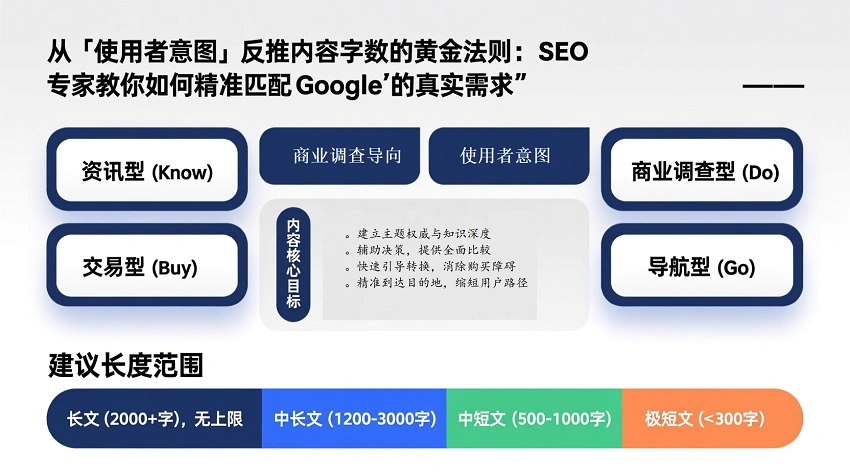
Say Goodbye to Word Count Anxiety, Embrace the New Era of E-E-A-T Logic After confirming that “word count is not a decisive factor for ranking,” the core challenge all content creators must face is: How do we define the boundaries of “high-quality content”? Seasoned SEO experts know that Google doesn’t care about word count; it cares about content utility. A 500-word article that perfectly answers a user’s complex question is far more valuable than a 5,000-word piece of general talk. This “Golden Rule” will take you deep into understanding: the ideal length of content is determined by analyzing user intent and building Topical Authority. We will use the E-E-A-T (Experience, Expertise, Authoritativeness, Trustworthiness) framework to precisely match Google’s real needs. Part 1: Professional Insights: Intent, Depth, and Topical Authority User Intent is the primary indicator used by Google’s algorithms (like RankBrain, BERT, and MUM) to judge content relevance. Your article length must serve this intent, otherwise, it leads to Content Dilution. Intent Type Content Core Goal Professional Insights: SEO Impact Informational (Know) Establish E-E-A-T image and comprehensively cover the topic. Through Topic Clusters strategy, build Topical Authority to establish the website as an authority in that field. Transactional (Buy) Maximize…
Key Insight: Choosing the wrong technology stack is the biggest hidden cost for independent sites. Data shows that 47% of cross-border sellers are forced to rebuild their websites within 2 years due to technical limitations, with average losses reaching 3 times the initial investment. The right technical roadmap can improve SEO effectiveness by 40% and conversion rates by 30%. Last week, another client approached us. His Shopify store hit a bottleneck after monthly sales exceeded $500,000: website loading speed was over 5 seconds, URL structure couldn’t be optimized, and weak blog functionality hampered content marketing effectiveness. Most painfully, 5 years of customer data and SEO equity were almost impossible to migrate. "If I had spent more time choosing the right technical path initially, I wouldn’t be so passive now." His sentiment echoes that of countless sellers. As a consultant with 18 years of experience in cross-border digital marketing, I have witnessed too many cases where poor technology selection led to heavy costs. This article will deeply analyze the pros and cons of Shopify, WordPress, and custom solutions, helping you avoid the trap of technical debt and choose the technical path most suitable for your business development. Panoramic View: Three Main Technical Paths for Cross-border Independent Sites Before diving into comparisons, we need to understand the fundamental differences between the three main technical paths. This is not just a tool choice, but a reflection of the business model. SaaS Hosted Type: "Turnkey Solution" in E-commerce Representative Platforms: Shopify, Shoplazza, Shopline, etc. Core Characteristics: Use platform services like renting, without worrying about server maintenance and technical details. Shopify, as the industry leader, provides a complete e-commerce solution, encompassing everything from payments and…
Key Insight: By 2025, cross-border e-commerce will enter an era of dual-track operation with "Marketplace + Independent Site". Data shows that the average profit margin for pure marketplace sellers has dropped from 25% in 2019 to 12% in 2024, while sellers who successfully operate independent sites maintain margins of 18-35%. This is not a simple either/or choice, but a strategic complement. Recently, I’ve received many inquiries from sellers: "Amazon’s advertising costs have increased again, ACoS is already over 40%, should I continue spending?" "My Shopee store was suddenly suspended, what should I do with the piled-up inventory?" These anxieties reflect a harsh reality: the marketplace (red dividend period) is fading, and business models solely reliant on marketplaces face significant challenges. As a consultant with 18 years of experience in cross-border digital marketing, I must be honest with you: an independent site is not a cure-all, but it is indeed a necessary path for brand globalization. This article will use detailed analysis from dimensions like traffic control, data assets, and cost structure to help you objectively assess whether you should open the second growth curve for your cross-border e-commerce business. Why is Everyone Talking About ‘Independent Sites’ Now? According to the latest data from Marketplace Pulse, in 2024, the average customer acquisition cost for sellers on Amazon US increased by 67% compared to 2021, while the average selling price decreased by 15%. This scissor effect of "rising costs, falling prices" is squeezing sellers’ profit margins. Three Signals of the Fading Marketplace红利 (Hónglì – Dividend) Exponential Increase in Customer Acquisition Cost: The average Amazon CPC cost was $0.8 in 2020 and has risen to $1.5 by 2024. In some popular categories like…
Featured Articles