SEO Techniques, Ranking Optimization Tips and Strategies
Long-Tail Keywords: Why They’re More Important Than You Think In the SEO world, we often hear these: Why can’t my core keywords rank? Why is traffic growth so slow? The answer often lies in those overlooked long-tail keywords. What Are True Long-Tail Keywords? Long-tail keywords typically consist of 3 or more words, with relatively low search volume but clear conversion intent. Compared to short keywords, long-tail keywords have three distinct characteristics: low search volume, high conversion rates, and low competition. These seemingly insignificant phrases are actually gold mines for targeted traffic. Keyword Type Monthly Searches Competition Conversion Rate Ranking Timeline Industrial Robot 5,000 Very High 1-2% 6-12 months Six-Axis Industrial Robot Price 200 Low 8-12% 1-3 months Injection Molding Six-Axis Robot Brand Comparison 50 Very Low 15-20% 2-4 weeks Real Case: How Long-Tail Keywords Drive B2B Business Growth An industrial valve manufacturer invested heavily in the core term “stainless steel valve” with minimal results. After shifting to a long-tail keyword strategy, they created content targeting specific needs like “chemical industry stainless steel ball valve specifications” and “high-temperature high-pressure gate valve selection guide.” Within just one month, qualified inquiries from long-tail keywords tripled, with closing rates reaching 28%. Starting Point: Understanding Search Intent Successful long-tail keyword strategies begin with deep understanding of user search intent. If you’re targeting the wrong direction, no amount of optimization will help. Three Types of Search Intent and Identification Methods Informational Intent: Users seeking knowledge or answers, like “what is servo motor” Commercial Intent: Users comparing products or services, like “ABB vs Siemens PLC performance comparison” Transactional Intent: Users ready to purchase, like “industrial touch screen wholesale price” Practical Tool Combination: Mining High-Value Long-Tail Keywords Google…
Why Technical Websites Need Professional SEO Ranking Strategies More In the current digital environment, WordPress has become the preferred platform for B2B technical websites, but many businesses find that traditional SEO methods cannot effectively enhance the authority of professional websites. Technical websites face unique challenges: highly specialized content, narrow target audience, and complex conversion paths. This requires a more refined WordPress SEO ranking strategy to address these challenges. Core metrics—ranking, trustworthiness, and conversion rate—interact closely with each other. Without good rankings, sufficient exposure cannot be gained; lacking trustworthiness makes conversion difficult even with traffic; and low conversion rates in turn affect continued support for SEO investment. These three elements form a complete cycle, each indispensable. Website Structure Optimization: Building a Solid SEO Foundation from the Technical Ground Up Establishing a Clear Content Architecture System An excellent website structure is the cornerstone of successful WordPress SEO ranking. Technical websites typically contain a large amount of specialized content. Without a reasonable organizational structure, not only will users struggle to find the information they need, but search engines will also be unable to effectively crawl and understand the website content. How to Implement Silo Structure: Organize content categories by topic relevance Establish a clear URL hierarchy structure (e.g., domain.com/category/subcategory/page) Ensure each category has a clear thematic focus Avoid content duplication and category overlap Best Practices for Technical Tags and Files Technical websites must correctly configure various technical tags, which is particularly important for multilingual, multi-regional businesses: Technical Element Best Practice Impact on WordPress SEO Ranking hreflang Tags Correctly configure hreflang attributes for multilingual version pages Avoid duplicate content, improve rankings in target regions Canonical Tags Specify canonical URLs to resolve duplicate content issues…
Understanding Hong Kong’s Unique Digital Landscape Hong Kong presents a distinctive challenge for search engine optimization professionals. What makes this market so different from other international territories? The answer lies in its complex linguistic landscape and unique search behaviors. While Google dominates with over 90% market share, users demonstrate distinct preferences that require specialized approaches. Why do standard international SEO strategies often fail in Hong Kong? The territory operates in a trilingual environment where English, Traditional Chinese, and Simplified Chinese coexist. Users frequently switch between languages during their search journey, creating a complex semantic web that demands sophisticated optimization techniques. Decoding Hong Kong Search Behavior Patterns What Drives Search Intent in Hong Kong? Hong Kong searchers demonstrate clear patterns that differentiate them from other markets. Mobile search dominance stands at approximately 75%, significantly higher than many Western markets. This mobile-first behavior influences everything from content formatting to page speed requirements. How does search intent vary across different sectors? Service-oriented queries dominate B2B searches, while brand-oriented queries are more common in B2C sectors. Understanding these intent patterns is crucial for effective hk Search Engine Optimization strategy development. Comparative Search Behavior: Hong Kong vs. Regional Neighbors Search Metric Hong Kong Singapore Taiwan Mobile Search Percentage 74.8% 68.2% 71.5% English Query Ratio 42% 68% 28% Local Business Intent High (78%) Medium (65%) High (72%) Building a Hong Kong-Optimized Keyword Matrix How to Structure Your Keyword Strategy for Maximum Impact Effective hk Search Engine Optimization begins with a well-structured keyword matrix. What elements should this matrix include? Start by identifying core industry terms combined with local modifiers. These geographic indicators signal relevance to both users and search engines. Identify Geographic Modifiers: Combine location indicators…
Poor Performance Is Not the End: We Understand Your Dilemma You’ve invested time and money, yet foreign trade promotion shows little effect, with few inquiries and low conversion rates. According to International Trade Centre research, over 65% of foreign trade enterprises experience poor performance in the initial stages of promotion. Frustration, doubt, and even thoughts of giving up—this is the reality for many business owners expanding overseas. As an Xunke Century international digital marketing consultant with 20+ years of experience, I want to tell you: poor foreign trade promotion results are often due to issues in specific areas, not because foreign trade promotion itself is ineffective. This article will deeply analyze the common reasons for ineffective foreign trade promotion and provide a systematic diagnosis and optimization plan. Self-Diagnosis: Five Common “Root Causes” of Poor Foreign Trade Promotion Results Identifying the Problem is the First Step to Solving It 🎯 Strategic Level: Unclear Goals, Vague Positioning Lack of deep insight into target markets and target customers. Promotion channel selection doesn’t match products and customers. Data shows that companies with vague positioning have 47% lower promotion ROI than precisely positioned companies. “At Xunke Century, we firmly believe in ‘strategy first’. Many companies fail in promotion because they lack understanding of B2B customer purchasing journeys and don’t develop targeted multi-market, multi-language layout strategies.” 📝 Keywords and Content Level: The Source of “Ineffective” Traffic Keyword selection is too broad or imprecise, bringing in large numbers of non-target customers. Low content quality, insufficient professionalism, failing to address customer pain points, lacking E-E-A-T. “Our experience shows that the precision of keyword matrices and the professionalism of content clusters are key to obtaining high-quality inquiries. ‘Ineffective’ clicks…
The “Selection Dilemma” in Foreign Trade Promotion: We Understand Your Concerns According to International Trade Centre data, over 68% of foreign trade enterprises feel confused and uncertain when choosing promotion service providers. The cross-border B2B market is full of opportunities, but the path to promotion is indeed challenging. Faced with a wide array of promotion companies in the market, business owners often feel at a loss, worried that choosing the wrong partner will not only waste valuable marketing budgets but also miss important opportunities for international market development. As a Xunke Century consultant with over 20 years of cross-border B2B experience, I deeply understand that how to choose a foreign trade promotion company is a key decision every exporting enterprise must face. This is not only about short-term investment returns but also directly affects the company’s international market layout and long-term development. This article will reveal the core standards and avoidance strategies for selecting reliable foreign trade promotion companies to help you make wise decisions. Avoid Pitfalls First: Beware of These Five Types of “Unreliable” Foreign Trade Promotion Companies Promotion Traps Foreign Trade Enterprises Must Beware Of ❌ Over-Promising Type “Guaranteed first-page ranking!”, “One million inquiries per month!” – These unrealistic promises are often the beginning of traps. Legitimate SEO requires time to accumulate; results that come too quickly usually come with black-hat technique risks. ❌ Lack of Industry Understanding They have a superficial understanding of your products and target markets, directly applying template solutions. They might not even understand your basic business processes, so how can they customize effective strategies for your business? ❌ Abnormal Pricing Type Price wars may sacrifice service quality, and unusually high prices don’t necessarily…
The Battle for Traffic Entrances in the Digital Age As user search behavior diversifies, the challenge for businesses to acquire online traffic becomes increasingly severe. Data shows that over 53% of website traffic comes from organic search, while 46% of local searches have commercial intent. In this context, SEO, GEO, and AEO, as the three main optimization strategies, each carry different missions. The core questions many business owners face are: What exactly are they? How do they differ? How should my business choose and utilize them? This article will comprehensively analyze the relationships between the three, provide practical selection guides and optimization strategies to help businesses enhance online visibility and achieve business growth goals. Analysis of Core Concepts of the Three Optimization Strategies What is SEO? Search Engine Optimization is the systematic work of optimizing website content and structure to improve natural rankings in search engines like Google and Baidu. According to research by Ahrefs, the average click-through rate for the first organic search result is as high as 28.5%, which fully illustrates the importance of SEO. Goals and Value: A professional search engine optimization strategy not only increases website traffic but, more importantly, enhances brand awareness and acquires high-quality potential customers. A mature SEO strategy should include three core pillars: technical optimization, content creation, and authority building. Main Optimization Points: Keyword Research: Identify user search intent and mine high-value keywords Content Creation: Create high-quality, relevant, and in-depth content to meet user needs Website Technical Optimization: Improve website speed, mobile adaptation, and structured data markup Link Building: Acquire high-quality external links to establish website authority What is GEO? Geographical Optimization is specialized optimization conducted for local search results, helping physical…
In today’s increasingly competitive global digital marketing landscape, cross-border e-commerce independent sites face unique ranking challenges. According to SimilarWeb data, over 68% of e-commerce website traffic comes from search engines, with Google dominating. However, multilingual content management, international link authority building, and cross-border trust establishment have become the three core barriers. Successful cross-border e-commerce SEO requires not only precise technical deployment but also a deep understanding of target market user behavior and culture. International Technical SEO: Website Structure & Multilingual Deployment The technical foundation of a cross-border e-commerce independent site determines the crawling efficiency of search engine bots and the user experience. International SEO technical deployment needs to balance multi-regional access speed and content relevance. Precise Hreflang Tag Deployment Correctly implementing hreflang tags is core to solving duplicate content issues in multilingual sites. According to Google’s official guidelines, hreflang misconfiguration is one of the most common technical problems for international websites, directly impacting the site’s ranking performance in different regions. “Hreflang annotations should accurately reflect the target language and region of the content, e.g., es-es for users in Spain, es-mx for users in Mexico. Misconfiguration may prevent search engines from correctly identifying content targeting, causing traffic dispersion.” When implementing hreflang, ensure: Each language version page includes hreflang tags pointing to all other language versions Use correct ISO 639-1 language codes and ISO 3166-1 Alpha-2 country codes Deploy synchronously in XML sitemaps and HTTP headers for comprehensive coverage International Website Structure Choices Website structure has a profound impact on International SEO. Different structural schemes suit different business scales and market strategies: Structure Type SEO Advantage Suitable Scenario Implementation Complexity Subdirectory (/es/) Consolidates domain authority, easy to manage SMEs, multilingual markets Low…
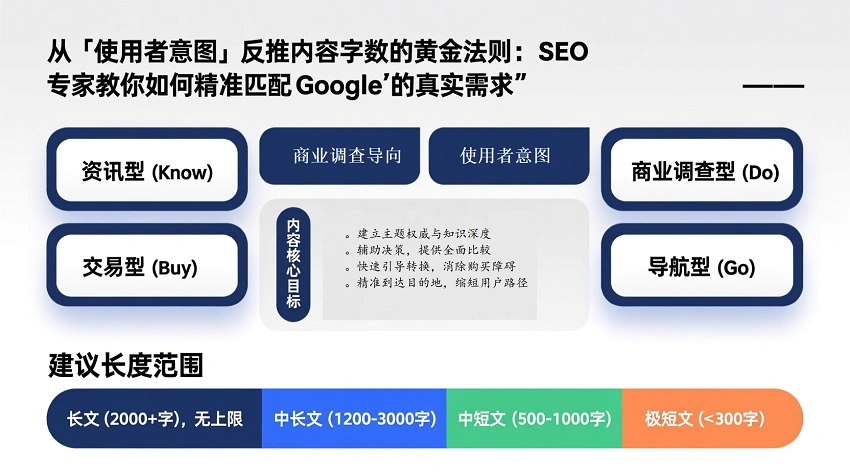
Say Goodbye to Word Count Anxiety, Embrace the New Era of E-E-A-T Logic After confirming that “word count is not a decisive factor for ranking,” the core challenge all content creators must face is: How do we define the boundaries of “high-quality content”? Seasoned SEO experts know that Google doesn’t care about word count; it cares about content utility. A 500-word article that perfectly answers a user’s complex question is far more valuable than a 5,000-word piece of general talk. This “Golden Rule” will take you deep into understanding: the ideal length of content is determined by analyzing user intent and building Topical Authority. We will use the E-E-A-T (Experience, Expertise, Authoritativeness, Trustworthiness) framework to precisely match Google’s real needs. Part 1: Professional Insights: Intent, Depth, and Topical Authority User Intent is the primary indicator used by Google’s algorithms (like RankBrain, BERT, and MUM) to judge content relevance. Your article length must serve this intent, otherwise, it leads to Content Dilution. Intent Type Content Core Goal Professional Insights: SEO Impact Informational (Know) Establish E-E-A-T image and comprehensively cover the topic. Through Topic Clusters strategy, build Topical Authority to establish the website as an authority in that field. Transactional (Buy) Maximize…
Key Insight: Choosing the wrong technology stack is the biggest hidden cost for independent sites. Data shows that 47% of cross-border sellers are forced to rebuild their websites within 2 years due to technical limitations, with average losses reaching 3 times the initial investment. The right technical roadmap can improve SEO effectiveness by 40% and conversion rates by 30%. Last week, another client approached us. His Shopify store hit a bottleneck after monthly sales exceeded $500,000: website loading speed was over 5 seconds, URL structure couldn’t be optimized, and weak blog functionality hampered content marketing effectiveness. Most painfully, 5 years of customer data and SEO equity were almost impossible to migrate. "If I had spent more time choosing the right technical path initially, I wouldn’t be so passive now." His sentiment echoes that of countless sellers. As a consultant with 18 years of experience in cross-border digital marketing, I have witnessed too many cases where poor technology selection led to heavy costs. This article will deeply analyze the pros and cons of Shopify, WordPress, and custom solutions, helping you avoid the trap of technical debt and choose the technical path most suitable for your business development. Panoramic View: Three Main Technical Paths for Cross-border Independent Sites Before diving into comparisons, we need to understand the fundamental differences between the three main technical paths. This is not just a tool choice, but a reflection of the business model. SaaS Hosted Type: "Turnkey Solution" in E-commerce Representative Platforms: Shopify, Shoplazza, Shopline, etc. Core Characteristics: Use platform services like renting, without worrying about server maintenance and technical details. Shopify, as the industry leader, provides a complete e-commerce solution, encompassing everything from payments and…
Key Insight: By 2025, cross-border e-commerce will enter an era of dual-track operation with "Marketplace + Independent Site". Data shows that the average profit margin for pure marketplace sellers has dropped from 25% in 2019 to 12% in 2024, while sellers who successfully operate independent sites maintain margins of 18-35%. This is not a simple either/or choice, but a strategic complement. Recently, I’ve received many inquiries from sellers: "Amazon’s advertising costs have increased again, ACoS is already over 40%, should I continue spending?" "My Shopee store was suddenly suspended, what should I do with the piled-up inventory?" These anxieties reflect a harsh reality: the marketplace (red dividend period) is fading, and business models solely reliant on marketplaces face significant challenges. As a consultant with 18 years of experience in cross-border digital marketing, I must be honest with you: an independent site is not a cure-all, but it is indeed a necessary path for brand globalization. This article will use detailed analysis from dimensions like traffic control, data assets, and cost structure to help you objectively assess whether you should open the second growth curve for your cross-border e-commerce business. Why is Everyone Talking About ‘Independent Sites’ Now? According to the latest data from Marketplace Pulse, in 2024, the average customer acquisition cost for sellers on Amazon US increased by 67% compared to 2021, while the average selling price decreased by 15%. This scissor effect of "rising costs, falling prices" is squeezing sellers’ profit margins. Three Signals of the Fading Marketplace红利 (Hónglì – Dividend) Exponential Increase in Customer Acquisition Cost: The average Amazon CPC cost was $0.8 in 2020 and has risen to $1.5 by 2024. In some popular categories like…
Featured Articles